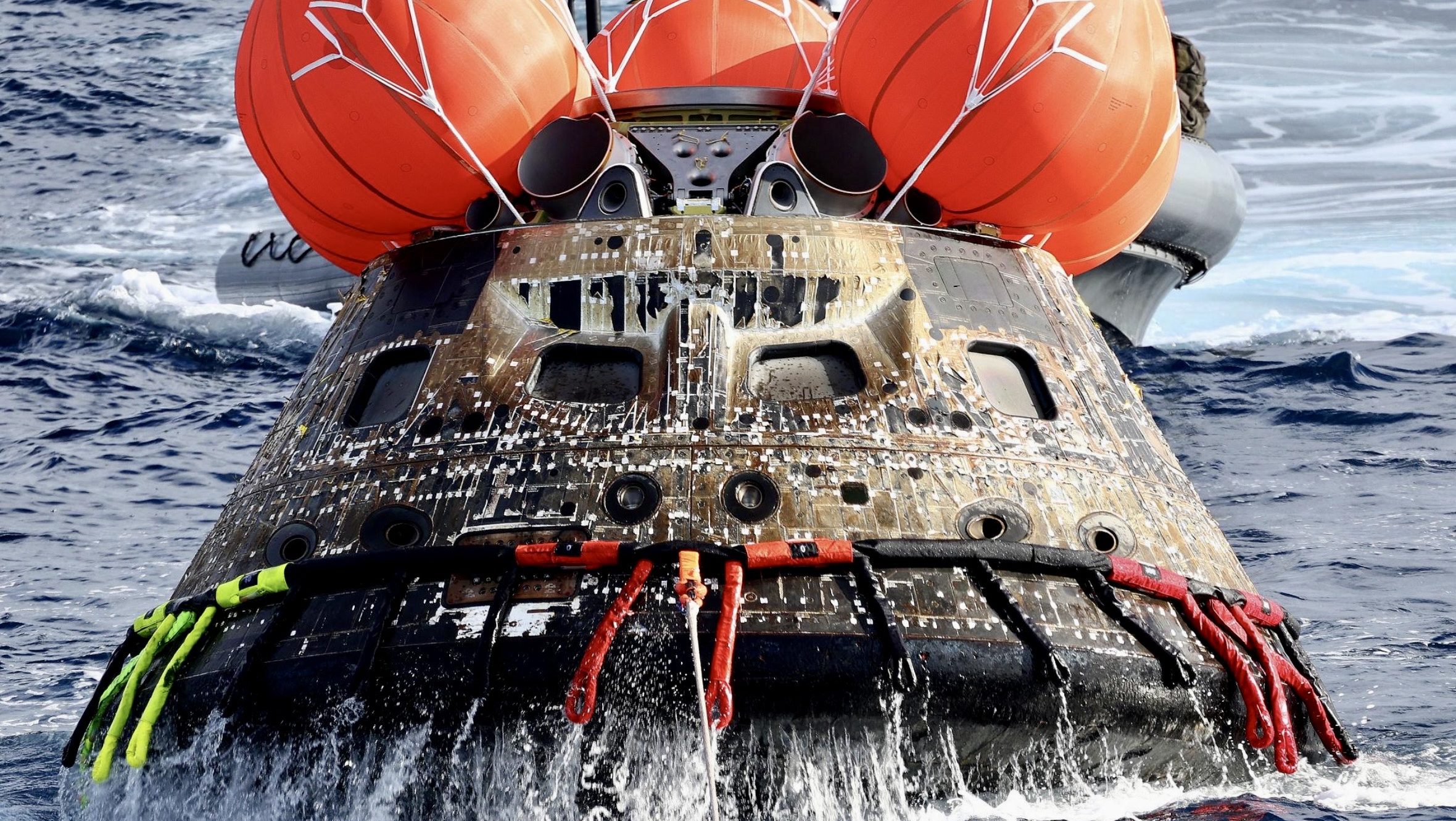
The crew of the Artemis II mission has successfully returned to Earth following a landmark flight around the Moon, marking a major milestone in the return of human deep-space exploration.
The mission, led by NASA, concluded on April 10, 2026, when the Orion spacecraft splashed down in the Pacific Ocean off the coast of San Diego, California. The landing occurred at approximately 8:07 p.m. EDT (5:07 p.m. PDT) after a high-speed atmospheric re-entry and parachute-assisted descent. Recovery operations were carried out by U.S. Navy and NASA teams, with the crew safely retrieved from the capsule.
The Artemis II mission carried four astronauts: Reid Wiseman, Victor Glover, Christina Koch, and Jeremy Hansen. The mission lasted roughly ten days and travelled hundreds of thousands of miles in a lunar flyby trajectory, making it the first crewed mission to travel around the Moon in over five decades.
During the mission, the Orion spacecraft completed a close flyby of the Moon, tested life support systems, propulsion, navigation, and heat shield performance, and conducted communication tests in deep space. The spacecraft re-entered Earth’s atmosphere at speeds exceeding 24,000 mph, with temperatures reaching several thousand degrees during peak heating.
The mission’s successful completion provides key data for upcoming phases of the Artemis program. The next mission, Artemis III, aims to return humans to the lunar surface, including the first woman and first person of colour to walk on the Moon. The longer-term goal of the Artemis program is to establish a sustainable human presence on and around the Moon as a foundation for eventual human missions to Mars.
The return of Artemis II underscores renewed momentum in human spaceflight and reflects expanding international collaboration, including contributions from the European Space Agency and the Canadian Space Agency. The mission’s success strengthens the pathway toward long-duration missions beyond Earth orbit and continued exploration of the solar system.
About the Author Brad Socha is the founder of The Universal Record, focused on sourced, factual global reporting. Coverage includes international news, geopolitics, technology, and major developments.