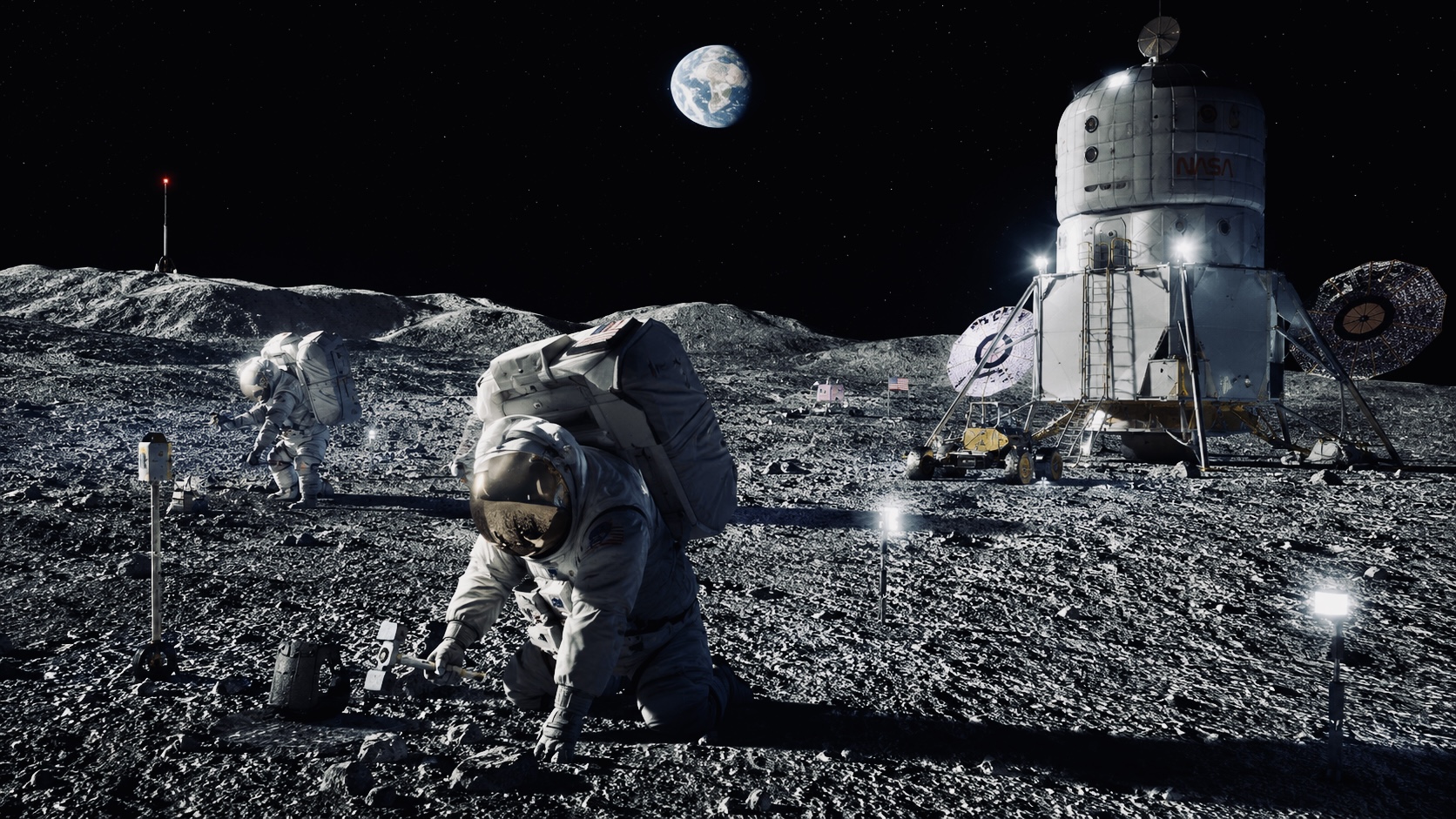
NASA unveiled major new details Tuesday outlining how the agency plans to establish a permanent human presence on the Moon, marking one of the most ambitious space exploration announcements in decades. The update, released during a high-profile Moon Base briefing at NASA Headquarters in Washington, provided new timelines, contracts, infrastructure plans, and mission phases aimed at building a long-term lunar outpost near the Moon’s south pole.
The announcement matters now because it signals a decisive shift in global space strategy. Rather than focusing only on short-duration lunar missions, NASA is openly moving toward sustained habitation, permanent infrastructure, and industrial-scale lunar operations. The plan also arrives during intensifying geopolitical competition involving China’s lunar ambitions and rapidly expanding private-sector space capabilities.
NASA officials confirmed Tuesday that the agency is preparing multiple robotic and cargo missions beginning later this year as part of a phased Moon Base initiative connected to the Artemis program.
According to NASA Administrator Jared Isaacman, the Moon Base project is intended to become “humanity’s first outpost on another celestial world.” Agency officials described the initiative as both a scientific effort and a strategic long-term expansion of human civilization beyond Earth.
The lunar south pole remains the central target for future operations because scientists believe permanently shadowed craters in the region may contain substantial quantities of frozen water ice. NASA considers those resources essential for long-duration habitation because water could potentially support drinking supplies, oxygen production, and fuel generation.
Tuesday’s announcement included several major commercial contracts.
Blue Origin received a contract valued at approximately $188 million to deliver lunar terrain vehicles and cargo equipment to the Moon using its Mark 1 cargo lander system. NASA also awarded contracts exceeding $200 million each to Lunar Outpost and Astrolab for the development of next-generation lunar rovers designed to support future astronaut operations on the surface.
Firefly Aerospace was also selected to develop spacecraft intended to deploy autonomous scouting drones on future lunar missions.
NASA officials stated that these systems are intended to help prepare landing zones, study terrain conditions, and assist with future infrastructure deployment before astronauts establish longer-term operations on the surface.
The Moon Base initiative will reportedly unfold in three major phases.
The first phase focuses on robotic exploration, infrastructure testing, and cargo delivery operations. NASA officials stated that multiple uncrewed missions are now scheduled through 2026 and 2027 to begin delivering technology demonstrations and scientific payloads near the lunar south pole.
The second phase involves early astronaut habitation and repeated surface missions beginning later this decade. NASA officials indicated Tuesday that regular human operations could begin around 2029 if current timelines remain on track.
The final phase involves establishing a semi-permanent or permanent lunar settlement capable of supporting continuous scientific activity, advanced exploration systems, autonomous logistics operations, and long-term infrastructure growth throughout the 2030s.
NASA also revealed new conceptual imagery showing expanded habitat modules, pressurized rovers, communications systems, autonomous drones, and large-scale surface power infrastructure.
One of the most significant changes involves the agency’s growing reliance on private-sector partners.
Rather than depending entirely on government-operated systems, NASA is increasingly integrating commercial launch providers, robotic landers, cargo systems, and infrastructure developers into the Artemis architecture. Officials described the new approach as a more flexible and scalable model for long-term lunar development.
The agency also confirmed that portions of the previously planned Lunar Gateway orbital station program may be reduced or repurposed as NASA prioritizes direct surface infrastructure instead.
The announcement comes only weeks after the successful Artemis II mission, which carried astronauts around the Moon for the first crewed lunar flyby since the Apollo era. NASA officials described Artemis II as a major confidence-building milestone ahead of future lunar landing missions expected later this decade.
Current NASA timelines continue targeting a crewed lunar landing mission around 2028.
The agency’s broader long-term strategy extends far beyond lunar exploration alone.
NASA repeatedly emphasized Tuesday that the Moon Base initiative is intended to serve as a stepping stone toward eventual human missions to Mars. Officials stated that developing reliable life-support systems, autonomous operations, radiation protection, surface mobility, and resource extraction technologies on the Moon will be critical before attempting multi-year Mars missions.
Despite growing excitement surrounding the announcement, enormous engineering challenges remain.
Long-duration lunar habitation presents major risks involving radiation exposure, extreme temperature swings, lunar dust contamination, communications delays, and long-term psychological isolation. NASA is also studying nuclear surface power systems to provide reliable energy during the Moon’s extended periods of darkness.
Transportation logistics remain another major hurdle.
NASA’s long-range plans involve dozens of launches carrying habitats, scientific instruments, vehicles, communications systems, cargo modules, and construction equipment over the coming decade. Some concepts presented Tuesday envision eventually using lunar soil itself for construction materials through advanced manufacturing technologies.
The announcement also highlights growing geopolitical competition surrounding the Moon.
China continues advancing its own lunar exploration initiatives through the International Lunar Research Station program in partnership with Russia and several allied countries. American officials increasingly view sustained lunar presence as both a scientific objective and a strategic national priority.
NASA officials stressed Tuesday that international cooperation will still remain part of the Artemis framework through agreements involving allied space agencies and commercial partners.
The broader economic implications are also beginning to attract attention.
Analysts increasingly view lunar infrastructure development as the foundation of a future space economy involving mining, communications, transportation, manufacturing, scientific research, and potentially fuel production for deep-space missions.
For now, however, NASA’s Moon Base plans remain in the early implementation stage.
The success of upcoming robotic landers, cargo deliveries, Artemis missions, and commercial partnerships will likely determine whether the agency can realistically achieve its aggressive lunar expansion timeline. Still, Tuesday’s announcement leaves little doubt that NASA is no longer treating the Moon simply as a destination for exploration.
It is increasingly being treated as the beginning of permanent human expansion beyond Earth.
About the Author Brad Socha is the founder of The Universal Record, focused on sourced, factual global reporting. Coverage includes international news, geopolitics, technology, and major developments.