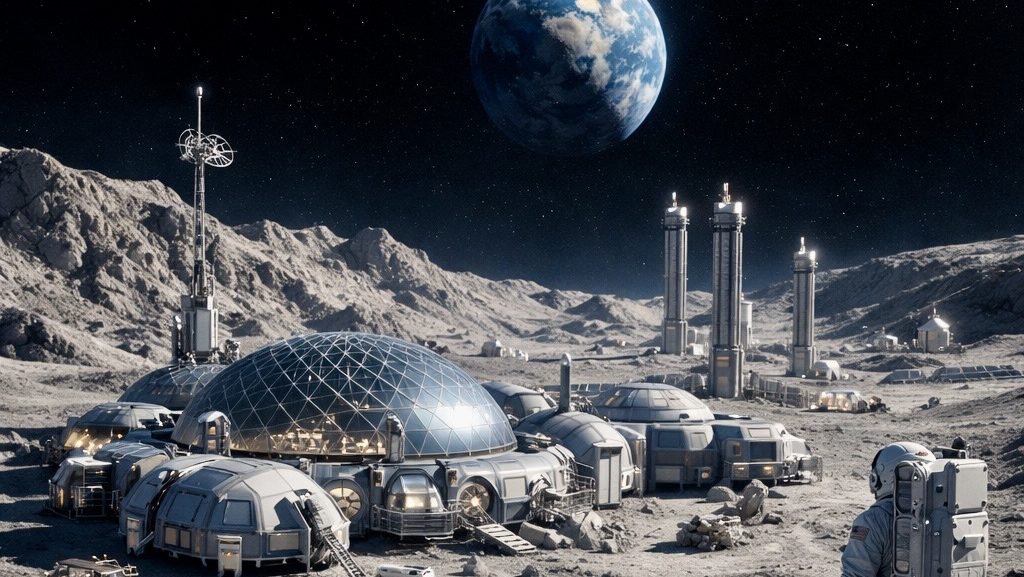
A growing number of national space agencies and private aerospace companies have outlined detailed plans to return humans to the Moon and establish sustained operations there during the late 2020s and early 2030s. The initiatives range from crewed missions and robotic exploration to proposed long-term infrastructure supporting science, industry, and deep-space travel.
United States — Artemis Program (NASA)
The United States’ primary lunar initiative remains the Artemis program, led by NASA in partnership with international space agencies and commercial contractors.
NASA’s current roadmap includes:
• Artemis II — planned crewed flyby mission around the Moon
• Artemis III — targeted human landing near the lunar south pole using a Human Landing System
• Development of the Gateway lunar space station to support long-duration missions
SpaceX’s Starship-based Human Landing System has been selected to transport astronauts between lunar orbit and the surface, while additional lander concepts from Blue Origin are also under development.
The Artemis program focuses on scientific research, long-term exploration and preparation for future missions to Mars.
China and Russia — International Lunar Research Station (ILRS)
China’s space agency, in cooperation with Russia, continues to promote the International Lunar Research Station (ILRS) concept.
Public planning documents describe:
• Robotic precursor missions throughout the late 2020s
• Construction phases projected around 2030–2035
• A long-term goal of establishing a permanent research presence on or near the lunar surface
China’s Chang’e robotic missions have already demonstrated lunar sample return capability and advanced landing technology, forming part of the broader roadmap toward crewed missions.
Europe — ESA Logistics and Surface Systems
The European Space Agency (ESA) is contributing to lunar exploration through both the Artemis partnership and independent technological development.
Key ESA initiatives include:
• The Argonaut lunar cargo lander, designed to deliver equipment and scientific payloads to the Moon
• Development of modular robotic systems and rover concepts intended to support surface construction, exploration and resource utilization
ESA’s role focuses on logistics, robotics and infrastructure rather than independent crewed launches.
India — Expanding Lunar Exploration
India’s space agency ISRO continues to advance its lunar capabilities following the successful Chandrayaan-3 landing mission.
Future planning discussions have included:
• Follow-up robotic exploration missions
• Potential collaborative lunar projects with international partners
Japan — Precision Landing and Future Participation
Japan’s SLIM mission demonstrated high-accuracy lunar landing capability, positioning the country as a future contributor to international lunar infrastructure.
Japan Aerospace Exploration Agency (JAXA) has discussed:
• Robotic cargo contributions
• Support systems aligned with Artemis and commercial lunar transport networks
Commercial Companies — Expanding Lunar Transport
Private aerospace companies are playing an increasing role in lunar logistics and exploration.
Notable developments include:
• SpaceX — Starship lunar landing system supporting Artemis missions
• Blue Origin — Blue Moon cargo and crewed lander development
• Commercial Lunar Payload Services (CLPS) missions delivering scientific equipment to the surface
These programs aim to establish a commercial transportation network capable of routine missions to the Moon.
Scientific Objectives and Long-Term Vision
Across all programs, several shared goals have emerged:
• Establishing sustainable operations at the lunar south pole
• Studying water ice deposits for life-support and fuel production
• Building infrastructure that could support deep-space missions beyond Earth orbit
• Deploying scientific observatories on the lunar surface, including concepts for advanced astrophysics research facilities
Analysts note that the coming decade represents the first coordinated global effort to maintain a continuous human and robotic presence beyond low-Earth orbit.
About the Author Brad Socha is the founder of The Universal Record, focused on sourced, factual global reporting. Coverage includes international news, geopolitics, technology, and major developments.