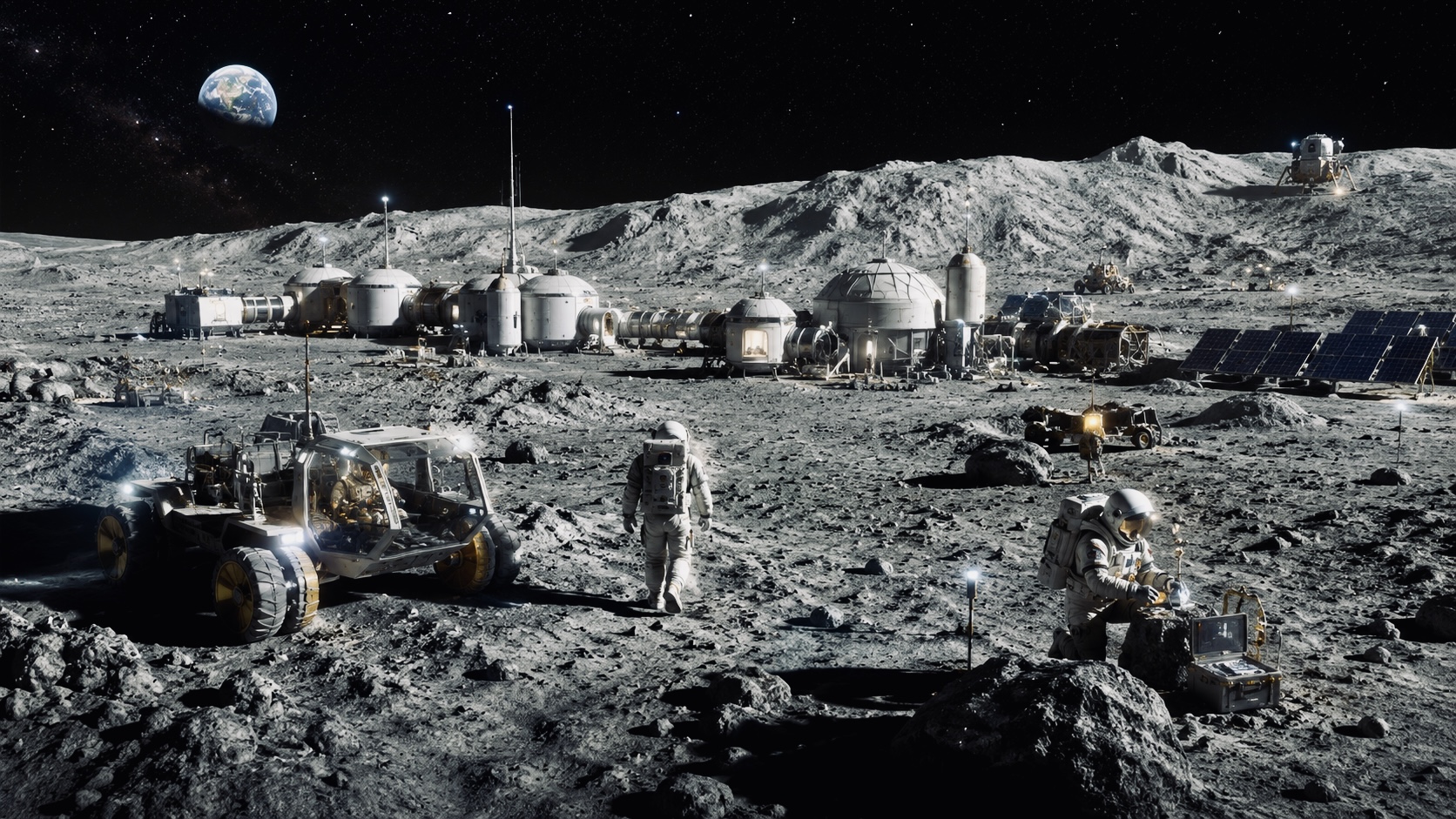
NASA’s Artemis program is shifting from short lunar visits toward a permanent foothold at the Moon’s south pole, with habitats, rovers, drones, and long-duration human missions planned over the next decade.
Brad Socha | June 23, 2026 | 8:31 PM EST
For the first time since the Apollo era, NASA is no longer treating the Moon as a destination for brief visits. Instead, the agency is building a long-term strategy aimed at establishing a sustained human presence on the lunar surface. The effort, centered on the Artemis program, has evolved from plans for occasional missions into a broader vision that includes habitats, transportation systems, robotic infrastructure, power generation, and eventually a permanent operational base near the Moon’s south pole.
The shift marks one of the most ambitious space exploration projects undertaken since the construction of the International Space Station. If successful, it could transform the Moon into humanity’s first off-world outpost and provide the foundation for future missions to Mars.
NASA’s chosen destination is the lunar south pole, a region that has attracted increasing attention because of evidence suggesting significant deposits of water ice trapped within permanently shadowed craters. Water is considered one of the most valuable resources for long-term exploration because it can be used for drinking, oxygen production, and potentially converted into rocket fuel.
Unlike the equatorial landing sites visited during the Apollo missions, the south pole also contains elevated areas that receive extended periods of sunlight, making them attractive locations for solar power generation.
NASA officials describe the Moon as both a scientific destination and a proving ground. Technologies developed there are expected to support future deep-space missions, particularly human expeditions to Mars.
Recent developments indicate that the agency is accelerating its focus on lunar surface infrastructure. NASA’s updated Artemis strategy places increasing emphasis on building capabilities directly on the Moon, including transportation networks, cargo delivery systems, surface mobility, and long-duration habitation. Multiple robotic and crewed missions are planned throughout the remainder of the decade to gradually assemble these capabilities.
One of the most visible components of the future Moon Base will be a new generation of lunar vehicles. NASA has already begun testing commercial Lunar Terrain Vehicle concepts designed to transport astronauts and cargo across the harsh lunar landscape. Unlike the relatively simple rovers used during Apollo, these next-generation vehicles are expected to incorporate autonomous navigation systems, advanced power management, and the ability to operate even when astronauts are not present.
The agency is also working with international partners on larger pressurized rovers that would function as mobile habitats. These vehicles could allow astronauts to travel much farther from the primary base while remaining protected from radiation, extreme temperatures, and lunar dust. Japan is developing one such rover in partnership with NASA as part of the broader Artemis effort.
Robotic exploration will play an equally important role. NASA’s plans include autonomous drones capable of traversing terrain that would be difficult or dangerous for astronauts. These systems are expected to map the region, inspect equipment, identify hazards, and scout future construction sites before human crews arrive. Recent mission concepts envision hopping drones exploring hundreds of square miles around future base locations.
The infrastructure needed to support permanent habitation extends beyond transportation. Reliable power remains one of the greatest challenges because the lunar night can last roughly two weeks. NASA and its partners are studying a combination of solar arrays, energy storage systems, and advanced nuclear technologies to ensure continuous operations regardless of lighting conditions. Long-term habitation will also require communications networks, life-support systems, and shielding against radiation and micrometeoroid impacts.
These efforts build upon a broader trend of technological advancement that has been accelerating across the space sector. Those interested in how emerging technologies are shaping the future exploration may also find value in AI Is Designing the Next Generation of Materials, which examines how advanced computing is helping engineers create stronger and lighter materials for demanding environments.
Commercial partnerships are central to the Moon Base strategy. Companies including SpaceX, Blue Origin, Firefly Aerospace, Astrolab, Lunar Outpost, and others have received contracts to develop landers, rovers, cargo systems, and exploration technologies. Recent contract awards include lunar terrain vehicles and robotic support systems intended to operate on the Moon before large-scale human habitation begins.
The growing involvement of private industry reflects a major change from the Apollo era, when government agencies designed and controlled nearly every aspect of lunar exploration. Today’s model relies heavily on commercial competition to reduce costs and accelerate innovation.
Beyond science and engineering, the project carries significant geopolitical implications. The United States, China, Europe, Japan, Canada, and other nations are all pursuing lunar ambitions. Establishing infrastructure near the Moon’s south pole could influence access to valuable resources and shape international cooperation in space for decades.
The effort also aligns with a broader human goal of expanding beyond Earth. Similar ambitions have driven exploration throughout history, from the Age of Sail to the dawn of the Space Age. Today’s lunar plans build upon decades of scientific and engineering progress, transforming concepts once confined to research studies into increasingly practical missions. If successful, the technologies developed on the Moon could influence not only future exploration but also how humanity approaches living and working beyond Earth.
NASA’s long-term objective remains clear: transition from temporary expeditions to continuous operations. Rather than visiting the Moon for days at a time, future crews may eventually spend months living and working there. Habitats, mobility systems, robotic assistants, and resource-utilization technologies would form the backbone of a permanent presence.
Significant challenges remain. Costs are substantial, timelines may shift, and many technologies still require testing in the harsh lunar environment. Yet the overall direction is becoming increasingly clear.
For the first time in more than half a century, the conversation is no longer simply about returning to the Moon. It is about staying there.
As Artemis missions continue through the late 2020s and into the 2030s, the foundations of what could become humanity’s first permanent settlement beyond Earth are beginning to take shape.
About the Author Brad Socha is the founder of The Universal Record, focused on sourced, factual global reporting. Coverage includes international news, geopolitics, technology, and major developments.