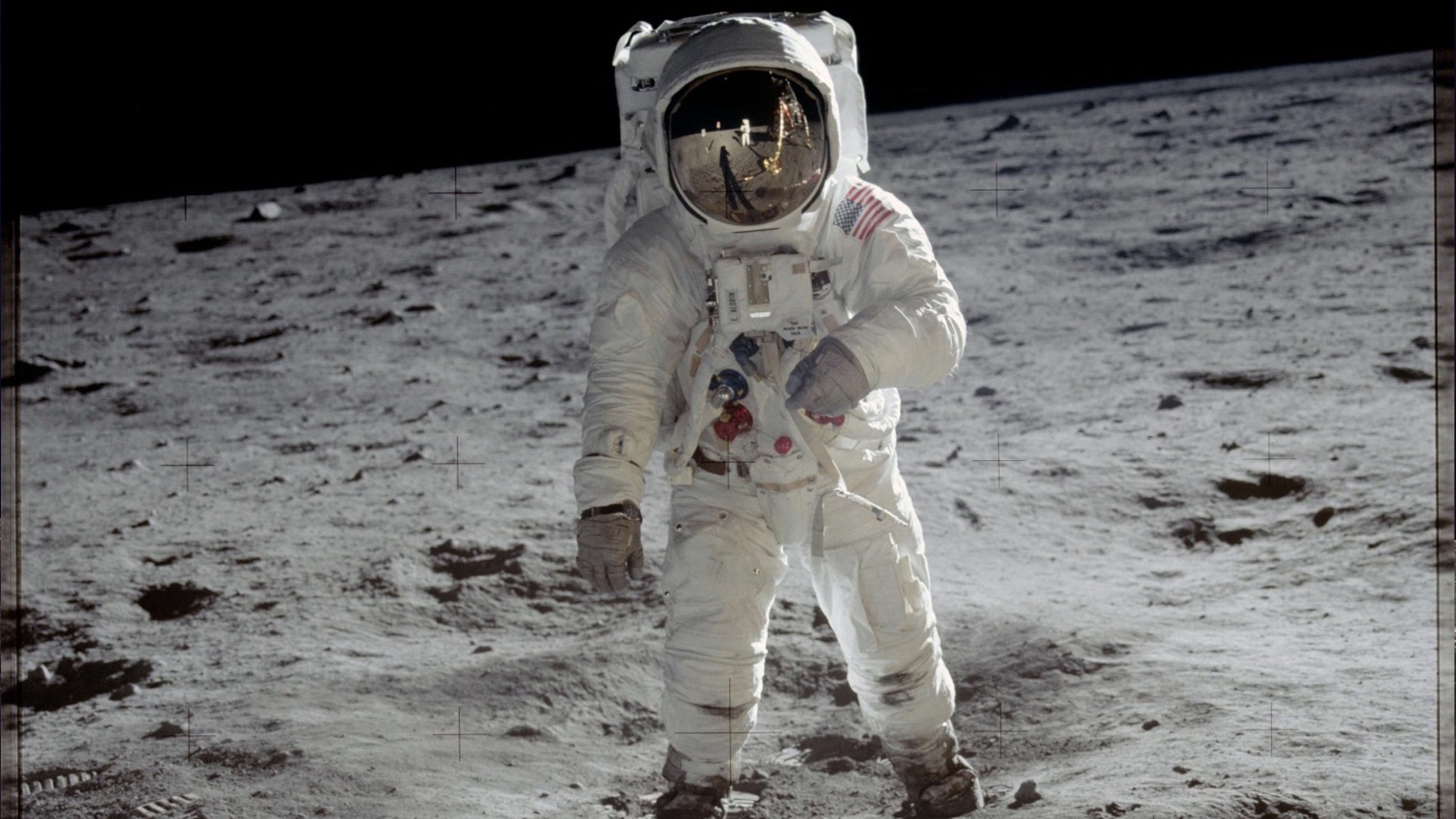
On July 20, 1969, Apollo 11 achieved humanity’s first successful Moon landing, marking a historic milestone in exploration, science, and engineering. Hours later, Neil Armstrong and Buzz Aldrin became the first people to walk on another world, forever changing humanity’s place in the universe.
Few moments in human history have matched the significance of Apollo 11’s successful landing on the Moon. More than half a century later, the mission remains a defining achievement of exploration, demonstrating what scientific innovation, international competition, and human determination could accomplish. The technologies developed during the Apollo program continue to influence aerospace engineering, computing, communications, and today’s renewed efforts to return astronauts to the lunar surface.
Apollo 11 was the culmination of one of the most ambitious projects ever undertaken. In 1961, amid the Cold War and the growing Space Race between the United States and the Soviet Union, President John F. Kennedy challenged the nation to land a man on the Moon and return him safely to Earth before the decade was over. At the time, the goal appeared extraordinarily ambitious. The United States had not yet sent an astronaut into orbit, and many of the technologies needed for a lunar mission did not yet exist.
During the following eight years, NASA designed new spacecraft, developed the powerful Saturn V rocket, expanded its astronaut corps, and conducted a series of increasingly complex missions through the Mercury, Gemini, and Apollo programs. Every launch provided valuable experience in rendezvous operations, spacewalks, navigation, and lunar flight.
Apollo 11 lifted off from Launch Complex 39A at NASA’s Kennedy Space Center in Florida on July 16, 1969, at 9:32 a.m. EDT (13:32 UTC). Riding atop the 363-foot (110.6-meter) Saturn V rocket, the most powerful launch vehicle successfully flown at the time, the crew consisted of Commander Neil A. Armstrong, Command Module Pilot Michael Collins, and Lunar Module Pilot Edwin “Buzz” Aldrin Jr.
After reaching Earth orbit, the spacecraft performed a translunar injection burn that sent the crew on a journey of nearly 384,000 kilometers (239,000 miles) toward the Moon. During the three-day voyage, the astronauts conducted routine system checks and prepared for one of history’s most challenging landings.
On July 20, 1969, Armstrong and Aldrin transferred into the Lunar Module Eagle, separating from Collins, who remained aboard the Command Module Columbia in lunar orbit.
As Eagle descended toward the Sea of Tranquility, unexpected problems emerged.
The spacecraft’s guidance computer issued several 1201 and 1202 program alarms, indicating it was becoming overloaded with data. Mission Control quickly determined that the alarms could be safely ignored, allowing the landing to continue. Moments later, Armstrong observed that the automatic guidance system was steering Eagle toward a rocky crater filled with large boulders.
Taking manual control, he carefully flew the spacecraft beyond the hazard while fuel reserves dwindled to only seconds of usable descent time.
At 20:17:40 UTC, Eagle touched down safely.
Armstrong radioed the words that instantly became part of history:
“Houston, Tranquility Base here. The Eagle has landed.”
Mission Control erupted in celebration as engineers, flight controllers, and millions watching around the world realized that humanity had successfully landed on another celestial body for the first time.
Several hours later, after preparing for the excursion, Armstrong descended the Lunar Module ladder.
At 02:56 UTC on July 21, 1969, still July 20 in the United States (EDT), he stepped onto the lunar surface and declared:
“That’s one small step for man, one giant leap for mankind.”
Buzz Aldrin joined him approximately 19 minutes later, describing the Moon as “magnificent desolation”, a phrase that captured both its stark beauty and complete isolation.
During their moonwalk, Armstrong and Aldrin spent approximately 2 hours and 31 minutes outside Eagle. They collected 21.5 kilograms (47.5 pounds) of lunar rocks and soil, deployed scientific experiments, photographed the surrounding landscape, and planted the United States flag. They also left behind a plaque bearing the message:
“We came in peace for all mankind.”
The experiments included a passive seismic instrument to detect moonquakes and a laser ranging retroreflector that scientists continue to use today to measure the distance between Earth and the Moon with remarkable precision.
Meanwhile, Michael Collins orbited the Moon alone aboard Columbia, completing 30 lunar revolutions while maintaining communications and preparing for the crew’s return.
After lifting off from the Moon, Eagle successfully rendezvoused with Columbia in lunar orbit. The crew transferred the collected samples before the ascent stage was discarded.
Apollo 11 departed lunar orbit on July 21 and began its journey home. On July 24, 1969, the spacecraft safely splashed down in the Pacific Ocean, where the crew was recovered by the aircraft carrier USS Hornet.
Although celebrated worldwide, the astronauts initially entered a 21-day quarantine as scientists sought to eliminate the possibility, considered extremely remote, that unknown lunar microorganisms might accompany them back to Earth.
Apollo 11 accomplished far more than winning the Space Race.
The mission accelerated advances in computing, materials science, telecommunications, navigation, and systems engineering. Technologies refined during Apollo later influenced commercial aviation, medical devices, integrated circuits, environmental monitoring, and countless other industries.
Perhaps its greatest legacy was inspiration.
An estimated 600 million people watched portions of the Moon landing, making it one of the largest live television audiences in history. For many, Apollo 11 demonstrated that seemingly impossible goals could be achieved through international scientific knowledge, engineering excellence, and sustained investment in research.
The mission also transformed planetary science. The returned lunar samples revealed new information about the Moon’s geological history and helped scientists better understand the early evolution of Earth and the Solar System.
More than five decades later, Apollo 11 continues to shape the future of space exploration. NASA’s Artemis program aims to return astronauts to the lunar surface, establish a sustained human presence near the Moon, and use those missions to prepare for eventual expeditions to Mars.
Every lunar mission since Apollo, and every future mission that follows, builds upon the extraordinary achievement of July 20, 1969.
Apollo 11 remains more than a historic landing. It represents one of humanity’s greatest collective accomplishments, a moment when science, engineering, courage, and exploration carried human beings beyond Earth and onto another world for the very first time.
About the Author Brad Socha is the founder of The Universal Record, focused on sourced, factual global reporting. Coverage includes international news, geopolitics, technology, and major developments.