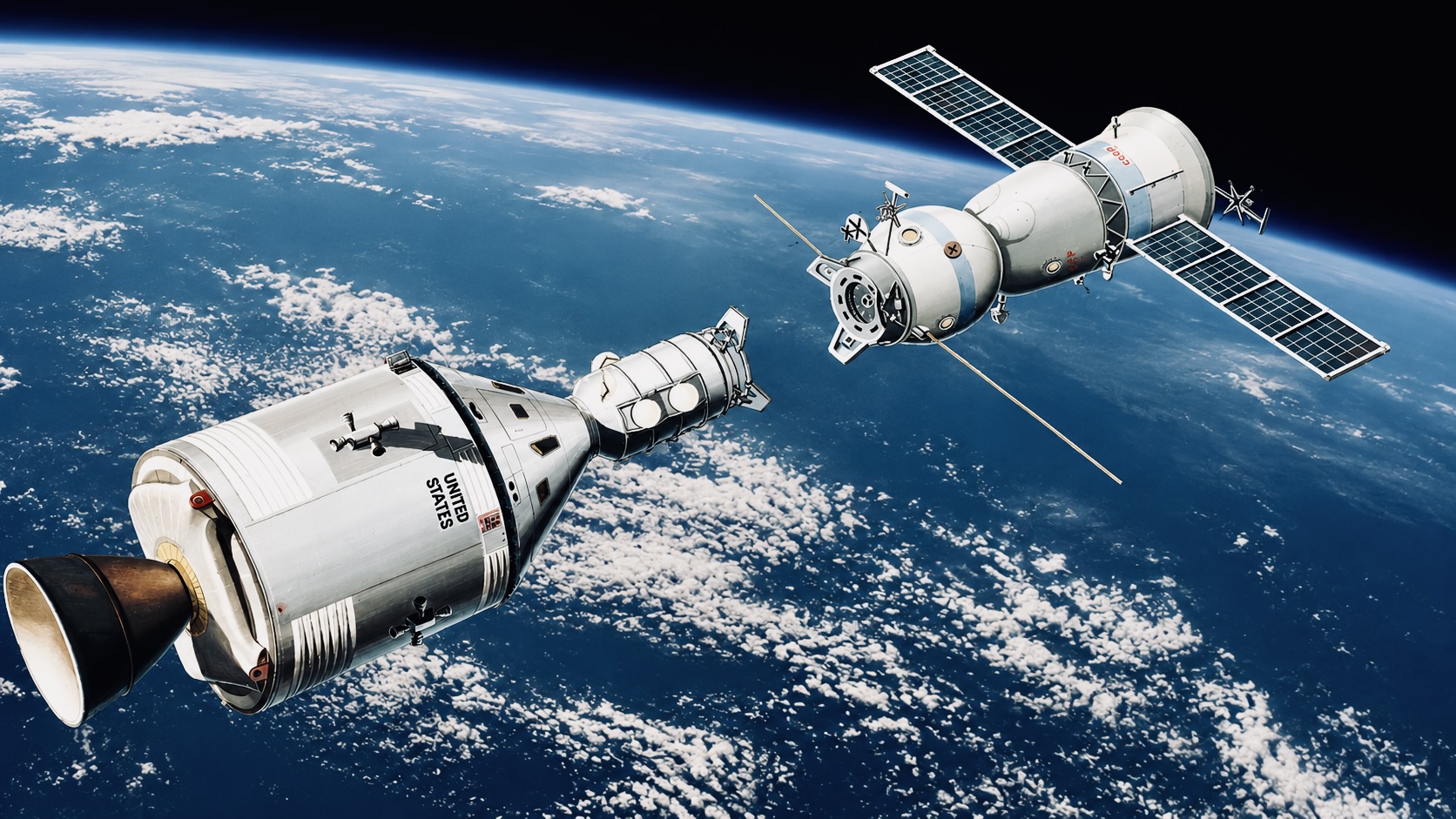
On July 17, 1975, American and Soviet spacecraft docked in orbit for the first time, transforming Cold War rivalry into a historic moment of cooperation that helped shape the future of international space exploration.
On July 17, 1975, one of the Cold War’s most enduring images was created, not on Earth, but hundreds of kilometres above it. As an American Apollo spacecraft docked with a Soviet Soyuz capsule in orbit, astronauts Thomas Stafford and Alexei Leonov reached across an open hatch and shook hands. The gesture lasted only moments, yet it became one of the defining symbols of international cooperation in space and helped lay the foundation for partnerships that continue today.
The Apollo-Soyuz Test Project (ASTP) was the first joint crewed mission between the United States and the Soviet Union. At a time when the two superpowers remained geopolitical rivals, the mission demonstrated that scientific collaboration could succeed even amid deep political differences. Its influence can still be seen in the International Space Station, multinational lunar exploration plans, and today’s cooperative approach to human spaceflight.
The mission began on July 15, 1975, when an Apollo spacecraft launched from Kennedy Space Center in Florida aboard a Saturn IB rocket. Just hours earlier, a Soyuz spacecraft carrying Soviet cosmonauts Alexei Leonov and Valeri Kubasov had lifted off from the Baikonur Cosmodrome in Kazakhstan.
Over the next two days, both spacecraft carefully adjusted their orbits until they met approximately 222 kilometers above Earth. At 12:12 p.m. EDT on July 17, the two vehicles successfully docked using a specially designed docking module developed jointly by American and Soviet engineers.
Shortly afterward, the hatch between the spacecraft opened.
Apollo commander Thomas Stafford and Soyuz commander Alexei Leonov greeted each other with a handshake that instantly became an international symbol of peaceful cooperation. They exchanged national flags, commemorative plaques, tree seeds and gifts while conducting television broadcasts viewed around the world.
The docking represented much more than a symbolic meeting. Engineers from both nations had spent years solving complex technical challenges to make the mission possible.
American and Soviet spacecraft used different cabin atmospheres, docking systems, communication equipment and engineering standards. NASA and the Soviet space program jointly developed a universal docking mechanism capable of safely connecting spacecraft designed under entirely different philosophies.
Many of the technologies and operational procedures created during Apollo-Soyuz later influenced future spacecraft docking systems and international mission planning.
The mission also included valuable scientific work.
The crews performed experiments involving solar observations, ultraviolet astronomy, materials processing in microgravity and Earth observation. Engineers also tested methods for transferring crew members between spacecraft and evaluated joint mission procedures that would later become routine aboard multinational space stations.
The astronauts and cosmonauts remained docked for nearly 44 hours before separating to complete additional experiments independently.
Apollo landed safely in the Pacific Ocean on July 24, 1975.
Soyuz returned to Earth on July 21.
Although the mission marked the final flight of the Apollo program, it also opened a new chapter in human spaceflight.
Only months earlier, the United States and the Soviet Union had signed agreements promoting greater scientific cooperation during a period of détente, when both governments sought to reduce Cold War tensions. Apollo-Soyuz became one of the most visible demonstrations that diplomacy could extend beyond Earth.
The mission did not eliminate political rivalry, nor did it end the Cold War. Instead, it showed that nations competing on Earth could still cooperate in areas where mutual benefit outweighed political differences.
That lesson became increasingly important during the decades that followed.
After the collapse of the Soviet Union in 1991, the United States and Russia dramatically expanded their cooperation in orbit. NASA astronauts flew aboard Russian Soyuz spacecraft, while Russian cosmonauts joined Space Shuttle missions.
These partnerships eventually led to construction of the International Space Station (ISS), one of the largest and most ambitious international engineering projects ever undertaken.
Since continuous occupation of the ISS began in 2000, astronauts from more than 20 countries have lived and worked together aboard the orbiting laboratory. The operational trust developed through Apollo-Soyuz helped establish many of the diplomatic and technical relationships required to sustain decades of multinational spaceflight.
The mission also influenced spacecraft design.
The concept of standardized docking systems eventually evolved into modern international docking standards now used by spacecraft such as NASA’s Orion capsule, SpaceX’s Crew Dragon and Boeing’s Starliner.
These compatible systems allow spacecraft from different organizations to safely connect with orbital stations and future exploration vehicles.
Today, international cooperation remains central to many of the world’s largest space programs.
NASA’s Artemis program includes contributions from the European Space Agency, the Canadian Space Agency and the Japan Aerospace Exploration Agency. Future lunar Gateway modules, communications systems and scientific payloads are being developed through multinational partnerships that echo the collaborative spirit first demonstrated during Apollo-Soyuz.
Even during periods of renewed geopolitical tension, scientific cooperation in space has often continued because of shared operational needs and decades of established trust.
Historians frequently describe Apollo-Soyuz as one of the most successful examples of science serving as diplomacy.
Rather than focusing solely on competition, the mission demonstrated how technological expertise could become a bridge between nations with profoundly different political systems.
Half a century later, the famous handshake between Thomas Stafford and Alexei Leonov remains one of space exploration’s most enduring images. It reminds us that some of humanity’s greatest achievements are accomplished not through rivalry alone, but through cooperation built on shared goals, mutual respect and scientific ambition.
As new missions prepare to return humans to the Moon and eventually journey toward Mars, the legacy of Apollo-Soyuz continues to influence how nations explore space together.
About the Author Brad Socha is the founder of The Universal Record, focused on sourced, factual global reporting. Coverage includes international news, geopolitics, technology, and major developments.