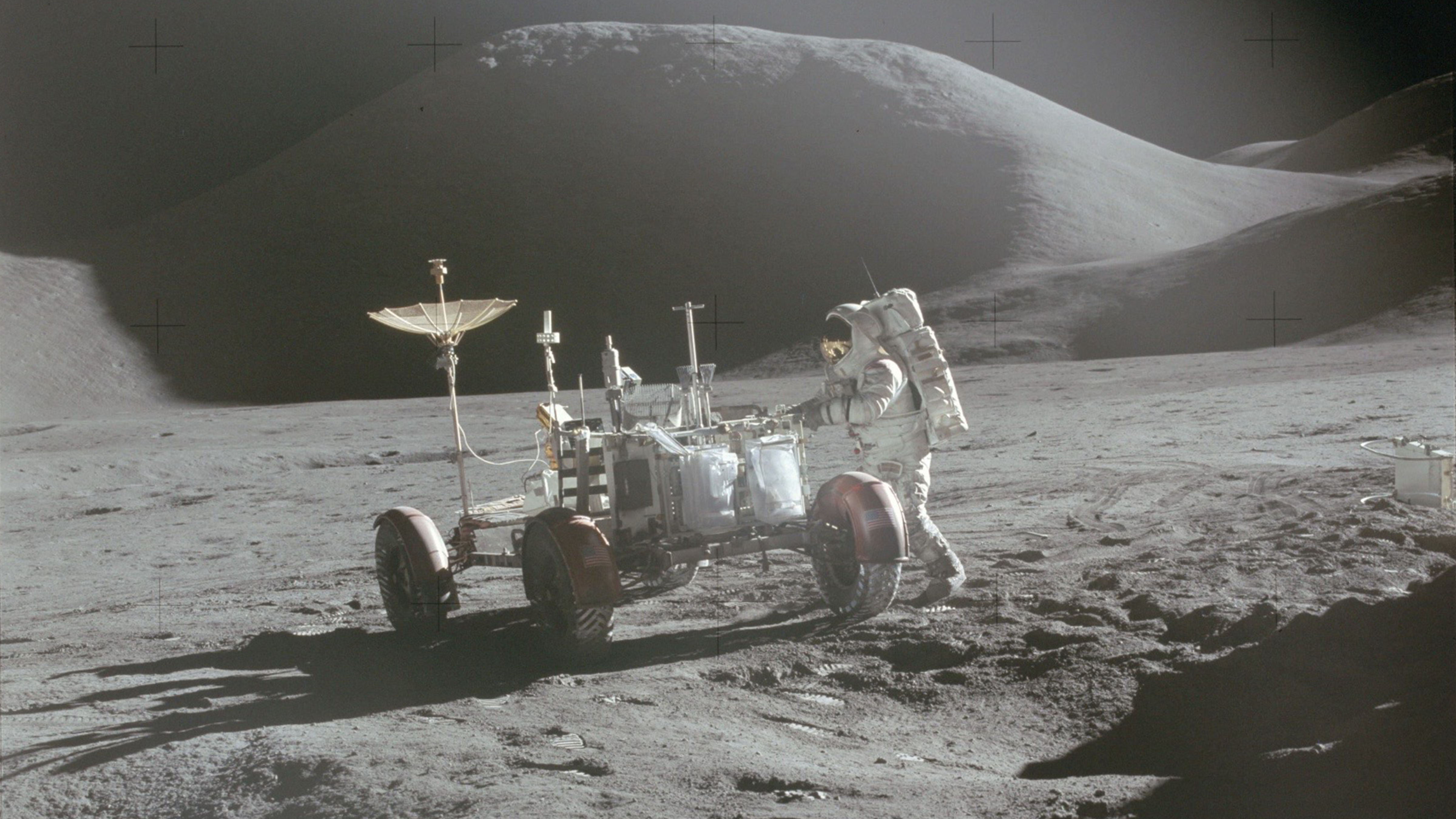
The first Lunar Roving Vehicle transformed human exploration of the Moon, allowing astronauts to travel farther, conduct more science, and redefine the future of planetary exploration
On July 30, 1971, Apollo 15 astronauts David Scott and James Irwin accomplished something no humans had done before, they drove a vehicle across the surface of another world. The debut of the Lunar Roving Vehicle (LRV), often called the “Moon Buggy,” marked a turning point in space exploration. By dramatically extending the distance astronauts could travel, the battery-powered rover transformed the Moon from a place visited on foot into a landscape that could be explored in far greater detail.
More than five decades later, the Lunar Roving Vehicle remains one of the most innovative machines ever built. Its success influenced robotic exploration of Mars, modern lunar mission planning, and NASA’s renewed efforts to return astronauts to the Moon through the Artemis program.
A New Era for Apollo
Apollo 15 launched from Kennedy Space Center on July 26, 1971, carrying Commander David Scott, Lunar Module Pilot James Irwin, and Command Module Pilot Alfred Worden. Unlike the earlier lunar landings, Apollo 15 was the first of NASA’s “J missions,” designed to maximize scientific exploration through longer stays, expanded equipment, and increased mobility.
The crew landed in the Hadley-Apennine region on July 30 after separating from the Command Module in lunar orbit. The landing site was selected because of its remarkable geological diversity, featuring the towering Apennine Mountains, Hadley Rille, a massive volcanic channel, and terrain believed to preserve clues about the Moon’s earliest history.
NASA scientists wanted astronauts to examine rocks and formations that had never before been within reach. Doing so required a solution to one of Apollo’s biggest limitations: distance.
The Moon Gets Its First Vehicle
Stored in a folded configuration inside the Lunar Module, the Lunar Roving Vehicle unfolded after landing through a carefully choreographed deployment process.
Built primarily by Boeing, with major systems developed by General Motors’ Delco Electronics division, the rover weighed about 210 kilograms on Earth but only about 35 kilograms under the Moon’s weaker gravity. Its lightweight aluminum frame, wire-mesh wheels, independent electric motors, and battery-powered drive system were engineered specifically for the harsh lunar environment.
Despite operating in extreme temperatures, abrasive dust, and complete vacuum, the vehicle performed exceptionally well.
During Apollo 15, Scott and Irwin drove the rover nearly 28 kilometers across three separate excursions, more than tripling the distance astronauts had covered during all previous Apollo surface missions combined.
Expanding Scientific Discovery
The additional mobility fundamentally changed the mission.
Rather than remaining close to the Lunar Module, the astronauts could travel several kilometers away to examine ancient mountain slopes, crater rims, and volcanic formations that would otherwise have been unreachable.
The crew collected approximately 77 kilograms of lunar rocks and soil, including some of the most scientifically valuable samples ever returned to Earth.
Among them was the famous “Genesis Rock,” a light-colored anorthosite believed to have formed during the Moon’s earliest crustal development more than four billion years ago. Although later research refined some early interpretations, the sample remains one of Apollo’s most historically significant geological discoveries.
The rover also carried cameras, scientific instruments, communication systems, navigation equipment, and tools that enabled researchers to conduct more detailed investigations than ever before.
Engineering for Another World
Designing a vehicle for the Moon presented challenges unlike anything engineers had previously encountered.
With no atmosphere, conventional cooling systems would not function. Tires made from rubber would fail in extreme temperatures, leading engineers to develop woven steel wire mesh wheels with titanium treads that provided both flexibility and traction across loose lunar soil.
Each wheel was powered independently, allowing the rover to continue operating even if one motor failed. Navigation relied on a directional gyro and wheel rotation counters rather than GPS, enabling astronauts to calculate their position relative to the Lunar Module throughout each excursion.
The vehicle’s top speed reached approximately 18 kilometers per hour, although astronauts generally traveled more slowly over rough terrain to maintain stability.
Its reliability exceeded expectations and demonstrated that human-operated vehicles could function successfully on another celestial body.
A Legacy That Continues Today
The success of Apollo 15’s rover influenced every subsequent Apollo lunar landing.
Improved versions of the Lunar Roving Vehicle were also used during Apollo 16 and Apollo 17, allowing astronauts to explore even greater distances while dramatically increasing the scientific return of the final Moon missions.
Beyond Apollo, the rover became a blueprint for future planetary exploration. Engineers developing robotic vehicles for Mars, including NASA’s Sojourner, Spirit, Opportunity, Curiosity, and Perseverance rovers, benefited from lessons learned during the design and operation of the Lunar Roving Vehicle.
Today, as NASA prepares Artemis missions intended to establish a sustained human presence on the Moon, new generations of lunar vehicles are once again under development. Unlike the Apollo rover, future systems are expected to support longer expeditions, carry larger payloads, and potentially operate autonomously between crewed missions.
The idea first demonstrated during Apollo 15, that mobility greatly expands scientific discovery, remains central to modern exploration strategies.
Driving Into History
The tracks left by Apollo 15’s Lunar Roving Vehicle remain preserved on the Moon today, undisturbed by wind or weather.
What began as a practical engineering solution became one of the defining achievements of the Apollo program. By allowing astronauts to venture beyond the immediate landing site, the rover unlocked new scientific discoveries, showcased remarkable engineering ingenuity, and proved that human exploration becomes far more capable when mobility is added to exploration.
More than half a century later, every plan for returning humans to the Moon, and eventually sending astronauts to Mars, continues to build upon the lessons learned when humanity first drove across another world.
About the Author Brad Socha is the founder of The Universal Record, focused on sourced, factual global reporting. Coverage includes international news, geopolitics, technology, and major developments.