Mirror Life: Why Scientists Are Calling for Safeguards
Scientists are exploring biology built from reversed molecular structures, raising questions about what might happen if an entirely new form of life became possible.
Scientists have learned to manufacture mirror-image versions of some of life’s essential molecules. But a more ambitious possibility, creating an organism built entirely from reversed biological components, has prompted warnings from researchers concerned about its potential consequences.
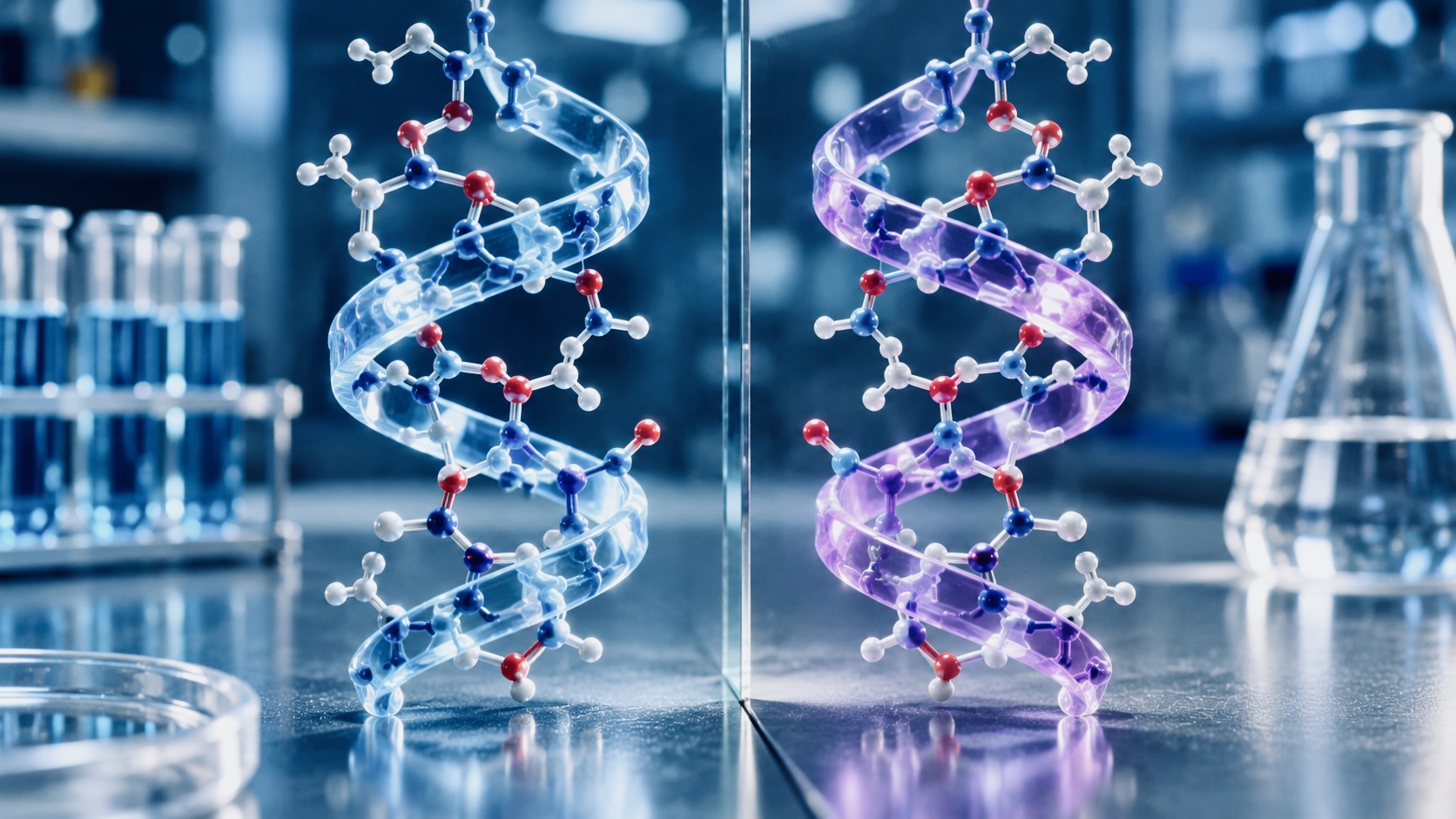
Known as mirror life, the concept involves constructing living cells whose molecular building blocks have the opposite orientation to those found in nature.
No self-replicating mirror organism has been created. The technology remains beyond current capabilities, and researchers disagree about how such organisms might behave if they were eventually developed.
Nevertheless, a group of 38 scientists published a warning in the journal Science in December 2024, arguing that the possible biological and environmental risks justify international discussion before the technology becomes feasible.
In March 2026, the United Nations Secretary-General’s Scientific Advisory Board added its assessment, recommending international coordination and safeguards while recognizing the potential benefits of research involving individual mirror-image molecules.
What Makes Mirror Life Different?
Many biological molecules have a property called chirality, meaning they can exist in two forms that are mirror images of one another, much like a person’s left and right hands.
Although the two forms can have the same chemical composition, their three-dimensional arrangements affect how they interact with other molecules.
Life on Earth uses a remarkably consistent molecular orientation. Proteins are generally assembled from left-handed amino acids, while DNA and RNA contain right-handed sugars.
This arrangement is fundamental to biological processes. Enzymes recognize particular molecular shapes, immune defenses identify biological structures, and cells depend on precisely matched molecular interactions.
Mirror biology reverses those orientations.
Scientists have already synthesized mirror-image DNA, RNA, proteins, and enzymes. Some of these molecules resist degradation by ordinary biological enzymes, making them attractive for potential medical treatments, diagnostics, and biotechnology applications.
However, producing isolated mirror molecules is fundamentally different from constructing a living organism.
A mirror bacterium would need an interconnected system capable of maintaining itself, processing nutrients, producing essential components, and reproducing.
Researchers would have to assemble an extraordinary range of molecular machinery, including systems capable of copying genetic information and manufacturing proteins.
Although progress has been made in producing individual components, scientists have not demonstrated a complete, functioning mirror cell.
The United Nations’ 2026 assessment described mirror life as a hypothetical technology likely at least a decade away. Other researchers caution that major technical barriers make any timeline uncertain.
Why Scientists Are Concerned
The principal concern is that a mirror organism might interact with the natural world in ways existing biological defenses are poorly equipped to manage.
Many immune responses depend on recognizing particular molecular structures. Because mirror molecules have reversed orientations, some mechanisms that identify and attack ordinary microorganisms might respond differently.
Researchers have therefore raised the possibility that mirror bacteria could evade important components of human, animal, and plant immune defenses.
Similar questions arise in ecosystems.
Ordinary bacteria face numerous natural controls, including viruses called bacteriophages, which infect bacteria, and microorganisms that consume them.
Some of these interactions depend on molecular compatibility. A mirror bacterium might resist certain predators or viruses that normally help regulate microbial populations.
If such an organism could reproduce outside a laboratory, scientists worry that its unfamiliar biology could create ecological consequences that are difficult to predict or reverse.
These concerns remain theoretical.
No mirror bacterium exists for researchers to test directly, and there is no experimental demonstration that such an organism could spread uncontrollably or cause disease.
Its reversed chemistry could also create disadvantages.
A mirror organism might struggle to obtain suitable nutrients, reproduce efficiently, or compete with ordinary microorganisms. Some researchers argue that these limitations could significantly reduce its ability to survive in natural environments.
A 2026 assessment by the U.S. National Academies emphasized that claims about environmental persistence and uncontrolled spread remain speculative without functioning mirror organisms to study.
The scientific disagreement is therefore not about an existing biological threat, but how to assess the potential risks of mirror life when its consequences and likelihood of causing harm remain uncertain.
The Debate Over Safeguards
The growing discussion has shifted toward determining which areas of mirror biology should continue and where research boundaries should be established.
At an international meeting hosted by the Institut Pasteur in Paris in June 2025, participating experts agreed that mirror life should not be created under current scientific understanding.
They also emphasized transparent communication, international coordination, and the role research funders could play in preventing projects aimed at producing self-replicating mirror organisms.
The United Nations Scientific Advisory Board subsequently recommended a dedicated international forum to consider governance arrangements and identify appropriate safeguards.
Such proposals do not necessarily require abandoning mirror biology.
Individual mirror-image molecules may offer practical benefits precisely because ordinary enzymes have difficulty breaking them down. Researchers are investigating applications involving more durable medicines, molecular diagnostics, and specialized biological materials.
The challenge is distinguishing these potentially beneficial activities from research that could substantially advance the construction of a complete mirror organism.
Oversight may become increasingly complicated as scientists develop more sophisticated synthetic cells, molecular manufacturing systems, and tools for assembling biological components.
Some researchers favour strong restrictions on attempts to create self-replicating mirror organisms. Others emphasize the need for proportionate oversight that does not unnecessarily interfere with lower-risk research.
There is currently no demonstrated mirror organism threatening public health or ecosystems. The concern is whether scientific capabilities could advance faster than the safeguards intended to govern their use.
Mirror life presents an unusual question for biotechnology: how should researchers evaluate a potentially consequential invention when the invention itself does not yet exist?
For now, scientists can study individual mirror molecules and their interactions with natural biology. Whether a complete mirror organism will ever be created remains uncertain.
The decisions being discussed today concern which scientific boundaries should be established before that possibility becomes a reality.
About the Author Brad Socha is the founder of The Universal Record, focused on sourced, factual global reporting. Coverage includes international news, geopolitics, technology, and major developments.