Extremely Large Telescope: A New View of the Universe
With a 39-metre mirror and technology designed to sharpen images through Earth’s atmosphere, the observatory under construction in Chile could reveal details of distant worlds and galaxies that existing telescopes cannot resolve.
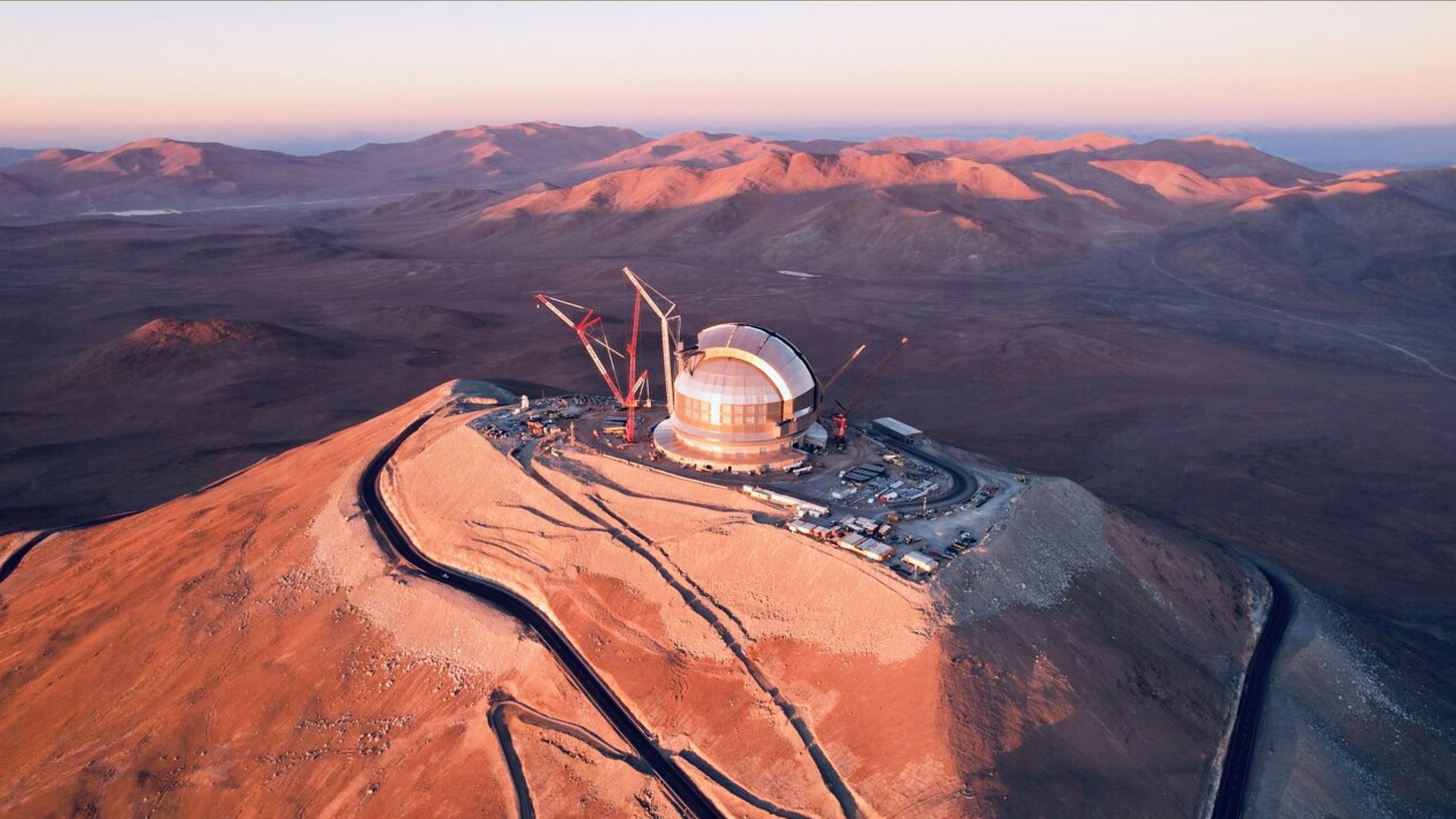
Featured image: The European Southern Observatory’s Extremely Large Telescope under construction on Cerro Armazones in Chile’s Atacama Desert, April 2026. Photo: ESO/G. Vecchia, CC BY 4.0.
The Extremely Large Telescope (ELT), under construction in Chile’s Atacama Desert, is approaching a major milestone. On October 14, the European Southern Observatory (ESO) announced that nearly 500 segments of its enormous primary mirror had arrived in Chile and that production of the final segment had begun in France.
The project is now more than 75% complete, according to ESO. When operational, the ELT will become the world’s largest optical and near-infrared telescope, allowing astronomers to investigate planets around other stars, distant galaxies and some of the universe’s most difficult scientific questions.
Unlike space telescopes, which must fit inside launch vehicles, the ELT can support an extraordinary mirror measuring 39 metres across. Its light-collecting surface will cover approximately 978 square metres, giving astronomers the ability to study objects too faint or too closely spaced for many existing observatories.
The telescope is being built on Cerro Armazones, approximately 3,046 metres above sea level. The Atacama Desert offers exceptionally dry conditions, dark skies and many clear nights, making northern Chile one of the world’s leading locations for astronomy.
How the ELT Will See Beyond Today’s Telescopes
The ELT’s primary mirror will consist of 798 hexagonal segments, each approximately 1.4 metres across. These separate pieces must operate together as a single optical surface, with their positions controlled to an accuracy measured in tens of nanometres.
Producing and maintaining that precision is a central engineering challenge. Mirror blanks are manufactured in Germany, then shaped and polished in France before being shipped to Chile for preparation and installation.
The telescope will also use adaptive optics to overcome one of the greatest limitations of ground-based astronomy: atmospheric turbulence.
As light travels through Earth’s atmosphere, changing air temperatures distort its path, causing stars to shimmer and telescope images to blur. The ELT will measure these distortions and rapidly adjust a deformable mirror to compensate.
Its five-mirror optical system includes a 2.4-metre adaptive mirror and another mirror designed to stabilize incoming light. Laser guide stars will help measure atmospheric conditions where suitable natural reference stars are unavailable.
Under favourable observing conditions, these systems should allow the ELT to produce exceptionally sharp images, potentially resolving details that are beyond the reach of current ground-based facilities.
That precision could be particularly important for studying exoplanets. Astronomers hope to separate the faint light of some planets from the much brighter stars they orbit and use spectroscopy to investigate atmospheric chemistry.
Such measurements may reveal water vapour, carbon-containing molecules and other atmospheric constituents. However, detecting a potentially habitable planet or identifying particular molecules would not, by itself, establish the presence of life.
The telescope is also expected to examine galaxies from the early universe, trace how stars and galaxies evolved, and study the environments surrounding supermassive black holes.
Its observations could help scientists investigate the distribution of dark matter and test aspects of fundamental physics. Dark energy may also be studied through measurements of cosmic expansion, although the results will depend on the capabilities of instruments introduced over time.
Why the ELT Will Complement the James Webb Telescope
The ELT and NASA-led James Webb Space Telescope (JWST) are designed to answer overlapping questions using different advantages.
JWST has a 6.5-metre primary mirror and operates beyond Earth’s atmosphere. Its instruments observe infrared wavelengths without atmospheric interference, making it especially valuable for studying early galaxies, dust-obscured regions and the atmospheres of distant planets.
The ELT’s much larger mirror will collect substantially more light and provide extremely fine angular resolution at suitable wavelengths. Its instruments will cover visible and infrared light, with atmospheric conditions determining which observations are possible.
JWST retains important advantages for infrared observations blocked or degraded by Earth’s atmosphere, while the ELT can offer greater resolving power for selected targets and can receive new instruments throughout its operating life.
Their observations may work together: Webb could identify a promising distant object, while the ELT examines its structure or motion in greater detail.
ESO’s initial instrument programme includes HARMONI, a spectrograph designed to study light across astronomical objects, and MICADO, a high-resolution imaging camera supported by advanced adaptive optics.
Later instruments include METIS, intended for mid-infrared observations, and ANDES, a high-resolution spectrograph that could investigate exoplanet atmospheres and perform precision measurements relevant to fundamental physics. These instruments are at different stages of development and will not all become operational simultaneously.
Construction remains demanding. The enormous moving structure, precision mirror alignment, specialized instruments and atmospheric-correction systems must function together. ESO revised the schedule in March 2025 after delays involving manufacturing problems, technological development and difficult weather conditions.
The current plan calls for telescope first light, initial test observations, in March 2029. Installation and commissioning of the first scientific instruments will follow, with scientific first light expected in December 2030.
These dates remain targets rather than guarantees. Completing the structure and collecting light will be important achievements, but they will not mean the entire scientific programme is immediately available.
The ELT’s significance lies in the observations it could make possible over decades of operation. By combining an exceptionally large mirror with advanced optics and increasingly sophisticated instruments, astronomers expect to examine previously inaccessible details of planetary systems, galaxies and cosmic structures.
Whether those observations produce unexpected discoveries remains unknown. What is already clear is that the telescope is being built to investigate questions that existing observatories cannot yet fully answer.
About the Author Brad Socha is the founder of The Universal Record, focused on sourced, factual global reporting. Coverage includes international news, geopolitics, technology, and major developments.