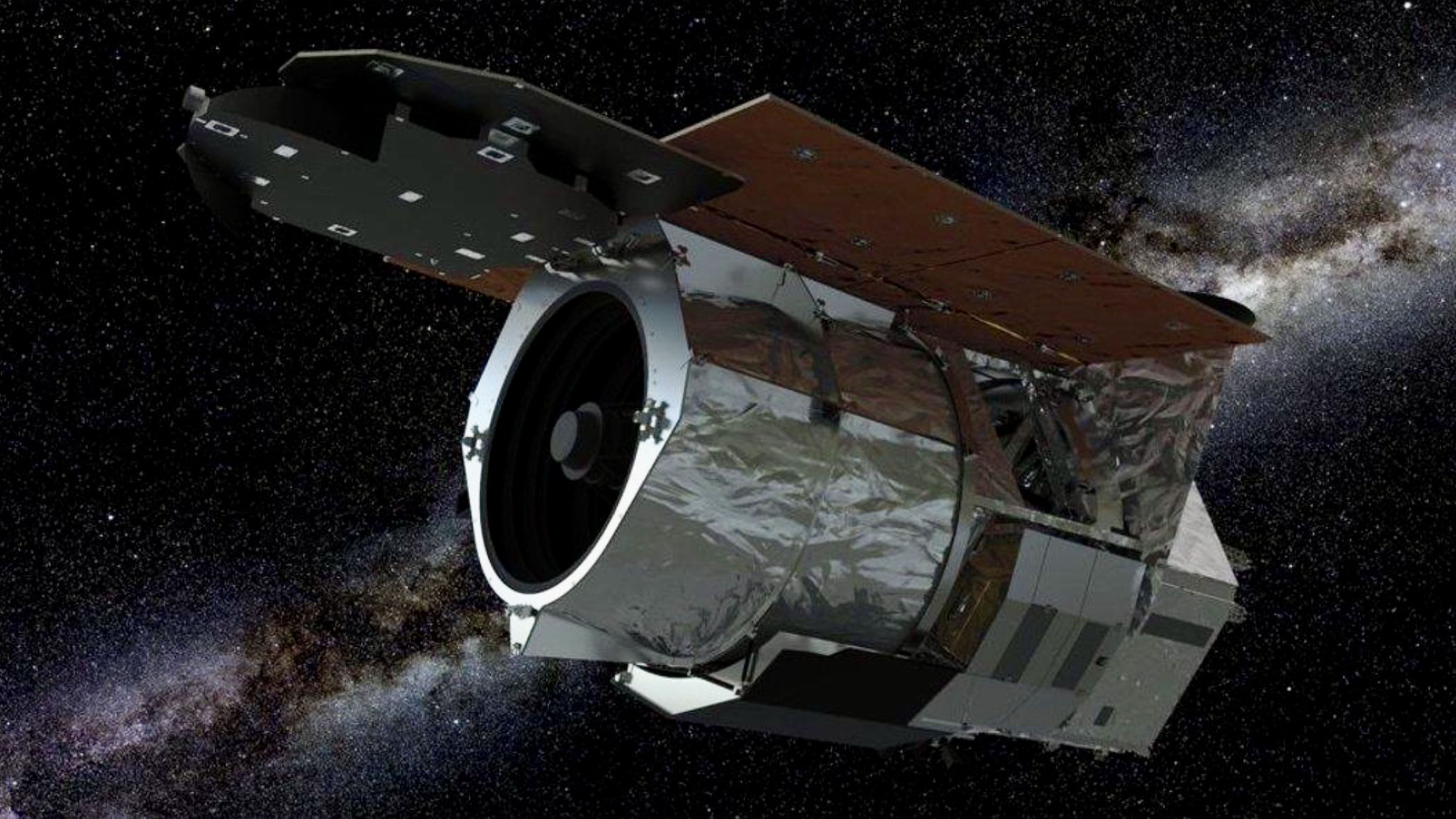
The Nancy Grace Roman Space Telescope is designed to survey the universe on an unprecedented scale, helping scientists investigate dark energy, dark matter, distant galaxies, and thousands of new worlds beyond our solar system.
The next major chapter in space astronomy is already taking shape. While the Hubble Space Telescope transformed humanity’s view of the cosmos and the James Webb Space Telescope is exploring the universe in extraordinary detail, NASA’s upcoming Nancy Grace Roman Space Telescope has been built to answer a different question: how can scientists study the universe on an enormous scale without sacrificing precision?
Scheduled for launch later this decade, the Roman Space Telescope is expected to become one of the most powerful astronomical survey instruments ever constructed. Rather than focusing on individual objects one at a time, Roman will capture expansive regions of the sky with exceptional clarity, allowing astronomers to study billions of galaxies, discover hundreds of thousands of exoplanets, and investigate some of the greatest unanswered questions in cosmology.
NASA describes the mission as complementary to both Hubble and Webb. Each observatory has a distinct role, and together they will provide scientists with one of the most comprehensive views of the universe ever assembled.
The mission is named after Dr. Nancy Grace Roman, widely recognized as the “Mother of Hubble.” During her career at NASA, Roman championed the development of large space telescopes at a time when many questioned whether such ambitious projects were possible. Her leadership helped lay the scientific and organizational foundation that ultimately led to the Hubble Space Telescope, forever changing astronomy.
By naming the observatory in her honour, NASA recognizes not only her contributions to Hubble but also her lasting influence on modern space science and the future of astronomical exploration.
Although Roman is often compared with Hubble and Webb, its design serves a fundamentally different purpose.
Hubble delivers extremely sharp images across a relatively small portion of the sky, making it ideal for detailed observations of individual galaxies, nebulae, and other celestial objects. James Webb specializes in infrared astronomy, allowing scientists to study the earliest galaxies, peer through dense clouds of cosmic dust, and analyze the atmospheres of distant exoplanets.
Roman, however, is designed to observe vast areas of space simultaneously. Its primary mirror measures 2.4 metres, the same diameter as Hubble’s, but its Wide Field Instrument provides a field of view approximately 100 times larger while maintaining image quality comparable to Hubble’s resolution.
This combination allows Roman to accomplish something previous observatories could not: rapidly survey enormous portions of the universe while still collecting data detailed enough for advanced scientific analysis.
Instead of studying dozens of galaxies during a single observing campaign, Roman will observe millions. Over the course of its mission, astronomers expect the telescope to collect information on billions of galaxies, creating one of the largest astronomical datasets ever assembled.
One of the telescope’s principal scientific objectives is investigating dark energy, the mysterious phenomenon believed to be accelerating the expansion of the universe.
Although dark energy is estimated to account for nearly 70 percent of the universe’s total energy content, scientists still do not understand its true nature. Roman will map the distribution of galaxies across immense distances and measure subtle distortions caused by gravitational effects. These observations will help researchers better understand how the universe has expanded over billions of years.
Closely related is Roman’s investigation of dark matter.
Unlike ordinary matter, dark matter cannot be observed directly because it neither emits nor reflects light. Scientists detect its presence through gravity, particularly by observing how it influences galaxies and bends light traveling across the universe.
Roman will perform some of the most extensive gravitational lensing surveys ever attempted. By measuring how distant galaxies appear slightly distorted as their light passes massive concentrations of dark matter, astronomers hope to create increasingly detailed maps showing how this invisible material is distributed throughout the cosmos.
The telescope will also dramatically expand the search for planets beyond our solar system.
NASA expects Roman to discover thousands of new exoplanets through gravitational microlensing, a technique capable of identifying planets that are difficult, or impossible, to detect using traditional transit methods. Scientists estimate the observatory could identify well over 100,000 candidate planetary events, including many planets similar in mass to Earth as well as free-floating “rogue” planets that travel through space without orbiting any star.
Roman will also carry a sophisticated Coronagraph Instrument, an advanced technology demonstration designed to block starlight and directly image giant exoplanets orbiting nearby stars. The instrument will also test technologies that could eventually enable future missions to directly image Earth-like planets.
The Roman Space Telescope’s scientific potential extends well beyond cosmology and planetary science. Astronomers will use the observatory to investigate how galaxies formed and evolved over billions of years, observe the growth of supermassive black holes, measure the distribution of galaxy clusters, and monitor transient events such as supernovae. Because Roman can repeatedly survey the same regions of the sky, it will also help scientists identify objects that change over time, providing new insights into the dynamic universe.
One aspect of the mission that is often overlooked is the enormous volume of data it will generate. Roman is expected to collect petabytes of scientific information during its mission, producing far more images than astronomers could manually analyze. To manage this unprecedented data flow, NASA and the scientific community are increasingly incorporating artificial intelligence and machine-learning technologies into their analysis pipelines.
AI systems will assist researchers by identifying unusual galaxies, recognizing gravitational lensing events, detecting possible exoplanets, locating supernovae, and flagging transient astronomical phenomena for further investigation. Machine-learning algorithms can rapidly sort through millions of observations, allowing astronomers to focus on the most scientifically significant discoveries. Human scientists, however, will continue to verify findings, interpret results, and publish the scientific conclusions. Rather than replacing astronomers, AI will serve as an increasingly valuable research assistant capable of accelerating discovery.
Developing and launching a flagship space observatory represents a significant public investment. NASA’s fiscal year 2025 budget documentation estimated the total lifecycle cost of the Nancy Grace Roman Space Telescope at approximately US$4.3 billion. While substantial, the mission’s cost remains considerably lower than that of the James Webb Space Telescope, partly because Roman incorporates an existing 2.4-metre telescope assembly donated to NASA rather than requiring an entirely new primary mirror.
NASA views the investment as part of a broader scientific strategy rather than a stand-alone mission. Roman is expected to operate alongside Hubble and Webb, allowing each observatory to contribute unique capabilities. Roman will identify large populations of interesting astronomical targets, while Hubble and Webb can perform detailed follow-up observations of selected objects. Together, the three telescopes will create a powerful observational network spanning visible, infrared, and wide-field survey astronomy.
The mission also reflects decades of international scientific collaboration. Universities, research institutes, aerospace companies, and government laboratories throughout the United States and abroad have contributed technologies, instruments, software, and scientific expertise. Once operational, the telescope’s observations will be made available to researchers worldwide, supporting thousands of independent scientific investigations over many years.
Although Roman has not yet launched, anticipation within the astronomical community continues to grow. Many of its most important discoveries remain impossible to predict. Similar uncertainty surrounded Hubble before its launch in 1990 and James Webb before 2021. Both observatories ultimately produced findings that extended far beyond their original scientific objectives.
NASA expects Roman to continue that tradition. Its unprecedented combination of wide-field imaging, high-resolution observations, and advanced instrumentation may reveal previously unknown classes of astronomical objects, refine measurements of the universe’s expansion, and uncover entirely new questions about the structure and evolution of the cosmos.
As humanity continues exploring the universe, the Nancy Grace Roman Space Telescope represents more than another scientific instrument. It reflects decades of technological progress, international cooperation, and scientific ambition. By surveying the universe on a scale never before possible, Roman could fundamentally change our understanding of everything from the invisible forces shaping cosmic evolution to the abundance of planets orbiting distant stars.
For NASA, the mission is not simply about producing spectacular images. It is about answering some of the most profound scientific questions ever asked, and perhaps discovering entirely new mysteries waiting beyond the limits of current knowledge.
About the Author Brad Socha is the founder of The Universal Record, focused on sourced, factual global reporting. Coverage includes international news, geopolitics, technology, and major developments.