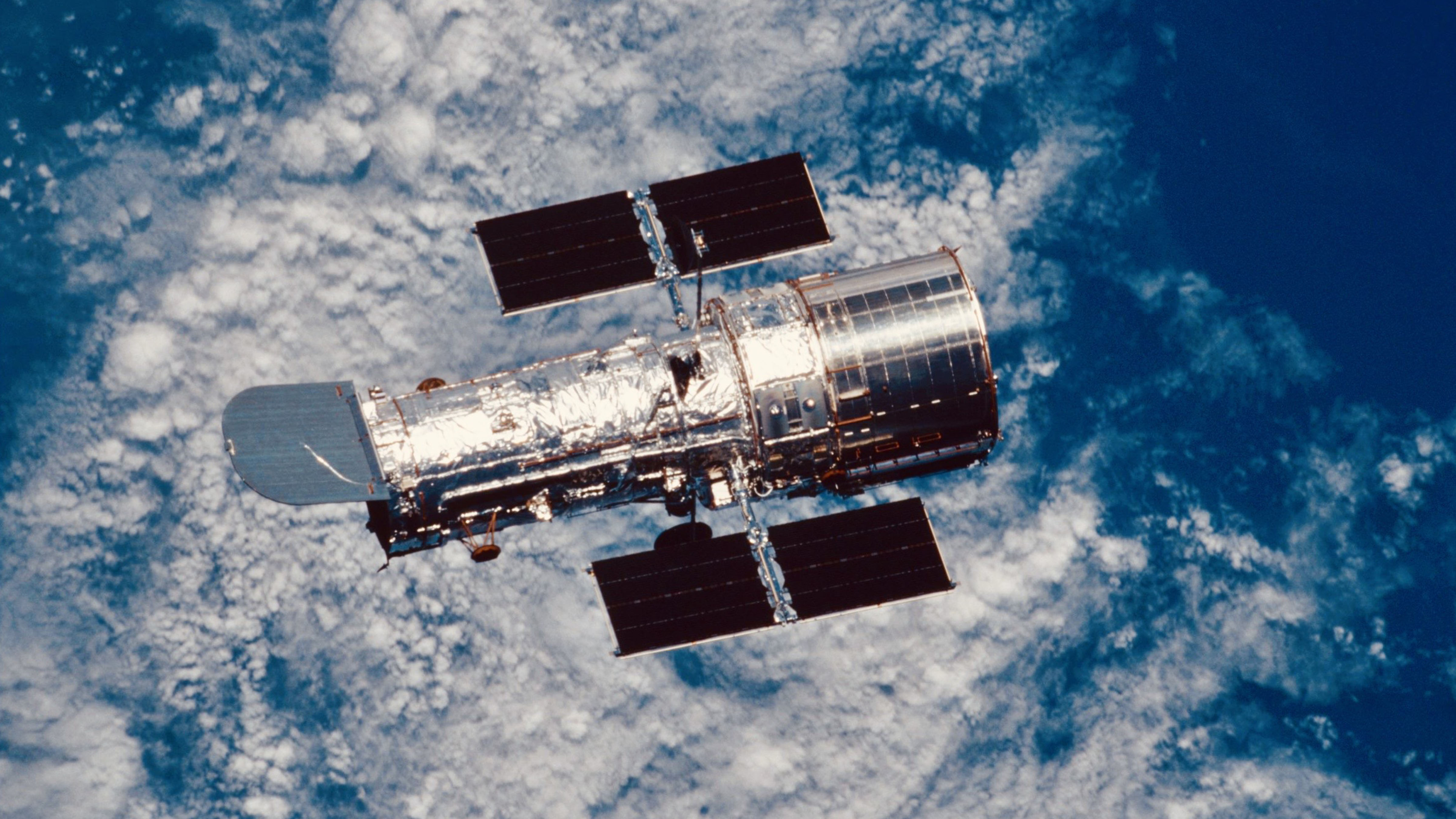
The Hubble Space Telescope was launched on April 24, 1990, marking a major turning point in the history of space exploration and scientific discovery. Deployed aboard Space Shuttle Discovery during mission STS-31, the telescope was placed into low Earth orbit at an altitude of approximately 547 kilometres, where it began observing the universe without the distortion caused by Earth’s atmosphere.
Developed through a partnership between NASA and the European Space Agency, Hubble was designed to capture high-resolution images across visible, ultraviolet, and near-infrared wavelengths. Its position in space allowed scientists to observe distant galaxies, nebulae, and stars with a level of clarity never before achieved by ground-based telescopes.
Shortly after its deployment, the mission faced a major challenge when a flaw in the telescope’s primary mirror caused images to appear blurred. The issue was traced to a spherical aberration, a defect that threatened to limit the telescope’s effectiveness. In 1993, astronauts aboard Space Shuttle Endeavour carried out a complex servicing mission to install corrective optics and upgraded instruments. The repair restored Hubble’s capabilities and is widely regarded as one of the most successful and ambitious maintenance missions ever conducted in orbit.
Following the repair, Hubble quickly became one of the most important scientific instruments in history. Its observations have contributed to key discoveries in astronomy, including refining the rate of expansion of the universe, known as the Hubble constant. Data collected by the telescope has also provided strong evidence for the existence of supermassive black holes at the centres of galaxies, reshaping understanding of galactic formation and evolution.
One of Hubble’s most significant contributions came through its deep field observations. By focusing on seemingly empty regions of space for extended periods, the telescope revealed thousands of previously unseen galaxies, offering a glimpse into the early universe. These images provided critical insight into how galaxies formed and evolved over billions of years.
The telescope has also played a role in the study of dark energy, the mysterious force believed to be driving the accelerating expansion of the universe. Observations of distant supernovae using Hubble data helped confirm that the universe’s expansion is not slowing down, but increasing over time, a discovery that earned the 2011 Nobel Prize in Physics.
Beyond distant cosmic phenomena, Hubble has also delivered detailed observations within our own solar system. It has captured images of planets, moons, and atmospheric events, including storms on Jupiter and seasonal changes on Mars. These observations have contributed to a deeper understanding of planetary science and ongoing changes within the solar system.
Over the course of its mission, Hubble has been serviced multiple times by astronauts, extending its lifespan and upgrading its instruments. Although no longer serviced by human missions, the telescope continues to operate today, providing valuable data to scientists around the world. It now works alongside newer observatories, including the James Webb Space Telescope, which expands observation capabilities further into the infrared spectrum.
More than three decades after its launch, the Hubble Space Telescope remains a cornerstone of modern astronomy. Its discoveries have influenced thousands of scientific studies and continue to shape humanity’s understanding of the universe. The telescope’s images have become some of the most widely recognized representations of space ever produced. At the same time, the Hubble Space Telescope continues to contribute valuable scientific data, with its longevity and adaptability making it one of the most successful space observatories ever deployed, reinforcing the importance of long-term investment in space exploration.
About the Author Brad Socha is the founder of The Universal Record, focused on sourced, factual global reporting. Coverage includes international news, geopolitics, technology, and major developments.