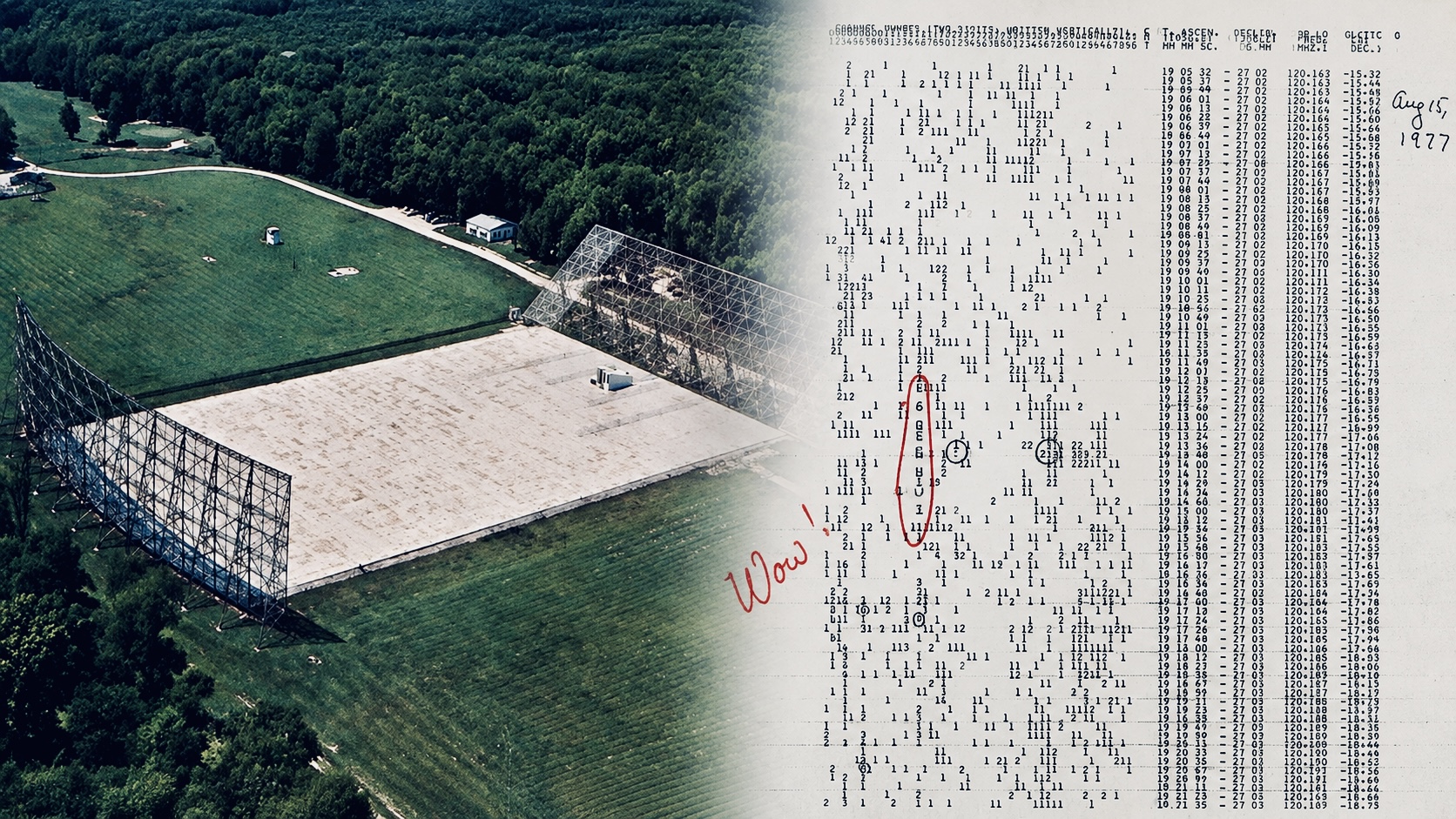
On August 15, 1977, an Ohio radio telescope recorded an extraordinary 72-second signal from the direction of Sagittarius. Nearly five decades later, its source remains unresolved.
On August 15, 1977, the Ohio State University Radio Observatory’s Big Ear telescope detected a powerful, narrowband radio transmission while conducting a search of the sky. The unusual signal lasted about 72 seconds, rose and fell in a pattern consistent with a fixed source passing through the telescope’s beam as Earth rotated, and appeared to originate from the direction of the constellation Sagittarius.
The observation became famous after astronomer Jerry Ehman examined the computer printout and wrote “Wow!” beside the sequence representing the signal’s strength. The name endured.
What produced it did not become clear. Despite repeated searches, the Wow! signal has never been convincingly detected again. It remains one of the best-known unexplained observations in the history of the search for extraterrestrial intelligence, but no evidence has established that it was produced by an extraterrestrial civilization.
That distinction is essential. The Wow! signal is scientifically intriguing precisely because its origin remains unresolved, not because it proved humanity had detected intelligent life elsewhere.
A Signal That Stood Out From the Noise
Big Ear was a large, stationary radio telescope near Delaware, Ohio, operated by Ohio State University. During the 1970s it became involved in SETI, the search for extraterrestrial intelligence, by examining radio frequencies for narrowband emissions that might merit further investigation.
Radio SETI researchers have long been interested in narrowband signals because concentrating radio energy into an extremely small frequency range can be characteristic of technological transmitters. That does not mean every narrowband detection is artificial or extraterrestrial; terrestrial radio interference and other effects must also be considered.
Big Ear was observing near the 21-centimetre neutral hydrogen line, around 1420 MHz, a scientifically important region of the radio spectrum.
The telescope did not track objects across the sky in the conventional way. Instead, Earth’s rotation carried celestial sources through its observing beams. A fixed astronomical radio source would therefore be expected to produce a characteristic increase and decrease in measured intensity as it entered, crossed and left a beam.
The August 15 detection behaved remarkably like that.
The computer recorded the sequence 6EQUJ5. The characters were not a message or coded communication. They represented successive measurements of radio intensity. Each measurement covered approximately 10 seconds, and the complete pattern corresponded to the roughly 72 seconds during which a source could pass through Big Ear’s beam.
Ehman was reviewing the telescope’s printed data when the sequence caught his attention. He circled it and wrote “Wow!” in red ink in the margin.
“I mean, without thinking, I wrote ‘Wow!’” Ehman later recalled. “It was the most significant thing we had seen.”
The signal’s rise and fall closely followed the response expected from the telescope as a distant, fixed radio source crossed its beam. That characteristic made the observation particularly interesting and complicated simple explanations involving ordinary local interference.
Its estimated position placed it in the general direction of Sagittarius. Because Big Ear used two separate feed horns, however, the observation produced two possible sky positions rather than one uniquely determined point.
There was another problem.
A persistent celestial source should have appeared again when the telescope’s second beam passed over the same location a few minutes later. It did not.
Why the Wow! Signal Remains Unresolved
Scientists immediately faced the problem that still defines the Wow! signal: there was only one detection.
Big Ear continued searching, and astronomers later conducted additional observations of the region with other radio telescopes. None reproduced the original event.
That lack of repetition prevents scientists from establishing its origin.
SETI research demands confirmation because Earth itself is saturated with radio transmissions capable of creating misleading detections. A compelling candidate must be observed again and subjected to independent analysis before an extraterrestrial technological origin could reasonably be claimed.
Over the decades, explanations proposed for the Wow! signal have ranged from terrestrial interference to natural astronomical phenomena and extraterrestrial technology. None has been conclusively demonstrated.
A comet hypothesis attracted attention in the 2010s but was met with substantial skepticism from radio astronomers and SETI researchers. More recently, researchers using observations from the Arecibo Radio Telescope have proposed that the signal could have resulted from a rare astrophysical event involving a compact cloud of cold neutral hydrogen temporarily brightened by a powerful transient source.
Modern reanalysis of archival Big Ear observations has strengthened interest in a natural astrophysical explanation. Researchers have identified other narrowband emissions associated with compact hydrogen clouds, although substantially weaker than the 1977 event. The work suggests the Wow! signal could represent an unusual natural radio phenomenon rather than an artificial transmission.
That remains a hypothesis, not a settled explanation.
Breakthrough Listen researchers have also returned to the mystery. In 2022, the Green Bank Telescope and the SETI Institute’s Allen Telescope Array conducted coordinated observations involving a Sun-like star identified as one possible source within the broader Wow! region. No technosignature candidate was detected.
The inability to reproduce the signal illustrates one of the central principles of modern SETI: an extraordinary observation is not the same as a confirmed discovery.
Nearly half a century after Big Ear recorded those six characters, technology has transformed the search. Modern radio observatories can process enormous quantities of digital data, compare observations from multiple telescopes and use sophisticated algorithms, including machine learning, to distinguish potential technosignatures from human-made interference.
Yet the original Wow! signal remains beyond definitive explanation.
Big Ear itself no longer exists. The telescope was dismantled in 1998 after the land was sold for development, but the original observation survived. The famous printout is preserved by the Ohio History Connection, and “6EQUJ5” has become one of the most recognizable sequences in the history of SETI.
The enduring significance of the Wow! signal is therefore not evidence that extraterrestrial intelligence contacted Earth in 1977. It is a reminder of how science handles an observation that is genuinely unusual but cannot be reproduced.
For 72 seconds, Big Ear recorded something remarkable from the sky. Until its source can be demonstrated, the most scientifically accurate answer remains the same one researchers have faced since 1977: we do not know what produced it.
Ohio State University Radio Observatory — The Big Ear Wow! Signal: What We Know and Don’t Know About It After 20 Years, Jerry R. Ehman https://www.bigear.org/wow20th.htm
About the Author Brad Socha is the founder of The Universal Record, focused on sourced, factual global reporting. Coverage includes international news, geopolitics, technology, and major developments.