1522: The First Voyage Around the World Is Completed
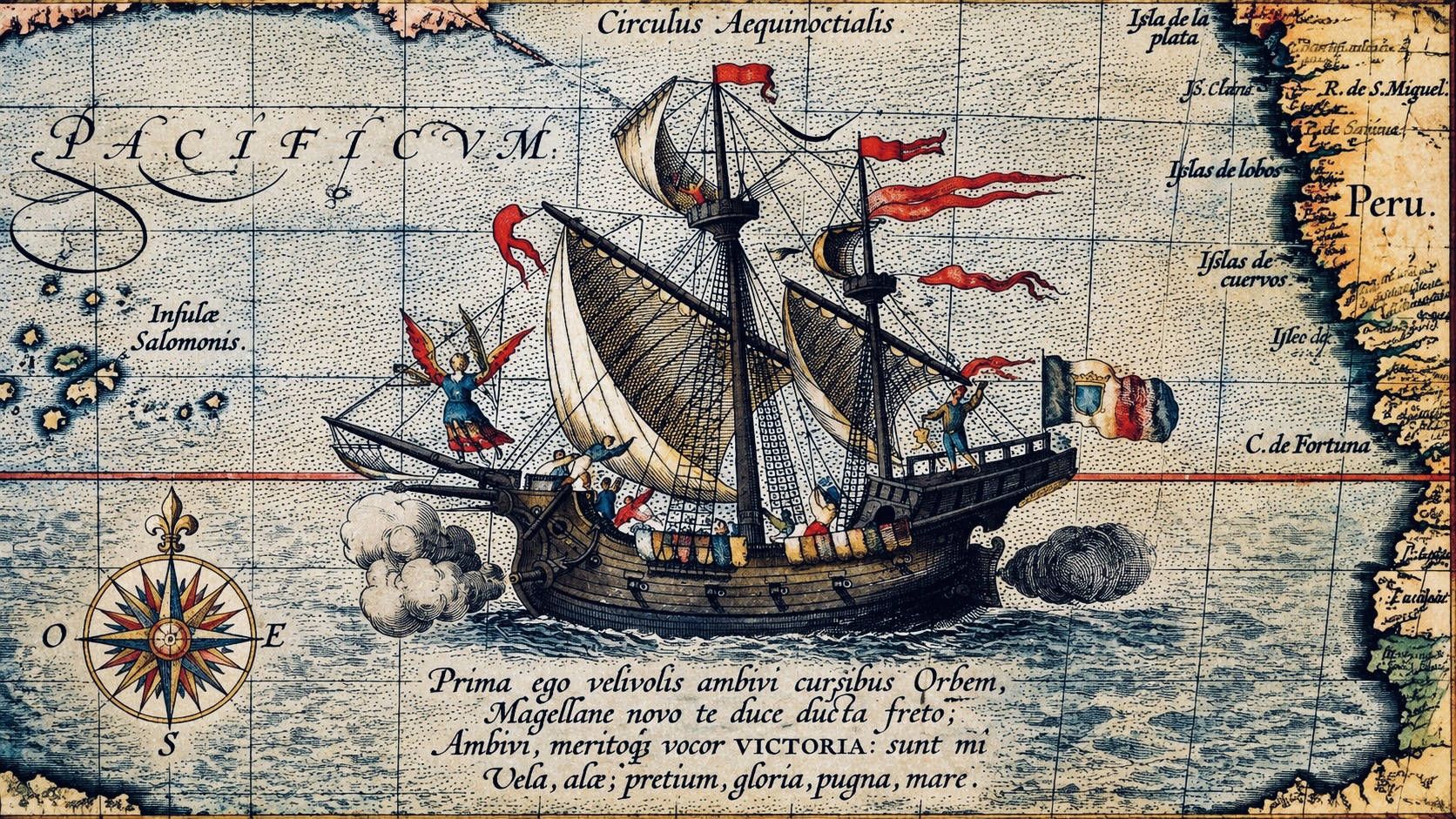
After nearly three years at sea, the battered Victoria returned to Spain with just 18 men aboard, completing a voyage that transformed humanity’s understanding of the planet.
On September 6, 1522, the ship Victoria entered Sanlúcar de Barrameda in southern Spain. Its arrival completed the first recorded circumnavigation of Earth, nearly three years after an expedition of five ships had departed the same port seeking a westward route to the lucrative Spice Islands.
The voyage had begun under the command of Portuguese navigator Ferdinand Magellan in the service of the Spanish Crown. Magellan never completed the journey. He was killed in the Philippines in 1521, leaving others to carry the expedition forward.
By the time the Victoria reached Spain under the command of Juan Sebastián Elcano, only 18 members of its crew remained aboard. Of the five ships that had set out, the Victoria alone completed the entire journey around the world. Spanish naval records place its return to Sanlúcar on September 6 and its arrival in Seville two days later.
The survivors had accomplished something unprecedented: they had sailed continuously around the planet, crossing oceans whose true scale Europeans had only begun to comprehend.
Circumnavigation Across an Unknown World
The expedition had left Sanlúcar de Barrameda on September 20, 1519. Its objective was not originally to circumnavigate Earth. Spain sought a westward maritime route to the Moluccas, or Spice Islands, avoiding routes around Africa dominated by Portugal.
Magellan led the fleet across the Atlantic and down the coast of South America. After a difficult search, the expedition found a navigable passage through the continent near its southern end, the waterway that would become known as the Strait of Magellan.
Beyond it lay an ocean whose dimensions astonished the expedition.
Magellan named it the Pacific because of the relatively calm conditions encountered during part of the crossing. But the voyage across it was punishing. Food deteriorated, fresh provisions disappeared and disease weakened the crews.
The expedition eventually reached the Philippines. There, on April 27, 1521, Magellan became involved in a conflict on Mactan Island and was killed. His death meant that although his expedition achieved the first circumnavigation, Magellan himself never sailed completely around Earth.
Leadership changed repeatedly as losses mounted. With too few sailors remaining to operate three vessels, the crew abandoned and burned the Concepción. The surviving Trinidad and Victoria eventually reached the Moluccas.
The two ships then separated. The Trinidad attempted to return eastward across the Pacific but failed and was ultimately captured by the Portuguese. Elcano took the Victoria westward across the Indian Ocean, choosing the route that would complete the circuit of the globe.
It was an extraordinarily dangerous decision.
Portugal controlled much of the established maritime network around Africa, while the Victoria was carrying a valuable cargo of spices. Elcano therefore sought to avoid Portuguese positions as much as possible while navigating across the Indian Ocean and around the Cape of Good Hope.
Hunger, illness and storms continued to reduce the crew.
At the Cape Verde islands, the survivors attempted to obtain provisions while concealing where they had been. Portuguese authorities discovered the deception and detained members of the crew, forcing the Victoria to escape without them.
On September 6, 1522, the ship finally reached Sanlúcar.
A Voyage That Changed the Map of Earth
Only 18 men aboard the Victoria completed the return to Spain that day, including Elcano and Antonio Pigafetta, whose account became one of the most important surviving narratives of the expedition. The ship reached Seville on September 8.
The expedition did not discover that Earth was spherical. Educated Europeans had understood the Earth to be spherical for many centuries.
Its achievement was different and, in practical terms, extraordinary.
For the first time, a maritime expedition had completed a continuous voyage around the planet. The journey demonstrated the interconnected nature of the world’s great oceans and provided Europeans with a dramatically clearer understanding of the immense distances separating continents.
The crossing of the Pacific was particularly important. The ocean proved vastly larger than many Europeans had anticipated. UNESCO, which has placed documentary records of the Magellan-Elcano expedition on its Memory of the World Register, describes the voyage as a milestone that helped establish a more concrete understanding of Earth’s dimensions and the enormous extent of its oceans.
The voyage also produced a curious observation with enormous implications for navigation and timekeeping. After sailing westward around the world, the survivors discovered that their reckoning of the date was one day behind that of people who had remained in place. The discrepancy resulted from their continuous westward travel around the rotating Earth, an effect eventually formalized through the concept underlying the International Date Line.
For Elcano, the accomplishment was straightforward enough to describe.
In a letter written from Sanlúcar on the day of his return, he informed Emperor Charles V that the expedition had gone around the entire globe, sailing westward until it returned from the east. The surviving letter is now among the documentary records associated with the first circumnavigation.
The human cost had been enormous. More than 200 people had departed with the expedition, and only a fraction returned to Spain. Some died from disease, hunger or violence; others deserted, were captured or returned by different routes.
Magellan conceived and led the expedition through its most important exploratory phase. Elcano completed it.
The Victoria’s arrival at Sanlúcar on September 6, 1522, therefore represented more than the return of a single battered ship. After almost three years at sea, its surviving crew had physically connected the world’s great oceans in one continuous voyage and completed the first recorded circumnavigation of Earth.
About the Author Brad Socha is the founder of The Universal Record, focused on sourced, factual global reporting. Coverage includes international news, geopolitics, technology, and major developments.