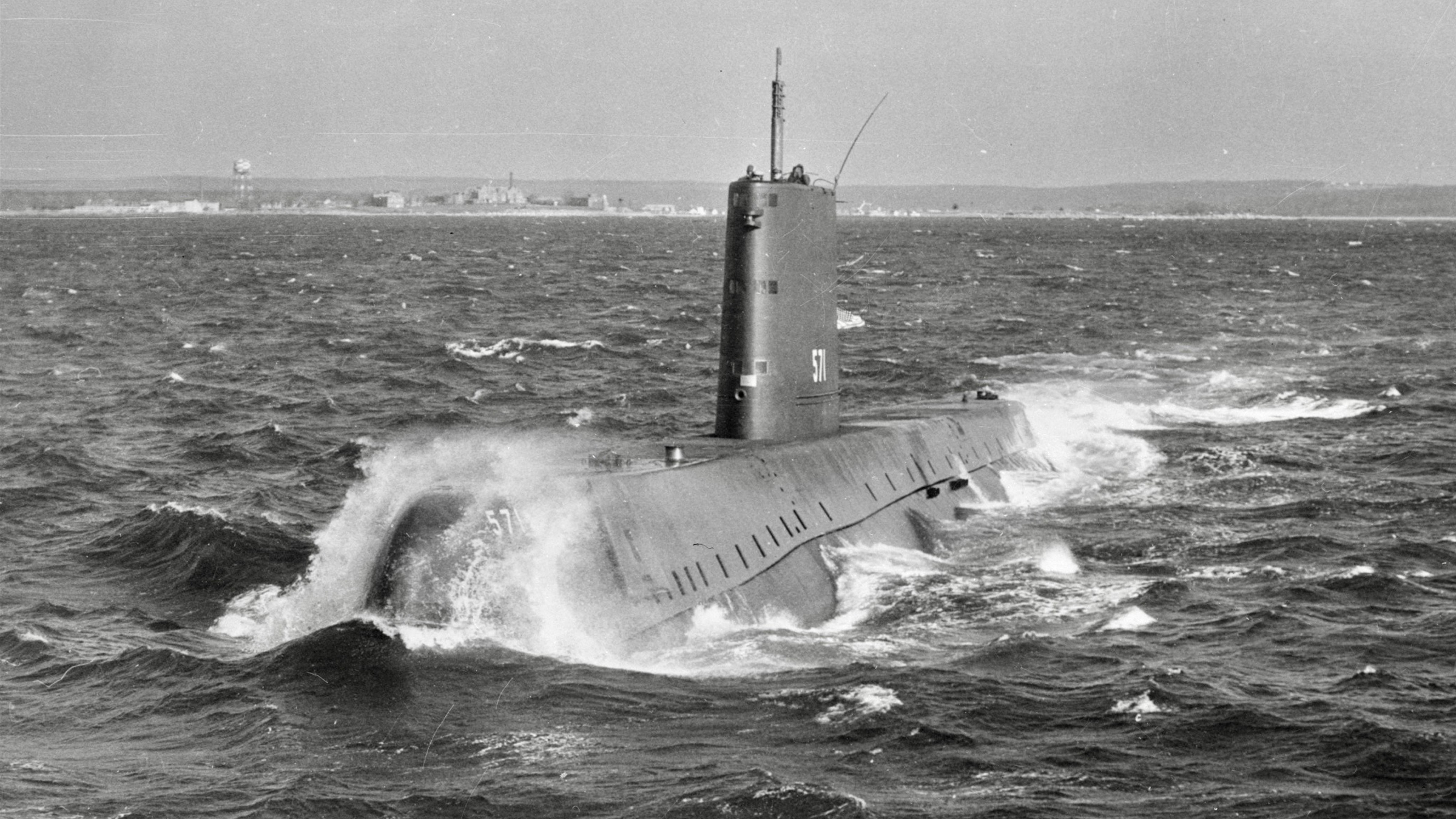
On August 3, 1958, the world’s first operational nuclear-powered submarine reached the geographic North Pole beneath the Arctic ice, proving the potential of nuclear propulsion and redefining naval strategy during the Cold War.
On August 3, 1958, the United States submarine USS Nautilus (SSN-571) achieved what had long been considered impossible: it became the first vessel to reach the geographic North Pole while traveling completely beneath the Arctic ice. The historic voyage demonstrated the extraordinary endurance of nuclear-powered submarines, marked a turning point in naval engineering, and reshaped military strategy during one of the most tense periods of the Cold War. More than six decades later, the mission remains one of the defining achievements in maritime history.
The successful transit was the culmination of years of technological innovation and careful planning. Unlike conventional diesel-electric submarines, which required regular access to the surface or a snorkel to recharge batteries, Nautilus could remain submerged for extended periods thanks to its nuclear reactor. This capability opened entirely new possibilities for exploration, scientific research, and military operations beneath the polar ice cap.
A Revolutionary Submarine
USS Nautilus was commissioned by the U.S. Navy on September 30, 1954, becoming the world’s first operational nuclear-powered submarine. Designed under the leadership of Admiral Hyman G. Rickover, often called the “Father of the Nuclear Navy,” the submarine represented a dramatic leap forward in propulsion technology.
Powered by a pressurized-water nuclear reactor developed by Westinghouse, Nautilus could operate underwater for weeks rather than days. Its range was limited primarily by food supplies and crew endurance rather than fuel, allowing missions that conventional submarines simply could not undertake.
Before attempting the Arctic voyage, Nautilus completed numerous operational patrols and technical evaluations to demonstrate the reliability of nuclear propulsion. The submarine had already attracted worldwide attention in January 1955 when it transmitted the now-famous message:
“Underway on nuclear power.”
Those four words announced the arrival of a new era in naval history.
Operation Sunshine
The North Pole mission, known as Operation Sunshine, was planned against the backdrop of increasing Cold War competition between the United States and the Soviet Union. The Arctic represented one of the shortest routes between the two superpowers, making it strategically important for future submarine operations.
Previous attempts to navigate beneath the Arctic ice had been forced to turn back because of difficult ice formations, shallow underwater ridges, and unreliable navigation. In 1958, Nautilus departed Pearl Harbor, Hawaii, before making its way north through the Bering Strait and into the Arctic Ocean.
Navigating beneath thousands of square kilometers of drifting sea ice presented extraordinary challenges. Surface landmarks were unavailable, magnetic compasses became unreliable at extreme northern latitudes, and thick ice prevented emergency surfacing in many locations. Engineers instead relied on an advanced inertial navigation system that continuously calculated the submarine’s position without external references.
At 11:15 p.m. Eastern Daylight Time on August 3, 1958, Nautilus crossed directly beneath the geographic North Pole. Shortly afterward, the crew transmitted a concise but historic message:
“Nautilus 90 North.”
The signal confirmed that humanity had successfully reached one of Earth’s most inaccessible locations from below the Arctic Ocean.
Technology That Changed Naval Warfare
The achievement carried significance far beyond exploration. The voyage demonstrated that nuclear-powered submarines could travel beneath Arctic ice for extended periods while remaining virtually undetectable.
For military planners, this capability transformed submarine operations. Nuclear submarines could patrol vast areas of the world’s oceans without requiring frequent resurfacing, making them far more difficult to locate and track. The success of Nautilus accelerated the development of increasingly capable nuclear-powered attack submarines and ballistic missile submarines that became central components of strategic deterrence during the Cold War.
The mission also reinforced confidence in nuclear propulsion technology at a time when civilian nuclear power programs were expanding around the world.
Beyond military applications, the voyage contributed valuable scientific knowledge about the Arctic Ocean. Data collected during the mission improved understanding of under-ice navigation, ocean depths, and the structure of the Arctic basin, supporting later scientific expeditions and submarine operations.
A Lasting Legacy
The success of USS Nautilus inspired future generations of naval engineers and explorers. In the decades that followed, numerous submarines from several nations operated beneath Arctic ice, but Nautilus remained the pioneer that proved such missions were possible.
The submarine itself continued serving the U.S. Navy until it was decommissioned in 1980 after more than 25 years of service. Recognizing its historic importance, the vessel was designated a National Historic Landmark and preserved as a museum ship.
Today, USS Nautilus is open to the public at the Submarine Force Museum in Groton, Connecticut, where visitors can tour the submarine that forever changed naval history.
The mission also remains closely associated with Admiral Rickover’s vision of nuclear propulsion. His insistence on rigorous engineering standards and operational safety established practices that continue to influence naval nuclear programs worldwide.
The voyage to the North Pole demonstrated more than technological achievement. It showed how scientific innovation, engineering excellence, and disciplined planning could overcome one of the planet’s most formidable natural barriers.
More than sixty-five years later, the message “Nautilus 90 North” continues to symbolize a defining moment in exploration and technological progress, one that expanded humanity’s ability to navigate the oceans while reshaping global naval strategy for generations.
About the Author Brad Socha is the founder of The Universal Record, focused on sourced, factual global reporting. Coverage includes international news, geopolitics, technology, and major developments.