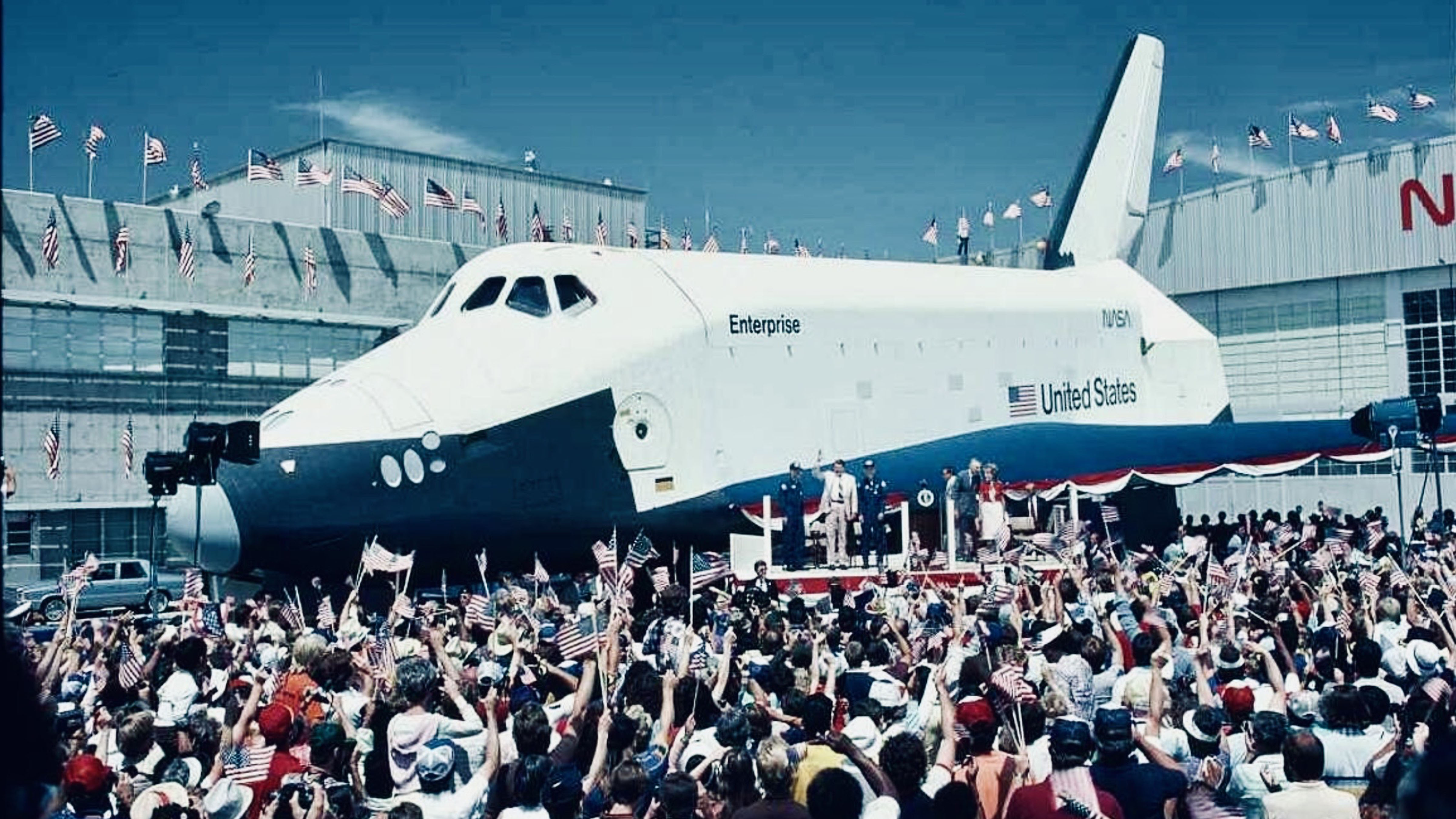
Built to test whether a winged spacecraft could fly and land safely, NASA’s first completed Shuttle orbiter also carried a name chosen after an extraordinary campaign by Star Trek fans.
On September 17, 1976, the doors of Rockwell International’s assembly facility in Palmdale, California, opened to reveal NASA’s first completed Space Shuttle orbiter. Painted prominently on its side was a name that had not originally been planned: Enterprise.
The spacecraft would never orbit Earth. Instead, Enterprise, designated OV-101, became a full-scale test vehicle for one of the most ambitious ideas in aerospace history, a reusable spacecraft that would launch like a rocket, return through the atmosphere and land on a runway like an airplane. Its unveiling also created an unusual connection between NASA and popular culture, with Star Trek creator Gene Roddenberry and members of the original television cast attending the ceremony.
How Enterprise Got Its Name
The Space Shuttle program had formally moved forward in January 1972, when President Richard Nixon announced development of what NASA envisioned as a partially reusable transportation system for carrying astronauts, satellites and scientific payloads between Earth and orbit.
Construction of OV-101 began in 1974. Unlike the operational orbiters that followed, Enterprise was built primarily for ground and atmospheric testing. It lacked many systems required for orbital flight and was not equipped to conduct a space mission.
NASA originally planned to name it Constitution, fitting its scheduled rollout on September 17, Constitution Day, during the United States Bicentennial year.
Then Star Trek fans intervened.
The original television series had ended in 1969 but developed a growing following through syndication. When fans learned of NASA’s proposed name, they organized a letter-writing campaign urging the government to name the spacecraft Enterprise after the fictional USS Enterprise.
The campaign reached the White House. On September 8, 1976, the 10th anniversary of Star Trek’s television premiere, President Gerald Ford discussed the issue with NASA Administrator James Fletcher. Ford supported Enterprise, citing both the name’s history in the U.S. Navy and its familiarity to millions of viewers. NASA adopted the change.
Nine days later, Enterprise emerged from the Palmdale facility.
More than 600 invited guests and 185 members of the media attended the September 17 ceremony. As the orbiter rolled from the building, the Air Force Band of the Golden West played Alexander Courage’s Star Trek theme. Roddenberry attended along with cast members including Leonard Nimoy, DeForest Kelley, Nichelle Nichols, George Takei, James Doohan and Walter Koenig.
NASA also introduced four astronauts central to what would come next: Fred Haise, Gordon Fullerton, Joe Engle and Richard Truly.
The following day, Enterprise was displayed again for Rockwell employees and the public. More than 35,000 people came to see it.
Enterprise Proves the Shuttle Can Land
The spectacle of the rollout was followed by serious engineering work.
In early 1977, Enterprise was transported overland to NASA’s Dryden Flight Research Center at Edwards Air Force Base. There, NASA began the Approach and Landing Test program to determine whether the enormous winged orbiter could safely fly through the atmosphere and land without engine power.
Enterprise was carried into the air atop a modified Boeing 747 known as the Shuttle Carrier Aircraft. Initial tests kept the orbiter attached to the 747 while engineers studied the combined aircraft. Later flights carried astronaut crews aboard Enterprise.
On August 12, 1977, the decisive test arrived. Enterprise separated from the carrier aircraft with Haise and Fullerton at the controls. The orbiter glided independently to the dry lakebed at Edwards and landed successfully.
Four more free flights followed, including tests with the aerodynamic tail cone removed to better reproduce the configuration an operational Shuttle would experience returning from space. The program demonstrated that the orbiter could separate from its carrier, glide under its own control and make an unpowered runway landing.
Enterprise continued serving NASA after the flight tests. Engineers used it for vibration testing and to verify that Shuttle hardware and ground facilities worked together as intended. In 1979, it was taken to Kennedy Space Center in Florida, where it was assembled with an external tank and solid rocket boosters and used for fit checks at Launch Pad 39A.
NASA considered modifications that could have made Enterprise capable of spaceflight, but the extensive changes required made that impractical. The orbiter remained a test vehicle.
The first operational Space Shuttle mission instead belonged to Columbia, which launched on STS-1 on April 12, 1981. The Shuttle program eventually flew 135 missions before retiring in 2011.
Enterprise never crossed the boundary into space, but its contribution came before those missions could begin. The vehicle gave engineers and astronauts a full-scale spacecraft with which to test assumptions that could not safely remain theoretical.
Today, Enterprise is preserved at the Intrepid Museum in New York City. Its name also preserves one of the more unusual episodes in NASA history: a fictional spacecraft inspired people who then persuaded the government to place its name on a real one.
When Enterprise emerged from its Palmdale hangar on September 17, 1976, the Space Shuttle had finally become more than drawings, components and engineering plans. A year later, that same vehicle demonstrated that the Shuttle could do something essential to the entire program, come back down and land.
About the Author Brad Socha is the founder of The Universal Record, focused on sourced, factual global reporting. Coverage includes international news, geopolitics, technology, and major developments.