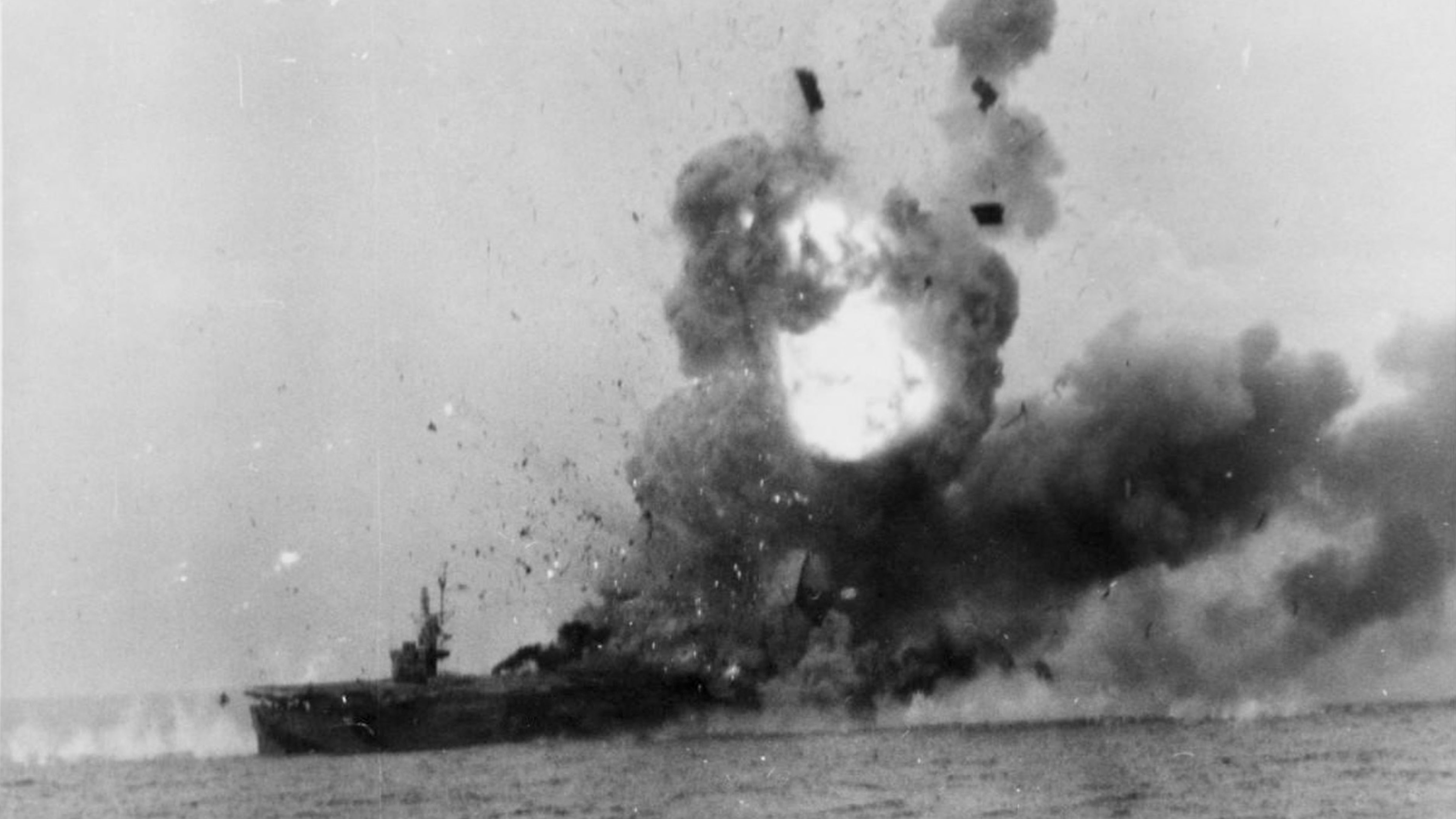
As Allied forces fought to retake the Philippines, Japan introduced coordinated suicide attacks against American warships, beginning a devastating new phase of naval warfare in the Pacific.
THE UNIVERSAL RECORD
Sourced reporting. No opinions.
Brad Socha | October 25, 2026 | 10:13 AM EST
Feature Image: U.S. Navy / National Archives — Public Domain.
On October 25, 1944, Japanese aircraft carried out the first widely recognized successful organized kamikaze attacks against American naval vessels during the Battle of Leyte Gulf in the Philippines. The attacks marked a significant escalation in the Pacific War, as Japan began deliberately assigning pilots to crash aircraft into enemy ships.
The most consequential early strike hit the American escort carrier USS St. Lo, which sank after a Japanese aircraft struck its flight deck and triggered explosions. Other American ships were damaged as Japanese forces introduced a tactic intended to compensate for their growing disadvantages in conventional air and naval combat.
Although aircraft had previously been deliberately crashed into enemy targets, the October 1944 operations marked the emergence of organized Japanese special attack units.
Why Japan Formed Kamikaze Units
By October 1944, Japan’s military position in the Pacific had deteriorated significantly.
American forces had advanced through the central and southwestern Pacific, capturing strategically important islands and weakening Japan’s ability to defend its remaining territories.
Japan’s naval aviation forces had suffered particularly severe losses. Experienced pilots had been killed in earlier campaigns, aircraft production struggled to replace losses effectively, and shortages of fuel limited training opportunities.
The Battle of the Philippine Sea in June 1944 had demonstrated the growing imbalance between American and Japanese naval air power.
Four months later, American forces returned to the Philippines.
On October 20, troops under General Douglas MacArthur landed on Leyte, beginning a campaign intended to sever Japan’s connections with territories in Southeast Asia and restore Allied control of the archipelago.
The Japanese Navy responded with a major operation involving several naval formations intended to attack the American invasion fleet.
The resulting Battle of Leyte Gulf, fought between October 23 and 26, became one of the largest naval engagements in history.
During these operations, Japanese naval leaders authorized a new form of attack.
Vice Admiral Takijirō Ōnishi, commanding Japan’s First Air Fleet in the Philippines, helped establish special attack units whose pilots would deliberately crash explosive-laden aircraft into American warships.
The Japanese term kamikaze, commonly translated as “divine wind,” referred to a historical tradition associated with storms that helped thwart Mongol invasions of Japan during the thirteenth century.
The organized units were formally designated tokubetsu kōgekitai, meaning special attack units.
Their missions differed fundamentally from conventional bombing or torpedo attacks. Pilots were expected to destroy or seriously damage their targets through direct impact, with no planned return.
Japan’s military leadership considered the tactic a means of inflicting substantial damage with limited aircraft and increasingly inexperienced pilots.
The creation of these units also reflected a broader military culture that emphasized sacrifice and resistance to surrender, although individual pilots’ motivations and circumstances varied.
October 25: Kamikaze Attacks at Leyte Gulf
The first organized missions were prepared during the days preceding October 25.
Historical accounts differ over the exact identification of the first kamikaze attack because earlier deliberate crashes occurred and some organized missions were launched before the successful strikes against American ships.
On October 25, Japanese aircraft attacked American escort carriers operating east of the Philippines.
These relatively small carriers were supporting the invasion of Leyte and providing aircraft for reconnaissance, ground support and protection against enemy attacks.
One Japanese aircraft struck USS St. Lo, an escort carrier originally commissioned as USS Midway before being renamed in October 1944.
The aircraft hit the carrier’s flight deck, and subsequent explosions and fires spread through the ship.
A series of internal detonations made the damage uncontrollable.
The crew abandoned the carrier, which sank later that morning. More than 100 American personnel were killed.
Other American escort carriers, including USS Santee, USS Suwannee and USS Kalinin Bay, also experienced Japanese air attacks during the fighting.
The day’s events unfolded amid the wider Battle off Samar, where a small American naval force confronted a much more powerful Japanese surface fleet.
The fighting demonstrated the intensity of Japan’s resistance to the American invasion and the danger faced by ships operating near the Philippine islands.
The sinking of St. Lo became the defining event associated with the first successful organized kamikaze operations.
It was not, however, the first instance of a Japanese pilot deliberately crashing an aircraft into an American vessel.
Earlier wartime incidents included intentional or apparently intentional crashes by pilots whose aircraft had been damaged or who acted without belonging to formally organized suicide units.
That distinction is essential to understanding October 25, 1944: the historical development was the introduction of coordinated special attack operations, rather than the invention of aircraft suicide attacks.
The new tactic did not reverse Japan’s deteriorating strategic position, but it created a serious additional threat for Allied naval forces.
During the following months, Japanese special attack operations expanded as American forces advanced toward Japan.
Kamikaze attacks became particularly prominent during the battles of Iwo Jima and Okinawa in 1945.
At Okinawa, Japan launched large-scale waves of suicide aircraft against American and Allied vessels, inflicting extensive damage and casualties.
Thousands of Japanese pilots died in special attack missions during the final year of the war. Their backgrounds included experienced aviators, young military trainees and men whose personal writings reveal differing attitudes toward their assignments.
American naval forces responded by strengthening radar warning systems, combat air patrols, fighter interception and antiaircraft defences.
Despite the damage inflicted, kamikaze operations could not overcome Allied advantages in industrial production, logistics, naval strength and air power.
Japan surrendered in August 1945, ending the Pacific War.
The organized attacks that began at Leyte Gulf remain among the most disturbing developments in the history of military aviation.
They demonstrated how a military facing overwhelming strategic disadvantages could adopt tactics involving the deliberate sacrifice of its personnel, while imposing significant human costs on both attackers and defenders.
October 25, 1944, marked the beginning of a campaign whose consequences would be felt across the Pacific until the war’s final days.
Sources:
U.S. National Archives — Kamikazes!
https://www.archives.gov/publications/prologue/2014/spring/kamikazes
U.S. Naval History and Heritage Command — Battle of Leyte Gulf: Kamikaze Attacks
https://www.history.navy.mil/content/history/museums/nmusn/explore/photography/wwii/wwii-japan/kamikaze/battle-leyte-gulf.html
National Naval Aviation Museum — Kamikaze
https://www.history.navy.mil/content/history/museums/nnam/explore/exhibits/online-exhibits—collections/kamikaze.html
U.S. Naval History and Heritage Command — H-Gram 038: Battle of Leyte Gulf
https://www.history.navy.mil/content/dam/nhhc/about-us/leadership/hgram_pdfs/H-Gram_038.pdf
Australian War Memorial — The First Kamikaze Attack?
https://www.awm.gov.au/wartime/28/kamikaze-attack
Smithsonian National Air and Space Museum — Kugisho MXY7 Ohka (Cherry Blossom) 22
https://airandspace.si.edu/collection-objects/kugisho-mxy7-ohka-cherry-blossom-22/nasm_A19480180000
The National WWII Museum — The Battle of Leyte Gulf
https://www.nationalww2museum.org/war/articles/battle-leyte-gulf
National Museum of the U.S. Air Force — Return to the Philippines
https://www.nationalmuseum.af.mil/Visit/Museum-Exhibits/Fact-Sheets/Display/Article/196783/return-to-the-philippines/
About the Author
Brad Socha is the founder of The Universal Record, focused on sourced, factual global reporting. Coverage includes international news, geopolitics, technology, and major developments.