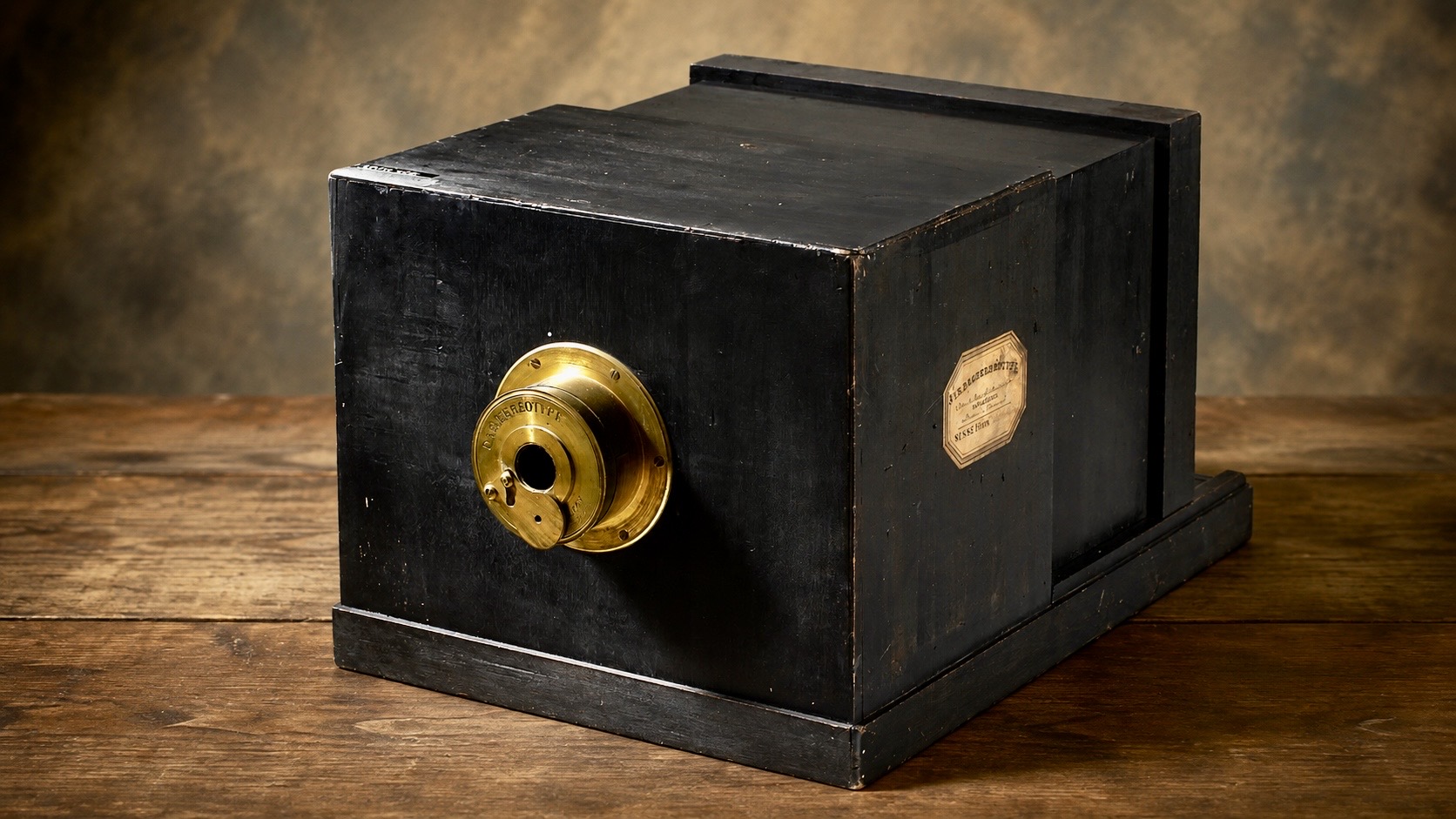
On August 19, Louis Daguerre’s revolutionary photographic process was publicly revealed in Paris, helping transform how humanity records people, places and events.
On August 19, 1839, a public meeting in Paris revealed the technical details of a process that would fundamentally change how the world could be recorded. Before an audience gathered for a joint session of France’s Académie des Sciences and Académie des Beaux-Arts, physicist and politician François Arago explained Louis-Jacques-Mandé Daguerre’s method for permanently capturing remarkably detailed images with light.
The process became known as the daguerreotype. Although photography had important pioneers before Daguerre, and several inventors were pursuing photographic methods independently, the events of 1839 brought a practical photographic process to widespread international attention. The Smithsonian notes that historians commonly regard 1839 as photography’s first year not because a single person suddenly invented the entire medium, but because it was the year photography was introduced to the world.
August 19 would eventually become recognized as World Photography Day, connecting today’s billions of digital photographs with a technological breakthrough announced nearly two centuries ago.
Before Photography Became Practical
Daguerre did not begin from nothing. French inventor Joseph Nicéphore Niépce had already experimented for years with methods of producing permanent images through the action of light. His work produced what is generally recognized as the earliest surviving photograph made with a camera, dating from the 1820s.
Daguerre, a successful artist and theatrical designer known for his Diorama, became interested in capturing images chemically. He and Niépce formally entered a partnership in 1829 and worked to improve photographic techniques. Niépce died in 1833, but Daguerre continued experimenting.
The method Daguerre eventually developed created a direct positive image on a highly polished, silver-plated copper sheet. The plate was sensitized using iodine vapour, exposed inside a camera and developed using mercury vapour before the image was fixed. The result could display extraordinary detail, but each plate produced a unique image rather than a negative from which multiple identical prints could be made.
News of Daguerre’s achievement was initially announced at the Académie des Sciences on January 7, 1839. The technical process itself, however, remained secret while arrangements were made for the French government to acquire the rights.
Arago became an influential advocate for the invention. The French government arranged pensions for Daguerre and Isidore Niépce, Nicéphore Niépce’s son and heir, in exchange for making the process publicly available. On August 19, the procedure was finally explained before the joint session in Paris.
That distinction matters. Photography did not simply appear on August 19, 1839. Years of experimentation had preceded the announcement, and other innovators, including William Henry Fox Talbot in Britain and Hippolyte Bayard in France, were developing their own photographic processes. What August 19 provided was a decisive moment when a workable method was publicly explained and could begin spreading rapidly.
Photography Spreads Around the World
The response was swift.
Within months, daguerreotype practitioners were working outside France. The process reached the United States in 1839, where photographers began experimenting with and improving it. By 1850, New York City alone had more than 70 daguerreotype studios.
Early cameras still imposed severe limitations. Exposure times could last several minutes even in bright sunlight, making portraits difficult. Subjects often had to remain motionless, sometimes supported by devices designed to keep their heads steady. Improvements in lenses and photographic chemistry soon shortened exposures and made portrait photography increasingly practical.
The implications went far beyond portrait studios.
Photography offered scientists a new method of recording observations through microscopes and telescopes. Explorers and archaeologists could preserve visual records of distant places and monuments. Governments and institutions could document people and events with a degree of visual precision previously unavailable.
It also changed personal memory. Painted portraits had generally required an artist’s time and remained beyond the means of many families. Daguerreotypes helped broaden access to portraiture, allowing a growing number of people to preserve detailed images of themselves and their relatives.
The daguerreotype itself would not dominate indefinitely. By the late 1850s, newer photographic methods were replacing it with processes that were faster, less expensive and capable of producing multiple prints from negatives.
Yet the larger transformation had only begun.
Photography eventually became inseparable from journalism, scientific research, warfare, advertising, art, identification, family life and historical documentation. Film cameras gave way to digital sensors, while smartphones turned photography from a specialized practice into an everyday activity available to billions of people.
The technology used today bears little resemblance to Daguerre’s polished metal plates and mercury fumes. The fundamental idea, however, remains recognizable: using light to preserve a visual record of a moment.
That is why August 19, 1839 remains important. It was not the day one person single-handedly invented photography. It was the day a groundbreaking photographic process was openly explained in Paris, accelerating the spread of a medium that would permanently change how humanity sees, and remembers, the world.
About the Author Brad Socha is the founder of The Universal Record, focused on sourced, factual global reporting. Coverage includes international news, geopolitics, technology, and major developments.