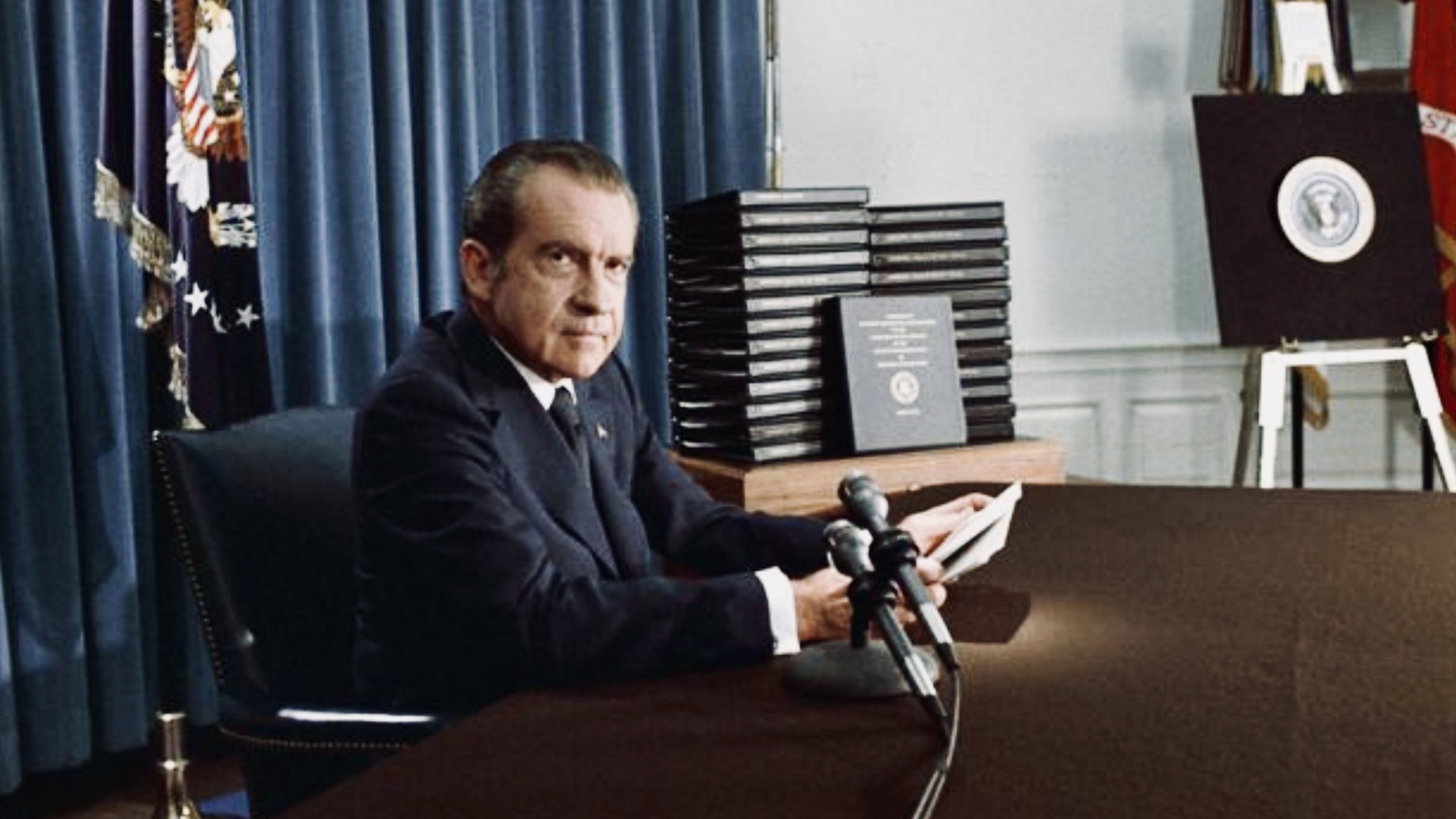
With the Watergate scandal closing in and impeachment advancing in Congress, Richard Nixon announced he would leave office, becoming the first U.S. president to resign.
On the evening of August 8, 1974, President Richard Nixon addressed the United States from the Oval Office and announced that he would resign at noon the following day. The decision came after the Watergate investigation exposed evidence tying his administration, and ultimately Nixon himself, to efforts to obstruct the investigation of the 1972 break-in at Democratic National Committee headquarters. His departure remains unprecedented: no other U.S. president has resigned from office.
The announcement ended a presidency that less than two years earlier had secured one of the largest electoral victories in American history. It also brought the country to an extraordinary constitutional moment, with the House of Representatives moving toward impeachment and the Senate preparing for a possible presidential trial.
Watergate Closes In on Nixon
The crisis began with the June 17, 1972, break-in at Democratic National Committee offices in the Watergate complex in Washington, D.C. Five men were arrested inside the offices, and investigations increasingly exposed connections between the burglary, Nixon’s reelection operation and efforts to conceal what had happened.
The scandal widened well beyond the original break-in. A Senate select committee investigated Watergate in nationally watched proceedings, while prosecutors pursued criminal cases. The revelation that Nixon had secretly recorded conversations in the White House made the tapes crucial evidence in determining what the president knew and how his administration had responded.
By 1974, the confrontation had become a constitutional struggle involving the presidency, Congress and the courts.
On February 6, the House authorized the Judiciary Committee to investigate whether grounds existed to impeach Nixon. The committee eventually approved three articles of impeachment: obstruction of justice on July 27, abuse of power on July 29 and contempt of Congress on July 30.
Meanwhile, Nixon resisted a subpoena seeking White House recordings. On July 24, the Supreme Court ruled unanimously in United States v. Nixon that he had to surrender subpoenaed tapes and documents for use in the Watergate criminal investigation. The decision sharply limited Nixon’s attempt to invoke presidential privilege to withhold the evidence.
The decisive blow came after Nixon complied.
On August 5, the White House released recordings that included a June 23, 1972, conversation later widely known as the “smoking gun” tape. The recording documented Nixon’s participation in an effort shortly after the break-in to interfere with the FBI investigation by involving the CIA. Congressional support for the president rapidly collapsed.
Senior Republican congressional leaders visited Nixon and made clear how badly his political position had deteriorated. Facing probable impeachment in the House and the prospect of conviction in a Senate trial, Nixon decided to leave office.
Nixon Addresses the Nation
At 9 p.m. Eastern time on August 8, Nixon appeared on television from the Oval Office. In the approximately 16-minute address, he acknowledged that he no longer had a sufficiently strong political base in Congress to continue pursuing the constitutional fight over Watergate.
Nixon did not deliver a broad admission of wrongdoing. Instead, he framed his resignation around the loss of congressional support and the need to avoid prolonging the political struggle.
“I have never been a quitter,” Nixon told the nation before announcing that he would resign effective at noon the next day.
The announcement did not itself end his presidency. That required Nixon’s formal resignation.
On August 9, a remarkably brief letter addressed to Secretary of State Henry Kissinger stated simply that Nixon was resigning the office of president. His term ended at noon.
Vice President Gerald Ford then took the presidential oath in the White House East Room, becoming the 38th president. Ford’s accession was unusual in its own right. He had become vice president only in December 1973 after Spiro Agnew resigned, making Ford the first person to reach the presidency without having been elected either president or vice president.
The transfer of power occurred peacefully despite the extraordinary circumstances. The constitutional system continued operating while a presidency collapsed under the combined pressure of a criminal investigation, congressional oversight, judicial review and the impeachment process.
Watergate’s consequences continued well beyond Nixon’s departure. Congress strengthened federal campaign-finance requirements in 1974, and the scandal contributed to a broader period of institutional reform and heightened scrutiny of presidential power.
One month after Nixon left office, Ford granted him a full pardon for federal offenses Nixon had committed or might have committed during his presidency. The September 8 decision ended the immediate prospect of a federal prosecution of the former president but became one of the most controversial decisions of Ford’s presidency.
Nixon’s resignation nevertheless remained the defining constitutional consequence of Watergate. He was never formally impeached by the full House and therefore never stood trial in the Senate; he resigned before those proceedings could occur.
More than half a century later, Watergate remains a reference point in debates over presidential accountability, executive privilege and congressional oversight. The events of August 1974 demonstrated that even during a profound political crisis, the transfer of presidential power could proceed through established constitutional institutions.
On August 8, Nixon announced that he would surrender the presidency rather than continue a political fight he could no longer win. The following day, for the first and so far only time in American history, a president of the United States resigned.
About the Author Brad Socha is the founder of The Universal Record, focused on sourced, factual global reporting. Coverage includes international news, geopolitics, technology, and major developments.