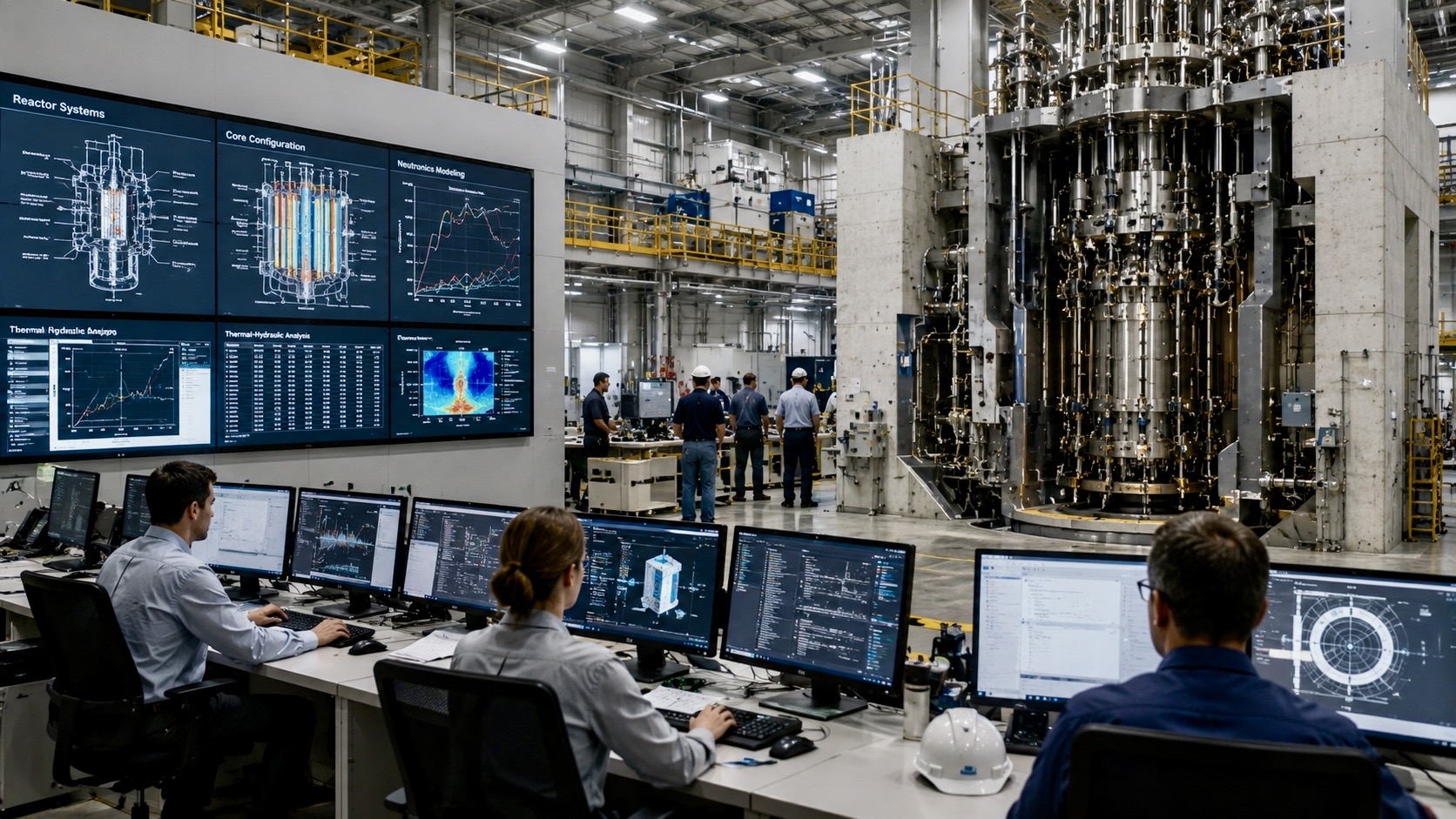
Artificial intelligence is helping engineers design safer reactors, predict equipment failures, streamline licensing, and accelerate the next generation of nuclear power as global electricity demand continues to rise.
Artificial intelligence is rapidly becoming one of the most influential tools in the future of nuclear energy. While AI is often associated with chatbots and consumer software, its impact is increasingly being felt inside research laboratories, engineering firms and nuclear facilities, where advanced machine learning models are helping design reactors, improve safety analyses, monitor equipment and reduce the time required to bring new technologies into operation.
The shift comes as governments and energy companies seek reliable, low-carbon electricity to meet soaring demand driven by artificial intelligence data centers, electrification and industrial growth. Rather than replacing nuclear engineers, AI is emerging as a powerful assistant capable of processing enormous amounts of technical data far faster than traditional methods while leaving critical safety decisions in human hands.
Designing Reactors Faster and Smarter
Designing a modern nuclear reactor requires thousands of engineering calculations covering heat transfer, materials science, neutron behavior, structural integrity and safety systems. These simulations traditionally require significant computing resources and can take months or even years.
AI is helping accelerate that process.
Researchers are increasingly combining machine learning with advanced physics simulations to evaluate thousands of design variations in far less time. Instead of replacing established engineering methods, AI identifies promising configurations that engineers can then validate using conventional safety analyses.
This approach is particularly valuable for Small Modular Reactors (SMRs) and advanced Generation IV reactor concepts, where developers are seeking safer, more efficient and easier-to-build designs. AI-assisted modeling can reduce development timelines while helping engineers optimize fuel efficiency, cooling systems and structural performance.
Several companies developing advanced reactors are now integrating AI directly into their engineering workflows. In one recent collaboration, Idaho National Laboratory and Oklo announced plans to use AI-enabled modeling, simulation and documentation tools to accelerate reactor and fuel-system development.
Improving Safety and Maintenance
AI’s most immediate impact may come long before new reactors begin producing electricity.
Modern nuclear plants generate vast amounts of operational data through thousands of sensors monitoring temperatures, pressures, vibrations, coolant flow and equipment performance. Machine learning systems can continuously analyze these data streams to identify subtle patterns that could indicate developing problems before they become serious.
Known as predictive maintenance, this approach allows operators to repair or replace components before failures occur, reducing unplanned shutdowns while maintaining high safety standards.
Researchers are also developing AI-powered digital twins, virtual models of operating reactors that simulate equipment behaviour in real time. Engineers can use these models to test maintenance strategies, evaluate operating conditions and better understand how reactor systems respond under changing conditions without affecting the actual facility.
Importantly, AI is intended to support operators rather than replace them. Human oversight remains essential, particularly in safety-critical industries where engineering judgment, regulatory review and multiple independent verification processes remain mandatory.
Helping Regulators Review Complex Designs
One of the largest obstacles facing advanced nuclear technology is the lengthy licensing process.
Preparing safety documentation for a new reactor can involve millions of pages of technical analysis. Reviewing that information is equally demanding for regulators.
The U.S. Department of Energy recently demonstrated how AI can assist in converting complex reactor safety documentation into formats that streamline regulatory review. The project involved the Department of Energy, Idaho National Laboratory, Argonne National Laboratory, Microsoft and Everstar, illustrating how AI may reduce administrative workloads while preserving rigorous technical evaluation.
Industry experts emphasize that AI does not approve reactors or replace regulatory decisions. Instead, it helps organize technical information, identify inconsistencies and reduce repetitive documentation tasks so engineers and regulators can focus on detailed safety assessments.
Meeting the Energy Demands of AI
Ironically, artificial intelligence is helping nuclear power while simultaneously increasing demand for it.
Training advanced AI models and operating hyperscale data centers require enormous amounts of electricity. Technology companies including Microsoft, Google, Amazon and Meta have all announced investments in nuclear energy or advanced reactor projects as they seek reliable, around-the-clock power sources capable of supporting future computing infrastructure.
Governments are responding by expanding support for advanced nuclear technologies, including SMRs and microreactors that can be deployed more quickly than traditional large-scale nuclear plants. AI-assisted engineering may further shorten development timelines by reducing design complexity and improving engineering efficiency.
Promise Tempered by Caution
Despite growing optimism, experts caution that AI is not a substitute for proven engineering practices.
International organizations and researchers note that AI systems depend heavily on high-quality data and can produce inaccurate results if trained on incomplete or biased information. Nuclear engineering also presents unique challenges because real-world accident data are limited, making it difficult to train models for every possible scenario.
For that reason, AI-generated analyses must undergo extensive validation before being used in design, maintenance or operational decision-making. Existing nuclear safety standards continue to require human review, independent verification and conservative engineering margins.
As a result, AI is expected to complement, not replace, the expertise of nuclear scientists, engineers and regulators.
The combination of artificial intelligence, advanced simulation and next-generation reactor technology represents one of the most significant developments in the nuclear industry in decades. If current research continues to mature, AI could help make future reactors faster to design, easier to maintain and more efficient to license, supporting efforts to provide reliable, low-carbon electricity for an increasingly digital world.
About the Author Brad Socha is the founder of The Universal Record, focused on sourced, factual global reporting. Coverage includes international news, geopolitics, technology, and major developments.