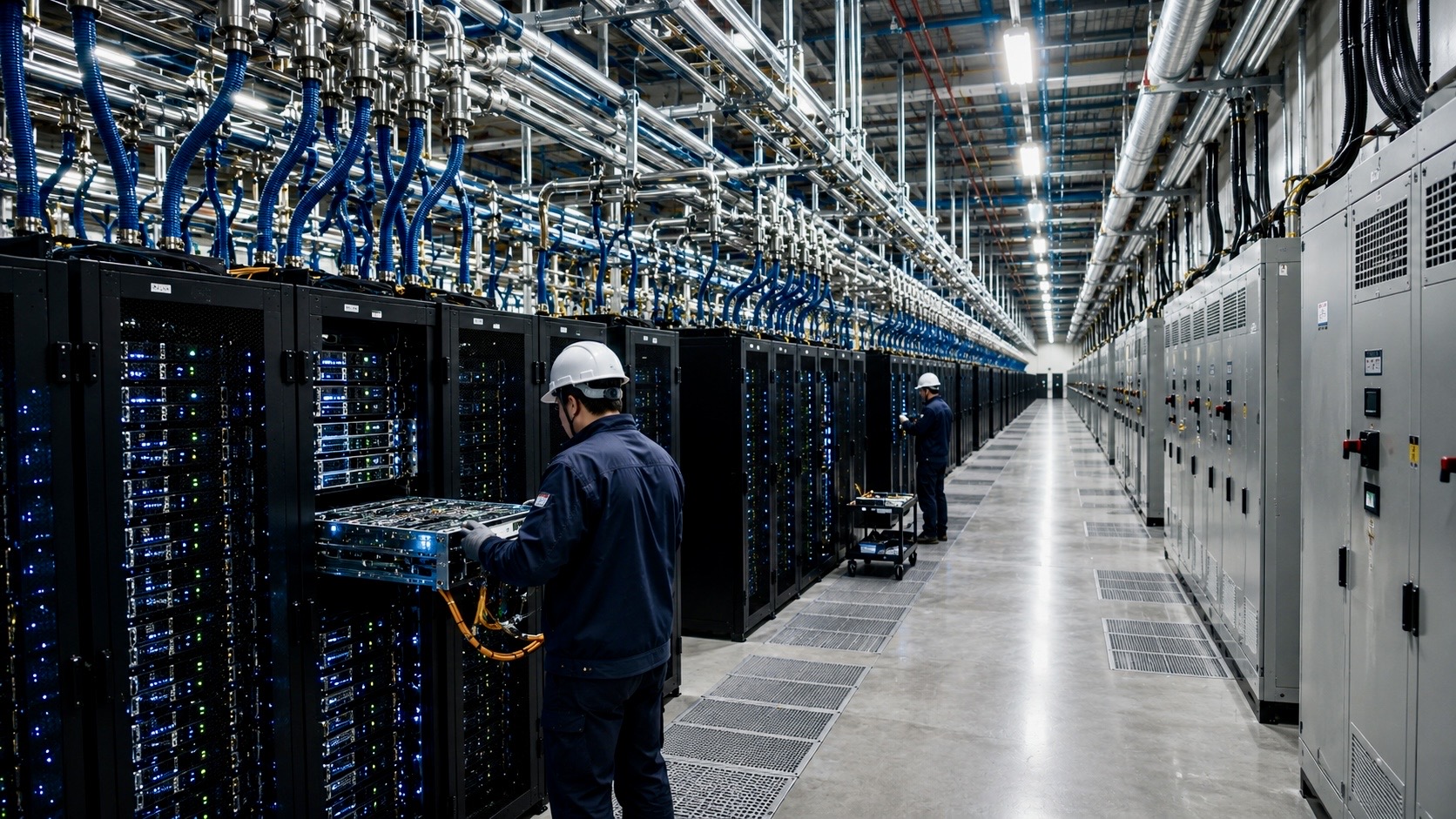
Technology companies are investing hundreds of billions of dollars in chips, electricity, cooling systems, and massive data centers as computing power becomes the foundation of the next generation of artificial intelligence.
The race to build more powerful artificial intelligence is no longer being defined solely by better algorithms. Increasingly, the deciding factor is access to computing power. Around the world, leading AI companies are committing unprecedented amounts of capital to construct data centers, purchase advanced processors, secure electricity supplies, and expand the infrastructure needed to train and operate increasingly sophisticated AI models.
What was once considered a software competition has evolved into an infrastructure race, one that is reshaping technology investment, electrical grids, semiconductor manufacturing, and even national economic policy.
Modern AI systems require enormous computational resources. Training frontier models involves processing vast quantities of data across tens or even hundreds of thousands of specialized AI chips working simultaneously. After deployment, those models continue consuming significant computing power as millions of users generate requests every day.
This demand has transformed graphics processing units (GPUs), originally developed for computer graphics, into some of the world’s most sought-after technologies. Companies including NVIDIA, AMD, and other semiconductor manufacturers have become central suppliers to the expanding AI economy, while cloud providers continue racing to install new generations of hardware.
But chips are only one piece of a much larger puzzle.
Behind every advanced AI model sits an enormous physical infrastructure. Modern AI data centers require reliable high-voltage electrical systems, extensive networking equipment, sophisticated cooling technologies, backup power generation, and buildings designed specifically for high-density computing.
As processors become more powerful, they also generate more heat. Traditional air cooling is increasingly giving way to advanced liquid-cooling systems capable of removing heat from densely packed server racks. Engineers are redesigning facilities to maximize efficiency while reducing downtime and operating costs.
Electricity has become another strategic resource.
The International Energy Agency has reported that AI is contributing to a rapid increase in data center electricity demand, prompting governments and utility providers to accelerate investments in generation capacity and grid modernization. In many regions, technology companies are signing long-term energy agreements and investing in renewable power, battery storage, and even nuclear energy partnerships to ensure future computing capacity.
Construction activity reflects the scale of these ambitions.
Companies including Microsoft, Google, Amazon, Meta, Oracle, OpenAI, xAI, and others are expanding hyperscale data centers across North America, Europe, and Asia. These facilities often require years of planning, billions of dollars in investment, and coordination with utilities, local governments, and construction firms.
Industry analysts estimate that combined capital spending by the world’s largest cloud providers could reach several hundred billion dollars this year alone, with forecasts continuing to rise as AI demand expands. TrendForce estimates the largest cloud service providers could collectively spend more than US$800 billion on capital expenditures in 2026, much of it directed toward AI infrastructure.
OpenAI has repeatedly described compute as one of the company’s most important long-term strategic priorities. The organization has expanded partnerships with infrastructure providers while raising significant new funding intended to accelerate AI deployment and computing capacity.
Meta has similarly announced plans for massive AI investments, including new data centers and specialized infrastructure designed to support future generations of AI models. Microsoft continues expanding Azure data centers across multiple continents while deploying custom AI accelerators and processors alongside NVIDIA hardware.
This growing demand is creating ripple effects far beyond the technology sector.
Construction companies are building specialized facilities at record pace. Utilities are upgrading transmission networks. Semiconductor manufacturers are expanding production capacity. Cooling equipment suppliers, electrical component manufacturers, and industrial engineering firms are experiencing strong demand driven by AI infrastructure projects.
Some economists also warn that this surge in investment could place additional pressure on supply chains and electricity markets. Increased demand for advanced semiconductors, electrical equipment, and energy infrastructure may contribute to higher costs for businesses and consumers in certain regions while requiring continued investment in power generation.
Governments are also watching closely.
Artificial intelligence has increasingly become a matter of economic competitiveness and national security. Countries able to provide abundant electricity, reliable infrastructure, semiconductor manufacturing capacity, and highly skilled engineering talent may become more attractive locations for future AI investment.
At the same time, communities hosting new data centers must balance economic benefits with concerns surrounding land use, water consumption, environmental impacts, and local electrical capacity.
Despite the extraordinary spending, questions remain about how quickly these investments will generate long-term financial returns. Investors continue debating whether current infrastructure expansion reflects sustainable growth or whether computing capacity could eventually outpace demand. Nevertheless, most major technology companies continue signaling that access to compute will remain one of the defining competitive advantages of the AI era.
One conclusion has become increasingly clear.
Artificial intelligence is no longer advancing through software innovation alone. Its future now depends just as much on physical infrastructure, on factories producing chips, power plants supplying electricity, engineers designing cooling systems, and data centres capable of supporting the computational demands of tomorrow’s AI.
The next breakthroughs in artificial intelligence may begin not inside a laboratory, but inside the world’s fastest-growing computing facilities.
About the Author Brad Socha is the founder of The Universal Record, focused on sourced, factual global reporting. Coverage includes international news, geopolitics, technology, and major developments.