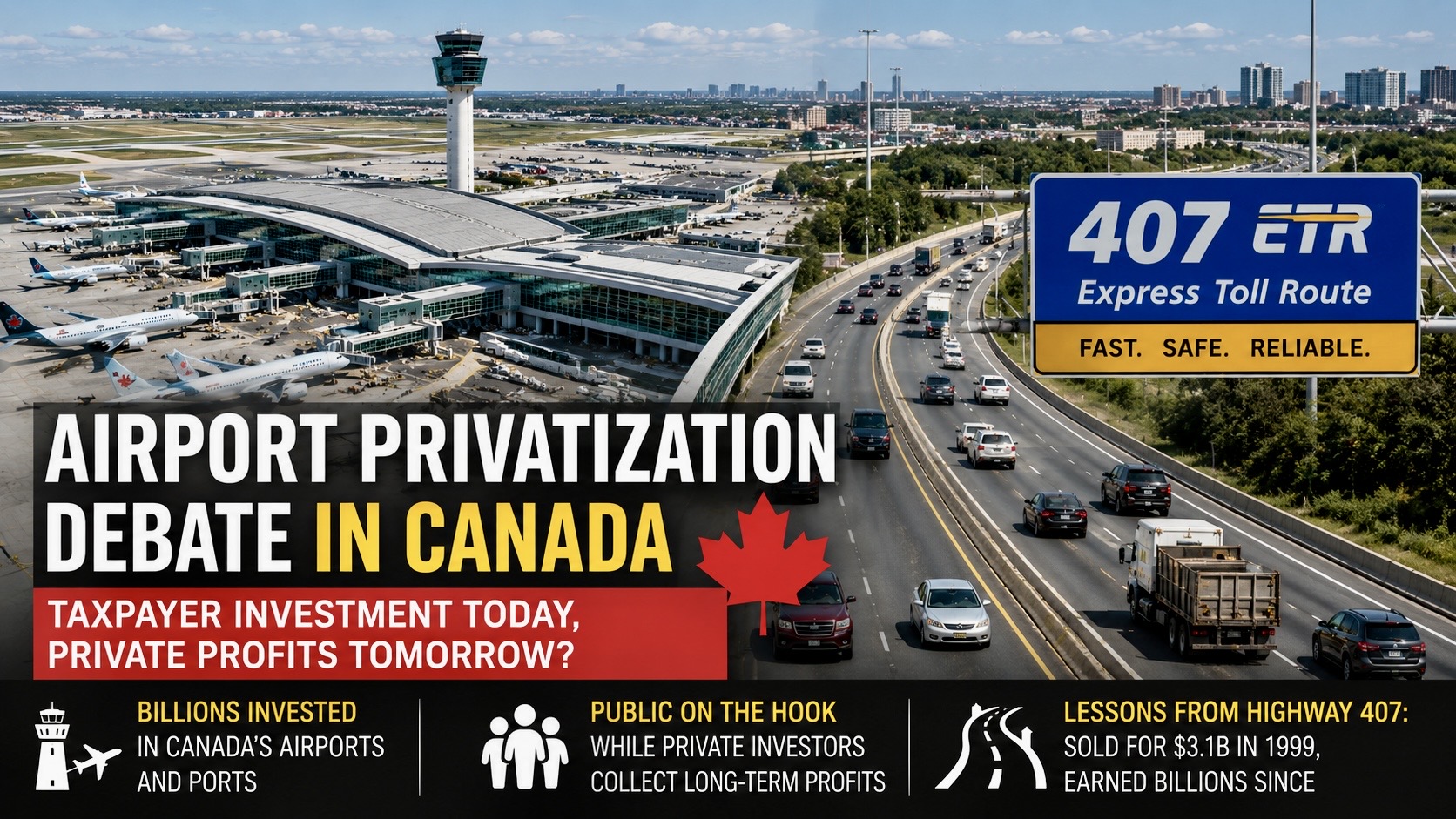
Canada’s federal government is examining whether private investment could play a larger role in the future ownership and financing of major airports and ports, reopening a national debate over infrastructure, taxpayer investment, and long-term public revenue.
The discussion has gained national attention because airports and ports are not ordinary commercial assets. They are critical transportation systems built through decades of public policy, taxpayer-supported infrastructure planning, government land agreements, and reinvestment models designed to support long-term economic growth. Critics argue that transferring future revenue streams from these assets into private hands could fundamentally change how Canadians benefit from infrastructure that has historically operated in the public interest.
Recent federal comments indicate Ottawa is reviewing “alternative ownership and investment models” for airports and ports as governments search for ways to finance future infrastructure expansion while limiting public borrowing pressures.
The issue is particularly sensitive because Canadian airports already operate differently than many global airport systems.
Major airports including Toronto Pearson, Vancouver International, Calgary International, and Montréal-Trudeau are federally owned but managed through local airport authorities operating on a not-for-profit basis under long-term leases. Revenue generated through airport operations is generally reinvested into infrastructure upgrades, maintenance, security, modernization, and expansion projects rather than distributed to shareholders.
Supporters of privatization argue that introducing institutional investors or private capital could accelerate modernization projects, improve efficiency, and unlock billions in infrastructure investment without placing the full financial burden on governments. Some analysts point to international airport systems where private investment has supported rapid expansion and increased passenger capacity.
However, critics argue the debate is not simply about efficiency. It is about who ultimately benefits from infrastructure that Canadians have spent decades helping finance.
The comparison most frequently raised is Ontario’s Highway 407 privatization.
Highway 407 was constructed using public funding before the province entered into a 99-year lease agreement in 1999 with a private consortium for approximately $3.1 billion. Over the following decades, the highway generated substantial long-term toll revenues while ownership interests became tied to large institutional and foreign investors, including Spanish infrastructure giant Ferrovial and Canadian pension funds.
The highway’s toll structure also became a source of public frustration as rates increased significantly over time. Critics of the deal argue the province surrendered a major long-term revenue-generating public asset for a short-term financial gain. Supporters counter that the agreement transferred financial risk away from taxpayers and provided immediate capital at the time.
The 407 remains one of Canada’s most discussed examples of infrastructure privatization because many economists and policy observers believe the asset later proved to be worth substantially more than the original lease agreement value.
That historical example is now being increasingly referenced in discussions surrounding airports and ports.
Critics argue Canadian taxpayers have already invested heavily in airport infrastructure over many decades through government land arrangements, transportation policy, infrastructure financing systems, regulatory frameworks, and modernization support. Under privatization models, they warn that future airport revenues, including passenger fees, parking revenues, retail income, terminal charges, and airline fees, could increasingly flow toward private investors rather than remaining tied to public transportation systems and reinvestment priorities.
Toronto Pearson International Airport is frequently cited within the debate because of the enormous amount of infrastructure investment connected to the airport over the years.
Pearson has undergone major terminal redevelopment projects, transit integration work, runway improvements, modernization initiatives, and operational expansion programs involving billions of dollars in cumulative infrastructure investment. Programs such as Pearson’s LIFT initiatives and modernization strategies have focused on long-term passenger growth, sustainability planning, logistics efficiency, and infrastructure resilience.
Critics argue that if ownership structures shift after decades of public-supported development, private investors could eventually benefit from infrastructure systems that taxpayers helped build and maintain over generations.
Some labour organizations and transportation advocates also warn privatization models may increase pressure to maximize profitability through higher passenger charges, airline fees, parking rates, or commercial rents. Canada already faces criticism for relatively expensive domestic air travel costs compared with many international markets.
Others raise concerns about accountability and public oversight.
Airport authorities currently operate within federal regulatory frameworks designed around public transportation objectives rather than direct shareholder returns. Critics argue private ownership models could gradually shift decision-making priorities toward profitability, potentially reducing public influence over infrastructure planning and long-term affordability.
At the same time, supporters of privatization argue institutional investors such as pension funds often seek stable, long-term infrastructure assets and may provide capital needed for future expansion projects without requiring governments to assume additional debt burdens.
Some analysts also note that privatization discussions do not necessarily mean outright asset sales. Alternative models could include partial ownership structures, concession agreements, infrastructure partnerships, or long-term operational leases rather than full privatization.
The federal government has not announced a formal privatization plan, and discussions remain in early stages. However, transportation policy experts say the debate is likely to intensify because airports and ports are increasingly viewed as strategic economic assets tied to trade, tourism, logistics, and national competitiveness.
The broader question now emerging is whether Canada should continue treating major transportation infrastructure primarily as long-term public assets, or whether governments should increasingly leverage those systems to attract private investment capital.
For critics, the concern is not only about ownership. It is about whether future generations could ultimately pay more to use infrastructure that was largely developed through decades of public investment while long-term revenue streams increasingly benefit private interests.
For supporters, the argument remains that modern infrastructure expansion may require investment models beyond traditional public financing.
As discussions continue, the debate over airports, ports, and infrastructure ownership is rapidly evolving into one of Canada’s most significant long-term economic and public policy conversations.
About the Author Brad Socha is the founder of The Universal Record, focused on sourced, factual global reporting. Coverage includes international news, geopolitics, technology, and major developments.