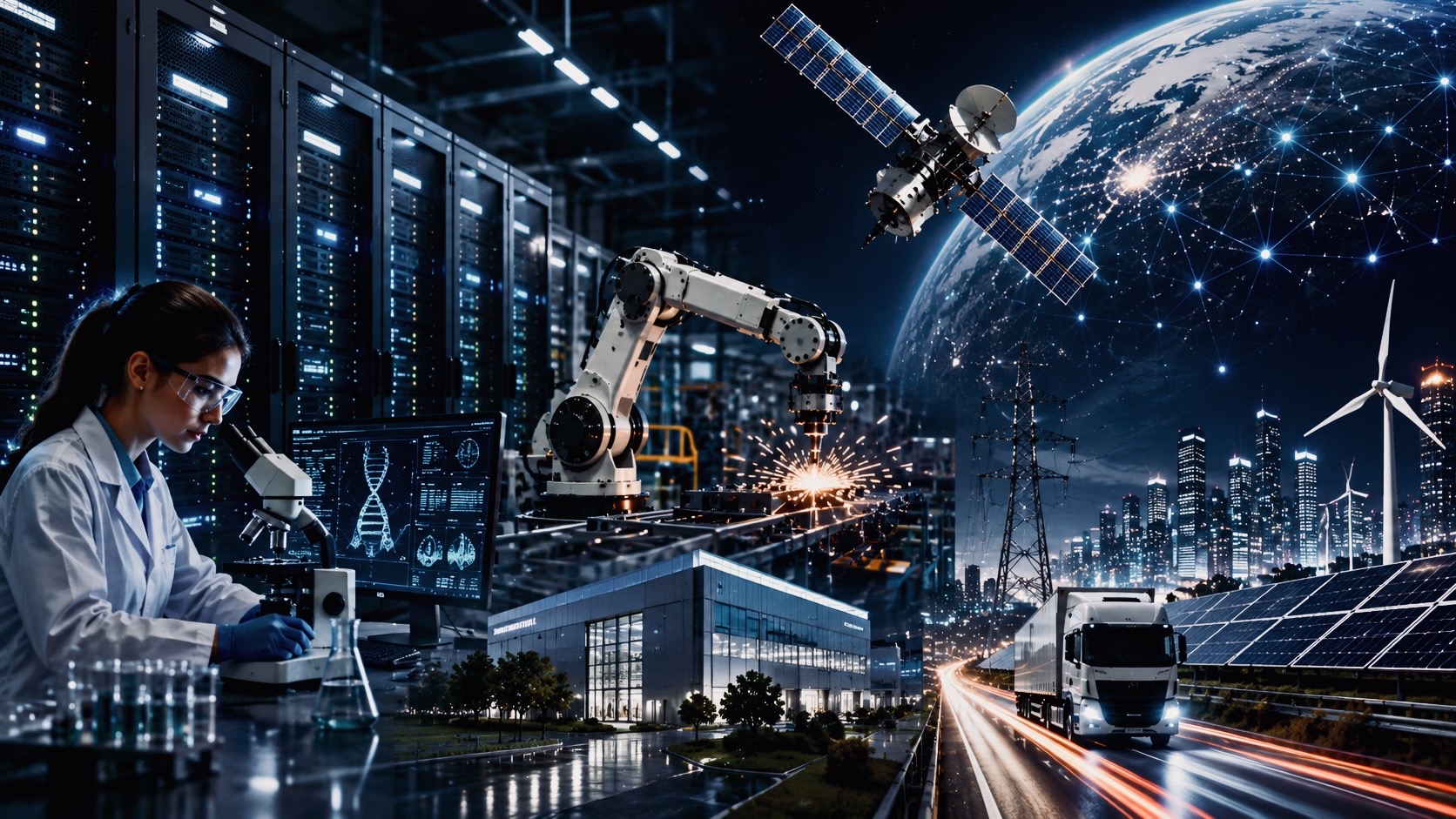
As OpenAI, SpaceX, NVIDIA, and other technology leaders invest heavily in infrastructure, researchers say the next phase of artificial intelligence may extend far beyond chatbots and virtual assistants.
Artificial intelligence may be entering a new phase, one that extends far beyond chatbots, image generators, and virtual assistants. While public attention has largely focused on consumer-facing AI tools, billions of dollars are now flowing into a broader transformation involving scientific research, healthcare, manufacturing, energy systems, defense technologies, and communications infrastructure.
The shift matters because it could determine where the next generation of economic growth occurs, which industries benefit, and how governments and businesses allocate trillions of dollars in future investment. Unlike the first wave of AI adoption, which largely centered on software and productivity tools, the emerging phase increasingly involves physical infrastructure, industrial systems, and scientific discovery.
The scale of investment is difficult to ignore.
Technology companies have collectively committed hundreds of billions of dollars toward AI-related infrastructure over the past several years. Data centers, semiconductor manufacturing plants, cloud computing networks, advanced robotics facilities, and AI research laboratories are expanding at a pace not seen since the early internet era.
OpenAI, Microsoft, Google, Amazon, Meta, Nvidia, and other major technology firms continue to increase spending on AI development. At the same time, investors are increasingly directing capital toward companies positioned to apply artificial intelligence to real-world industries rather than simply build consumer applications.
The result is a growing debate over whether the world is witnessing the beginning of a second and potentially larger AI boom.
Following the Money
One of the clearest indicators comes from capital expenditure budgets.
Major technology firms have announced plans involving hundreds of billions of dollars in combined spending on AI infrastructure, including specialized chips, networking equipment, power generation, and large-scale computing facilities.
Nvidia has become one of the world’s most valuable companies due largely to demand for AI processors. Semiconductor manufacturers in the United States, Taiwan, South Korea, and Europe are expanding production capacity to meet projected demand.
Governments are also participating.
The United States, European Union, China, Japan, South Korea, and several Middle Eastern countries have launched programs designed to attract AI investment and secure access to advanced computing resources. Many policymakers increasingly view artificial intelligence as a strategic technology comparable to energy, aerospace, or telecommunications.
This raises an important question: who ultimately benefits from the enormous flow of capital?
Technology firms developing foundational AI models stand to gain significantly. Semiconductor manufacturers, cloud providers, power utilities, data center operators, and telecommunications companies may also see substantial growth.
However, much of the investment is being justified on expectations of future productivity gains that have yet to be fully realized.
Beyond Chatbots
The next phase of AI appears increasingly focused on specialized applications.
Researchers are using artificial intelligence to accelerate drug discovery, identify new materials, analyze genomic data, and improve disease detection. Several pharmaceutical companies now rely on AI systems to help prioritize compounds for testing, potentially reducing development timelines.
Manufacturing companies are deploying AI-driven systems to optimize production lines, predict equipment failures, and improve quality control. Recent developments in robotics are also expanding AI’s role in physical workplaces. In Humanoid Robots Enter the Workforce as AI Takes On New Roles, researchers and manufacturers are exploring how AI-powered robots could move from research labs into real-world industrial environments.
Energy providers are exploring AI tools capable of managing electricity demand, forecasting consumption patterns, and integrating renewable energy sources more efficiently.
Agricultural applications are expanding as well. AI-powered systems can monitor crop conditions, identify disease outbreaks, optimize irrigation, and improve yield forecasting.
The pattern emerging across sectors is that AI increasingly functions as an infrastructure technology rather than merely a software product.
SpaceX has become a central figure in this discussion due to its launch capabilities, Starlink satellite network, and expanding role in communications infrastructure. As satellite networks generate enormous amounts of data, AI systems are becoming increasingly important for analysis, network management, and operational efficiency.
The combination of global communications networks, advanced computing, and AI-driven automation has led some analysts to describe space infrastructure as a critical component of the next technology cycle.
If reports regarding SpaceX’s multi-trillion-dollar valuation prove sustainable, the company may become one of the clearest examples of how AI, communications, and aerospace technologies are increasingly interconnected.
The Infrastructure Challenge
The expansion of artificial intelligence is creating demands that extend well beyond software development.
Large AI models require vast quantities of electricity, specialized chips, cooling systems, and high-speed data networks.
Data center construction has accelerated globally, leading to growing concerns about energy consumption and grid capacity. Some regions are already evaluating how future electricity demand from AI facilities could affect long-term infrastructure planning.
This raises questions about whether existing power systems can support projected growth.
Several utility companies have reported significant increases in anticipated demand from data center projects. Policymakers are now examining whether additional generation capacity will be required to support future AI expansion.
The outcome may influence investment decisions for decades.
Lessons From Previous Technology Booms
History offers useful comparisons.
The railroad boom of the nineteenth century transformed transportation and commerce but also produced speculative investment bubbles.
The internet revolution created enormous economic value while simultaneously generating periods of excessive optimism and market volatility.
Artificial intelligence may follow a similar pattern.
Some experts argue that current investment levels reflect rational expectations about long-term productivity gains. Others warn that portions of the market may be pricing in outcomes that remain uncertain.
Both perspectives acknowledge one point: AI is becoming deeply embedded within the global economy.
What Remains Unknown
Despite the enthusiasm surrounding artificial intelligence, several key questions remain unresolved.
It is not yet clear how quickly businesses will realize measurable productivity improvements from large-scale AI deployment.
Questions also remain regarding regulation, cybersecurity risks, intellectual property issues, workforce impacts, and energy requirements.
Many of the largest AI projects involve private companies, meaning detailed financial information is often unavailable to the public.
As a result, investors, policymakers, and researchers continue to evaluate whether current spending levels will generate returns consistent with expectations.
A Shift Larger Than Software?
What distinguishes the current moment from earlier AI developments is the breadth of industries becoming involved.
Artificial intelligence is increasingly influencing healthcare, manufacturing, scientific research, communications, transportation, defense, and energy systems simultaneously.
That breadth suggests the technology may be evolving into a foundational layer of modern infrastructure rather than a standalone industry.
Whether current investment levels ultimately prove justified remains uncertain.
What is increasingly clear, however, is that the next phase of artificial intelligence appears far larger than chatbots alone. The real story may not be the software people use today, but the infrastructure, industries, and scientific breakthroughs being built around AI for decades to come.
About the Author Brad Socha is the founder of The Universal Record, focused on sourced, factual global reporting. Coverage includes international news, geopolitics, technology, and major developments.