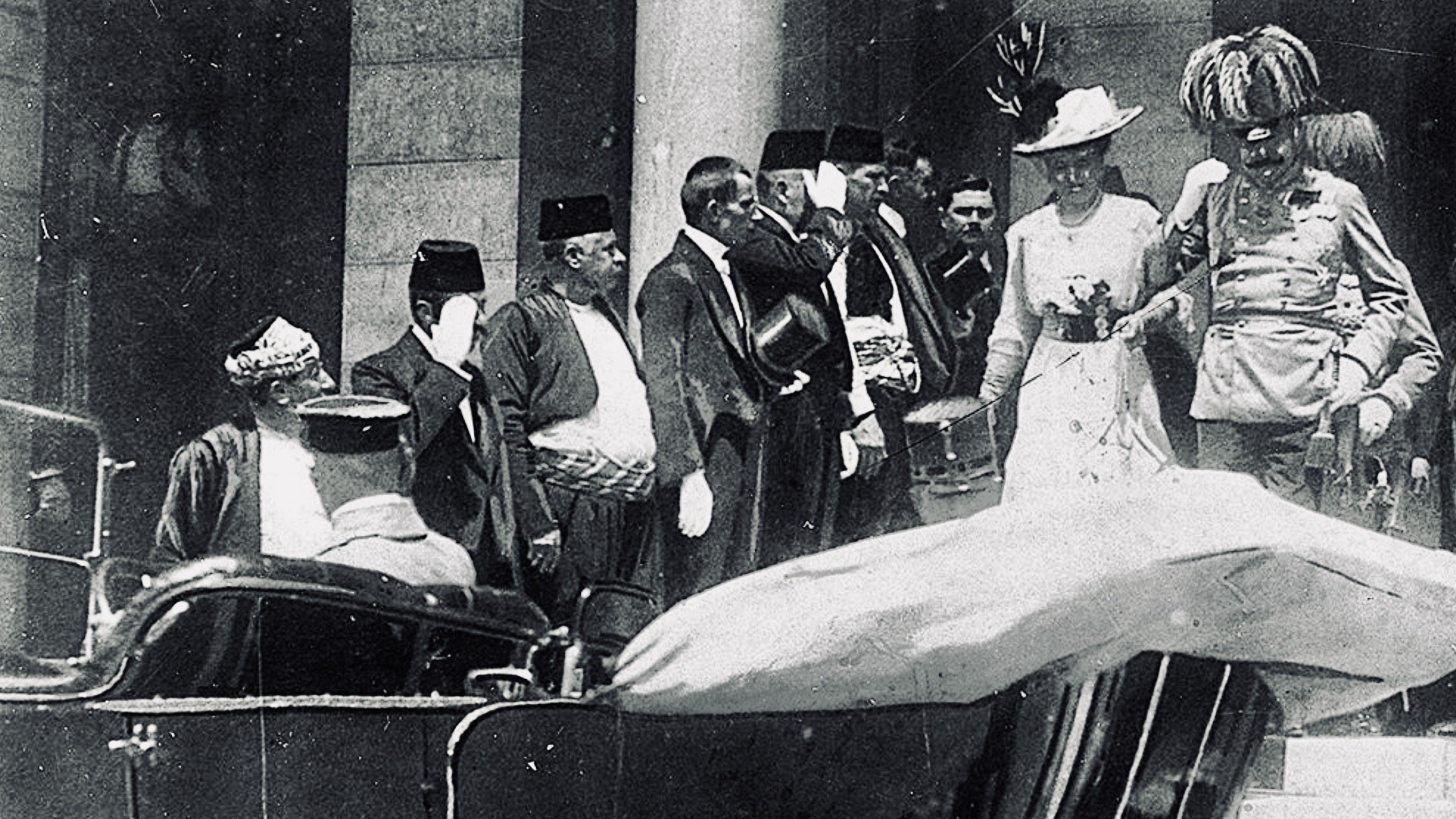
The killing of Austria-Hungary’s heir in Sarajevo triggered the diplomatic crisis that escalated into the First World War, permanently reshaping global politics, borders, and modern history.
Some historical moments instantly alter the course of civilization. The assassination of Archduke Franz Ferdinand on June 28, 1914, is widely regarded as one of those defining events. Although a single act of political violence did not, by itself, cause the First World War, it set in motion a chain of diplomatic decisions, military mobilizations, and alliance commitments that ultimately drew much of the world into one of history’s deadliest conflicts. More than a century later, the events in Sarajevo continue to influence international relations, military strategy, and the study of how regional crises can rapidly become global confrontations.
Archduke Franz Ferdinand was the heir presumptive to the throne of Austria-Hungary, one of Europe’s largest multinational empires. He and his wife, Sophie, Duchess of Hohenberg, traveled to Sarajevo, the capital of Bosnia and Herzegovina, on June 28, 1914, to inspect military exercises and attend official events. Bosnia had been annexed by Austria-Hungary in 1908, a move that angered many ethnic Serbs who believed the territory should eventually become part of a larger Serbian state.
Nationalist tensions had been building across the Balkans for years. Serbia had emerged stronger following the Balkan Wars of 1912 and 1913, while Austria-Hungary viewed Serbian nationalism as a growing threat to the stability of its empire. Secret revolutionary groups sought to weaken Austrian control, and among them was the organization commonly known as the Black Hand, whose members supported violent action to advance Serbian nationalist goals.
A group of young Bosnian Serb conspirators positioned themselves along Franz Ferdinand’s motorcade route through Sarajevo. Early in the procession, one attacker threw a bomb at the Archduke’s vehicle. The explosive missed its intended target and detonated beneath another vehicle in the convoy, injuring several officers and bystanders. Despite the failed attack, the visit continued.
Later that morning, after deciding to visit wounded officials in hospital, the Archduke’s driver mistakenly turned onto the wrong street. As the vehicle attempted to reverse, it stopped directly in front of nineteen-year-old Gavrilo Princip, one of the conspirators who believed his opportunity had passed. Standing only a few feet away, Princip fired two shots with a pistol. One struck Franz Ferdinand in the neck, while the other fatally wounded Sophie. Both died within minutes.
The assassination shocked Europe. Austria-Hungary quickly concluded that elements within Serbia had supported the conspiracy, although the extent of official Serbian government involvement has remained a subject of historical debate. Backed by Germany’s assurances of support, Vienna issued a stringent ultimatum to Serbia on July 23, 1914. Serbia accepted many of its demands but rejected several provisions that would have compromised its sovereignty.
Austria-Hungary declared war on Serbia on July 28. What followed became known as the July Crisis. Existing alliances rapidly transformed a regional conflict into a continental war. Russia mobilized in support of Serbia. Germany declared war on Russia and then France. Germany’s invasion of Belgium brought Britain into the conflict after Britain honored its treaty obligations. Within days, Europe’s major powers were at war.
The conflict expanded far beyond Europe. Colonial territories, overseas possessions, and alliances drew countries from Africa, Asia, the Middle East, Oceania, and North America into the fighting. By the war’s conclusion in 1918, approximately 70 million military personnel had been mobilized, and historians estimate that around 20 million people lost their lives, with millions more wounded or displaced.
The First World War transformed warfare itself. Industrial production enabled prolonged conflicts fought with machine guns, heavy artillery, poison gas, tanks, aircraft, submarines, and extensive trench systems. Scientific and technological advances increased both military capability and the scale of destruction, introducing methods of warfare never before seen on such a global level.
Politically, the consequences were profound. Four major empires, the Austro-Hungarian, German, Ottoman, and Russian Empires, collapsed during or immediately after the war. New nations emerged across Europe, while revolutionary movements reshaped governments and societies. The Russian Revolution of 1917 eventually led to the establishment of the Soviet Union, profoundly influencing twentieth-century geopolitics.
The peace settlement that followed also had lasting consequences. The Treaty of Versailles imposed significant territorial losses, military restrictions, and financial reparations on Germany. Many historians argue that unresolved grievances stemming from the treaty contributed to political instability during the interwar period and helped create conditions that led to the Second World War.
The assassination itself has become a subject of extensive historical study because it illustrates how interconnected international systems can magnify local events. Europe in 1914 was characterized by rigid alliance structures, competitive military planning, rising nationalism, imperial rivalries, and limited diplomatic flexibility. Once mobilization orders began, leaders found it increasingly difficult to reverse course.
Modern scholars generally agree that Gavrilo Princip’s actions served as the immediate catalyst rather than the sole cause of the war. The deeper origins lay in decades of political tensions, military competition, alliance commitments, and nationalist movements. Without those underlying conditions, the assassination might not have resulted in a global conflict.
Today, Sarajevo preserves numerous sites connected to June 28, 1914. Museums, memorials, and historical exhibits continue to examine both the assassination and its broader consequences. Historians, military academies, and diplomatic institutions regularly study the July Crisis as an example of how miscalculation, escalating commitments, and failed diplomacy can transform a localized crisis into international catastrophe.
More than 110 years later, the assassination of Archduke Franz Ferdinand remains one of history’s most consequential political killings. It altered the trajectory of nations, accelerated technological and military change, redrew maps, and influenced international politics for generations. Its legacy serves as a reminder that seemingly isolated events can produce global consequences when they intersect with fragile political systems and competing strategic interests.
About the Author Brad Socha is the founder of The Universal Record, focused on sourced, factual global reporting. Coverage includes international news, geopolitics, technology, and major developments.