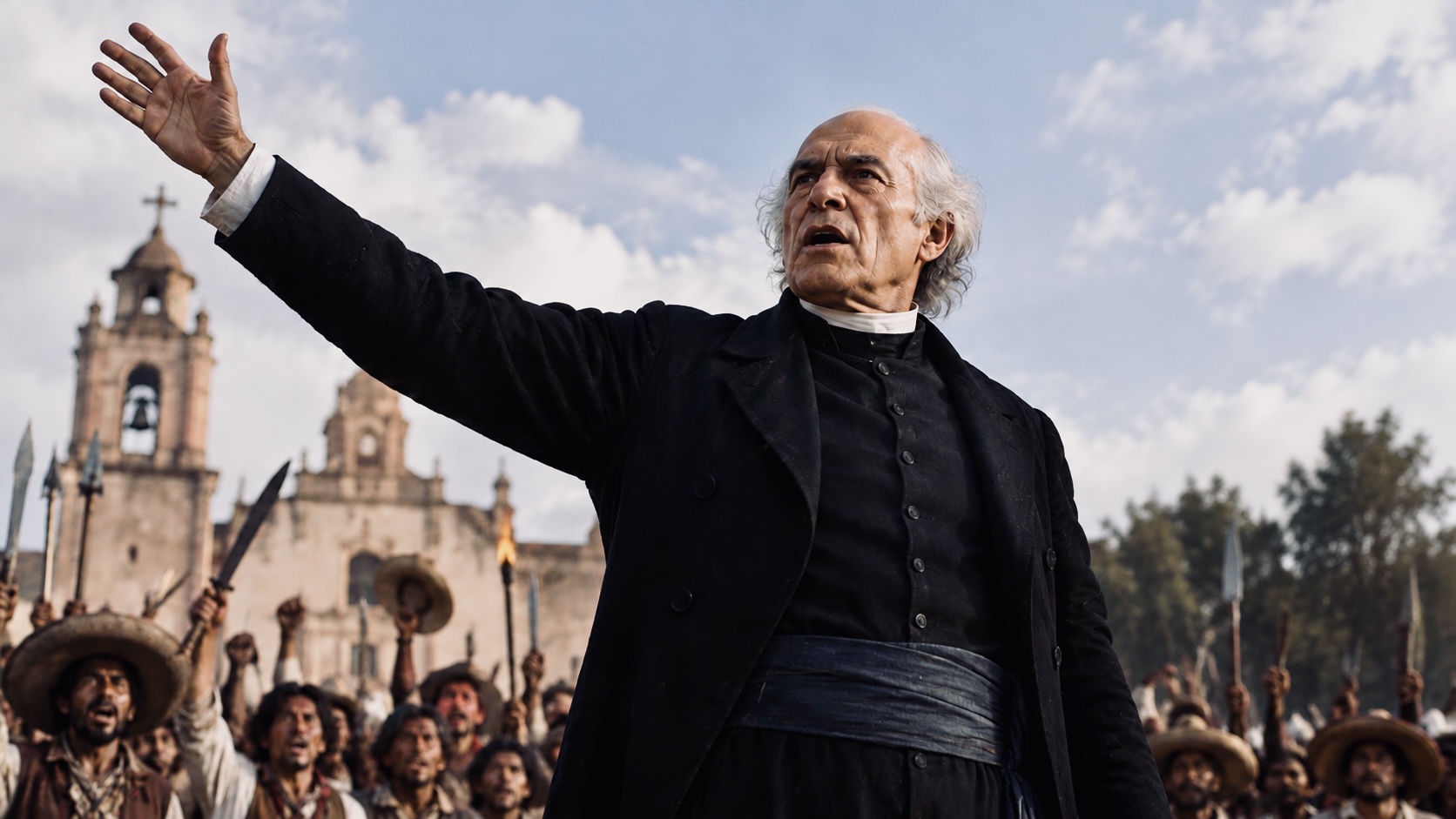
Miguel Hidalgo’s call to arms in Dolores ignited an uprising against colonial rule, beginning a struggle that would transform New Spain and ultimately produce an independent Mexico.
In the early hours of September 16, 1810, Catholic priest Miguel Hidalgo y Costilla summoned residents of Dolores, Guanajuato, and called them to take up arms. The event remembered as the Grito de Dolores marked the beginning of the Mexican War of Independence, an upheaval that would continue for more than a decade before Spanish colonial rule was finally broken.
The uprising did not begin according to plan. Hidalgo and fellow conspirators had been preparing a revolt when colonial authorities discovered the conspiracy in Querétaro. Warned that arrests were imminent, the insurgent leaders faced a choice: abandon their plans or act immediately. They chose rebellion.
The Grito de Dolores
The crisis that produced the revolt extended far beyond Mexico. Napoleon’s invasion of Spain in 1808 and the forced abdications of Charles IV and Ferdinand VII created a political crisis throughout the Spanish Empire. In New Spain, questions about legitimate government became entangled with longstanding social and economic divisions.
Hidalgo, born in 1753 and ordained as a priest, had served in Dolores since 1803. He became associated with a group that included military officers Ignacio Allende and Juan Aldama, as well as Querétaro corregidor Miguel Domínguez and his wife, Josefa Ortiz de Domínguez. Their meetings formed part of what became known as the Conspiracy of Querétaro.
Plans for an uprising were exposed in September 1810. Ortiz de Domínguez helped send a warning that the conspiracy had been discovered, and Allende and Aldama made their way to Dolores. During the early hours of September 16, Hidalgo decided that waiting was no longer possible.
The church bell was rung to gather the population. Hidalgo then delivered the appeal that became known as the Grito de Dolores.
Exactly what Hidalgo said remains uncertain. No contemporary verbatim transcript of the speech survives, and later versions differ. Mexican historical records nevertheless establish its essential purpose: Hidalgo called those gathered in Dolores to join an armed movement against the existing government.
The revolt expanded with remarkable speed. Later that morning, Hidalgo led hundreds of followers away from Dolores toward San Miguel el Grande. At the sanctuary of Atotonilco, the insurgents adopted an image of the Virgin of Guadalupe as a standard, creating one of the most enduring symbols of the independence movement.
Thousands soon joined.
The insurgent force captured several important communities and moved toward Guanajuato, where fighting at the Alhóndiga de Granaditas became one of the early conflict’s defining confrontations. By late October, Hidalgo’s army had advanced toward Mexico City and defeated royalist forces at the Battle of Monte de las Cruces.
But the initial momentum did not last.
Hidalgo chose not to advance into Mexico City. The insurgent movement subsequently suffered major military reversals, while disagreements emerged among its leaders. Royalist forces defeated Hidalgo’s army at the Battle of Calderón Bridge in January 1811.
Hidalgo, Allende, Aldama and other insurgent leaders were later captured while attempting to move north. Hidalgo was executed in Chihuahua on July 30, 1811. His death, however, did not end the rebellion.
Independence Outlives Hidalgo
Leadership passed to other insurgents, most prominently José María Morelos, another Catholic priest who had met Hidalgo shortly after the revolt began. Morelos organized campaigns across southern New Spain and gave the independence movement a clearer political program.
In 1813, the Congress of Chilpancingo heard Morelos’s Sentimientos de la Nación, which called for the independence of America from Spain and set out principles for a new political order. Morelos was captured and executed in 1815, but armed resistance continued under leaders including Vicente Guerrero.
The final phase developed under very different political circumstances. In 1821, former royalist commander Agustín de Iturbide and Guerrero joined around the Plan of Iguala. The resulting Army of the Three Guarantees entered Mexico City on September 27, 1821, marking the effective end of Spanish colonial government and the consummation of Mexican independence.
The struggle that began at Dolores had lasted 11 years and passed through dramatically different phases. It involved competing political visions, shifting alliances and enormous social upheaval rather than a single uninterrupted military campaign.
September 16 nevertheless became the defining date in Mexico’s national memory.
The anniversary commemorates the beginning of the independence struggle rather than its completion. Each year, the Grito is reenacted on the evening of September 15, with the principal national ceremony taking place at Mexico City’s National Palace. The following day, September 16, is Mexico’s Independence Day.
More than two centuries after Hidalgo summoned the people of Dolores, the moment remains inseparable from the creation of modern Mexico. The uprising did not deliver independence immediately, and Hidalgo did not live to see the country emerge from Spanish rule. What began that September morning instead opened an 11-year struggle that ultimately ended three centuries of colonial government and established Mexico as an independent nation.
About the Author Brad Socha is the founder of The Universal Record, focused on sourced, factual global reporting. Coverage includes international news, geopolitics, technology, and major developments.