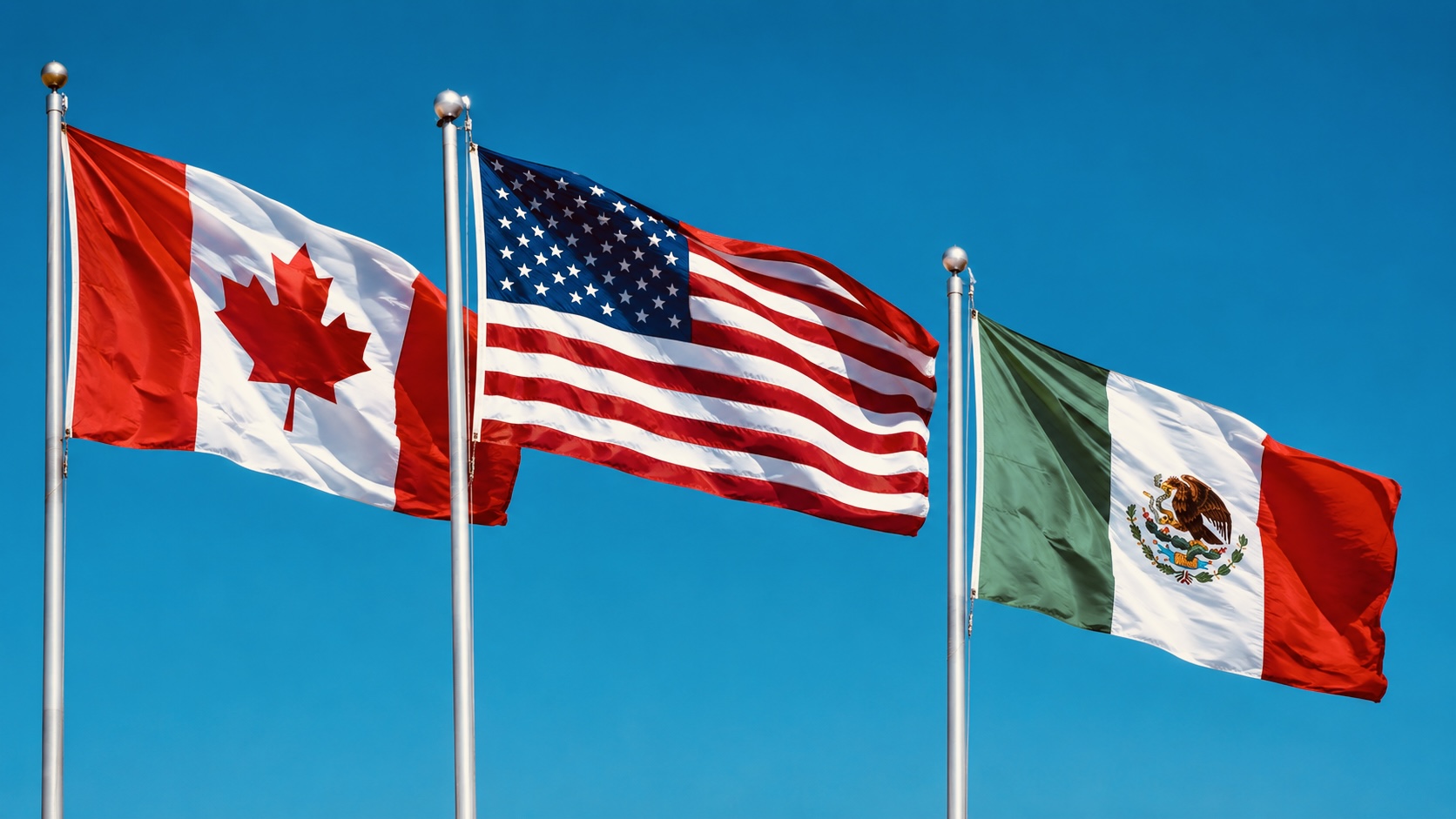
Washington’s decision launches annual review negotiations instead of extending the North American trade agreement, leaving businesses and investors facing years of uncertainty.
North America’s most important trade agreement has entered a new phase. The United States has formally declined to extend the Canada–United States–Mexico Agreement (CUSMA/USMCA) for another 16-year term during its first mandatory six-year review, triggering an annual review process rather than ending the agreement.
The decision does not terminate CUSMA/USMCA today. Instead, it begins what could become years of negotiations over the future of the trade pact governing nearly US$2 trillion in annual North American trade. For businesses, manufacturers and exporters across Canada, the United States and Mexico, the announcement introduces fresh uncertainty into long-term investment and supply-chain planning.
The agreement, which replaced NAFTA in 2020 after being negotiated during U.S. President Donald Trump’s first administration, contains a unique “sunset review” provision requiring the three countries to decide six years after implementation whether to extend the agreement for another 16 years.
On July 1, the United States chose not to provide that extension.
According to U.S. Trade Representative Jamieson Greer, Washington believes the agreement contains significant shortcomings that require additional negotiation before any long-term renewal is considered. Rather than ending the pact, that position activates the review mechanism established in Article 34.7 of the agreement.
Under the treaty, CUSMA/USMCA remains fully in force. Goods that currently qualify for preferential treatment continue to do so, and existing dispute settlement mechanisms remain available. However, unless all three countries eventually agree to extend the agreement, annual joint reviews will now occur while negotiations continue.
If no agreement is reached over the next decade, the treaty could expire in 2036.
The review mechanism was intentionally built into CUSMA/USMCA during negotiations as a way to ensure the agreement would evolve with changing economic conditions rather than remain unchanged for decades. At the time, supporters argued the provision would encourage modernization. Critics warned it could also create recurring uncertainty for businesses making long-term investments.
Today’s decision has effectively moved the agreement into that second scenario.
Trade discussions are expected to focus on several issues the United States has repeatedly identified in recent months.
Among them are automotive rules of origin, manufacturing requirements, labour standards, steel and aluminum trade, market access, supply-chain resilience and concerns surrounding Chinese investment and manufacturing within North America. Reuters has reported that the United States has proposed stricter U.S. content requirements for vehicles assembled under CUSMA/USMCA, although negotiations remain ongoing.
Canada has emphasized maintaining open North American supply chains while continuing to oppose U.S. tariffs affecting Canadian steel, aluminum, lumber and automotive products. Mexican officials have likewise indicated they remain committed to negotiating improvements while keeping the trilateral framework intact.
One important point often misunderstood is that today’s announcement is not equivalent to withdrawing from the agreement.
The review clause functions separately from the withdrawal provisions. By declining to extend the agreement today, the United States has triggered annual reviews rather than immediate termination. Businesses can continue operating under existing CUSMA/USMCA rules while negotiations proceed.
Even so, uncertainty itself carries economic consequences.
Manufacturers planning billion-dollar investments frequently rely on stable trade rules extending decades into the future. Automotive production, semiconductor facilities, battery manufacturing, energy infrastructure and critical mineral processing often require investment horizons measured in decades rather than years.
Economists have long warned that prolonged uncertainty surrounding CUSMA/USMCA could delay investment decisions, encourage companies to postpone expansion and complicate cross-border supply-chain planning.
Canadian industries could be particularly affected because approximately three-quarters of Canada’s merchandise exports are destined for the United States. Many sectors, including automotive manufacturing, aerospace, agriculture, forestry, mining and energy, operate through deeply integrated North American production networks.
The timing also coincides with broader changes in global trade.
Governments are increasingly emphasizing domestic manufacturing, strategic industries, critical minerals and supply-chain security following years of pandemic disruptions, geopolitical tensions and expanding industrial policies.
Those trends are expected to shape CUSMA/USMCA negotiations just as much as traditional tariff issues.
Trade experts also note that the review process itself offers flexibility.
Although today’s decision begins annual reviews, the three governments may still reach an agreement at any point before 2036. If consensus is achieved, the agreement could then be extended for another 16-year term without waiting for the decade-long process to conclude.
For now, negotiations are expected to continue over the coming months.
Officials from all three countries have indicated discussions will remain active, with additional negotiating rounds anticipated throughout the year. Reuters reported that U.S. and Mexican officials are already planning further meetings, while formal negotiations with Canada are expected to expand as the review process progresses.
While today’s announcement introduces a new level of uncertainty, it also marks the formal beginning of what could become the most significant North American trade negotiations since CUSMA/USMCA itself entered into force in 2020.
The outcome will influence manufacturing, investment, employment and economic integration across Canada, the United States and Mexico for years to come.
About the Author Brad Socha is the founder of The Universal Record, focused on sourced, factual global reporting. Coverage includes international news, geopolitics, technology, and major developments.