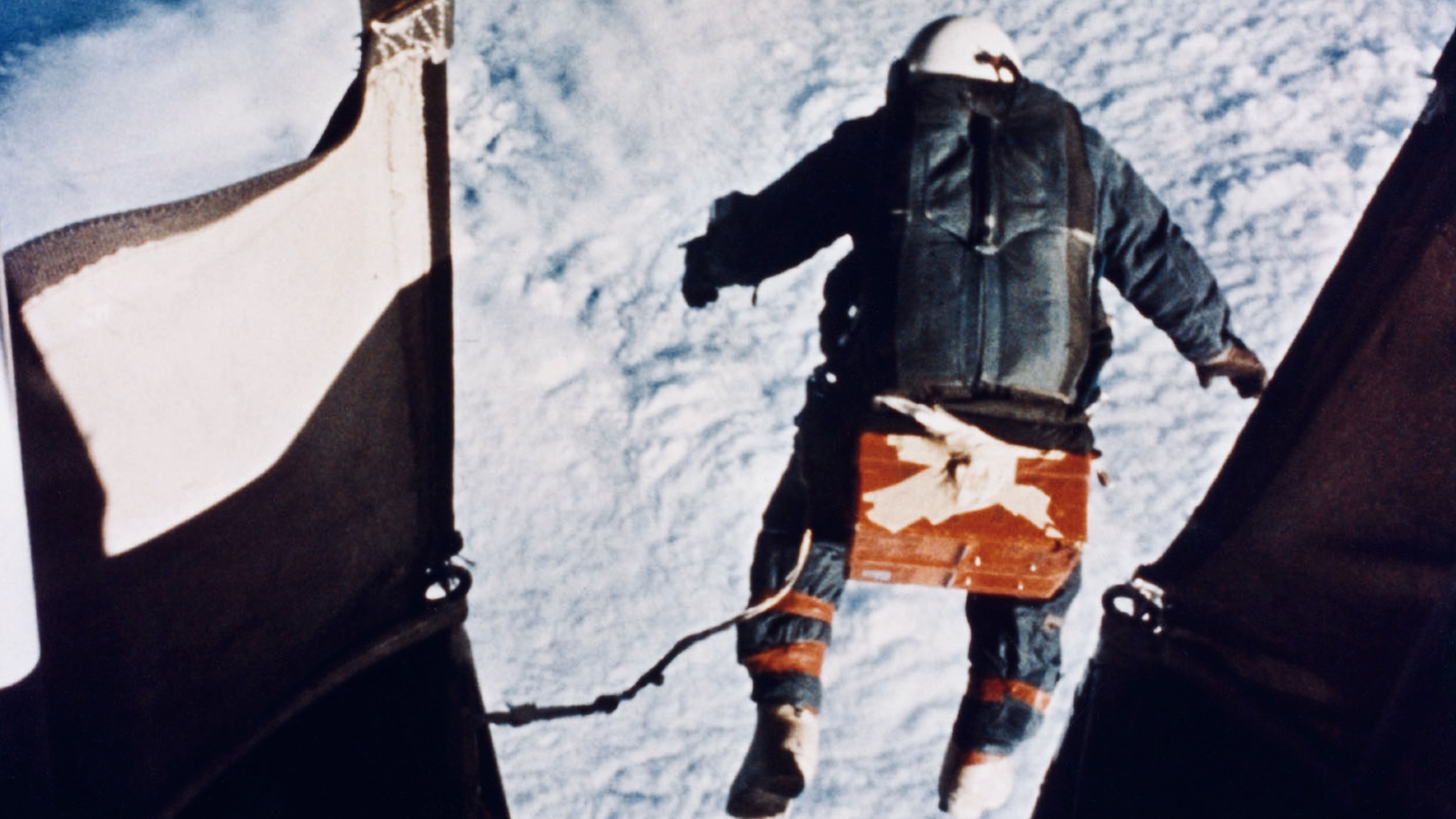
1960: Joseph Kittinger Leaps From the Stratosphere
From 102,800 feet above New Mexico, an Air Force test pilot stepped into near-space conditions to prove that humans could survive an emergency escape from extreme altitude.
On August 16, 1960, U.S. Air Force Captain Joseph Kittinger rose beneath a helium balloon to approximately 102,800 feet, more than 31 kilometres above New Mexico, and stepped from an open gondola into the stratosphere. His extraordinary descent was not designed primarily as a stunt or record attempt. It was the culmination of Project Excelsior, an Air Force research program intended to determine whether pilots could safely escape aircraft operating at extreme altitudes.
Kittinger fell for roughly four minutes and 36–38 seconds before the main phase of his parachute descent, establishing a benchmark that would endure for decades. More importantly, the mission provided practical evidence about pressure suits, stabilization parachutes and human survival in an environment increasingly relevant to high-altitude aviation and the emerging age of human spaceflight.
Kittinger and the Problem of Escaping at Extreme Altitude
Aircraft were climbing higher and flying faster during the 1950s, creating a dangerous problem. A pilot forced to abandon an aircraft at extreme altitude faced far more than an ordinary parachute jump.
The atmosphere provided little oxygen and almost no protection from extreme cold. Low atmospheric pressure could make survival impossible without specialized equipment. A falling person could also enter an uncontrolled flat spin, potentially reaching a rate severe enough to cause unconsciousness or death.
Project Excelsior was established to investigate these hazards and develop a workable high-altitude escape system. One of its central technologies was a multistage parachute arrangement designed by Francis F. Beaupre. A small stabilization parachute could control the falling pilot before the main parachute opened at a safer altitude.
The danger was demonstrated dramatically during Kittinger’s first Excelsior jump in November 1959. After jumping from about 76,400 feet, a parachute malfunction sent him into a violent spin estimated at approximately 120 revolutions per minute. Kittinger lost consciousness, but the automatic system deployed his main parachute and saved his life.
A second jump from 74,700 feet in December 1959 was successful. Excelsior III would push the experiment much higher.
On August 16, Kittinger ascended beneath a massive helium balloon in an open gondola. He wore a David Clark partial-pressure suit, insulating and electrically heated clothing, oxygen equipment and biomedical instrumentation. Above him was the balloon; beneath him was more than 30 kilometres of atmosphere.
At 102,800 feet, an automatic camera captured one of the defining photographs of early aerospace research: Kittinger stepping away from the gondola with Earth far below.
He was above more than 99 percent of Earth’s atmosphere.
Then he fell.
The stabilization system prevented the type of catastrophic spin experienced during his first Excelsior jump. Estimates of his maximum speed differ among historical and technical records depending on the measurement and calculation method. The National Museum of the U.S. Air Force gives a figure of about 614 mph, while a NASA account cites 714 mph. The Fédération Aéronautique Internationale’s historical record lists a maximum descent speed of about 990 km/h, or 615 mph.
After more than four and a half minutes of free fall, Kittinger’s parachute descent carried him safely to the New Mexico desert. His total descent lasted roughly 13 minutes and 45 seconds.
From Project Excelsior to the Space Age
The records attracted attention, but Project Excelsior’s greater significance was what the experiment demonstrated about human survival.
Kittinger had shown that a person equipped with appropriate pressure protection and a stabilization system could descend safely from an altitude where the atmosphere was dangerously thin. The work addressed both the physiological problems of high-altitude escape and the challenge of protecting humans in a space-like environment. Kittinger himself later discussed those two objectives in a 1962 presentation preserved in NASA’s technical archive.
The timing was significant. In 1960, the United States was preparing for human spaceflight while experimental aircraft such as the X-15 were pushing toward the edge of the atmosphere. NASA’s historical research into pressure suits identifies Project Excelsior as part of the broader development of technologies required to protect people at extreme altitude.
Kittinger’s work also followed his involvement with Project Manhigh, another Air Force high-altitude balloon program that investigated how humans and equipment would perform in near-space conditions. NASA later described findings from such research as helping lay groundwork for the American space program of the 1960s.
The 1960 jump remained the world’s most famous benchmark for high-altitude parachuting for more than half a century. On October 14, 2012, Austrian skydiver Felix Baumgartner jumped from 38,969.4 metres, about 127,852 feet, over New Mexico, setting FAI world records for exit altitude, free-fall distance without a drogue and maximum vertical speed without a drogue. Kittinger was part of Baumgartner’s team and served as a key communicator during the mission.
Two years later, Alan Eustace climbed even higher, jumping from more than 41 kilometres in 2014 and establishing another high-altitude benchmark.
Yet Kittinger’s leap remains distinct because its original purpose went beyond seeing how high or fast a person could fall. Project Excelsior was an aerospace safety experiment conducted at a moment when engineers were confronting an entirely new question: how to keep humans alive as aviation moved toward the boundary of space.
More than six decades later, the photograph of Kittinger stepping from his tiny gondola captures that transition. What appears to be one man falling toward Earth was also an experiment in how humans might survive when technology carried them higher than aircraft had routinely gone before.
About the Author Brad Socha is the founder of The Universal Record, focused on sourced, factual global reporting. Coverage includes international news, geopolitics, technology, and major developments.