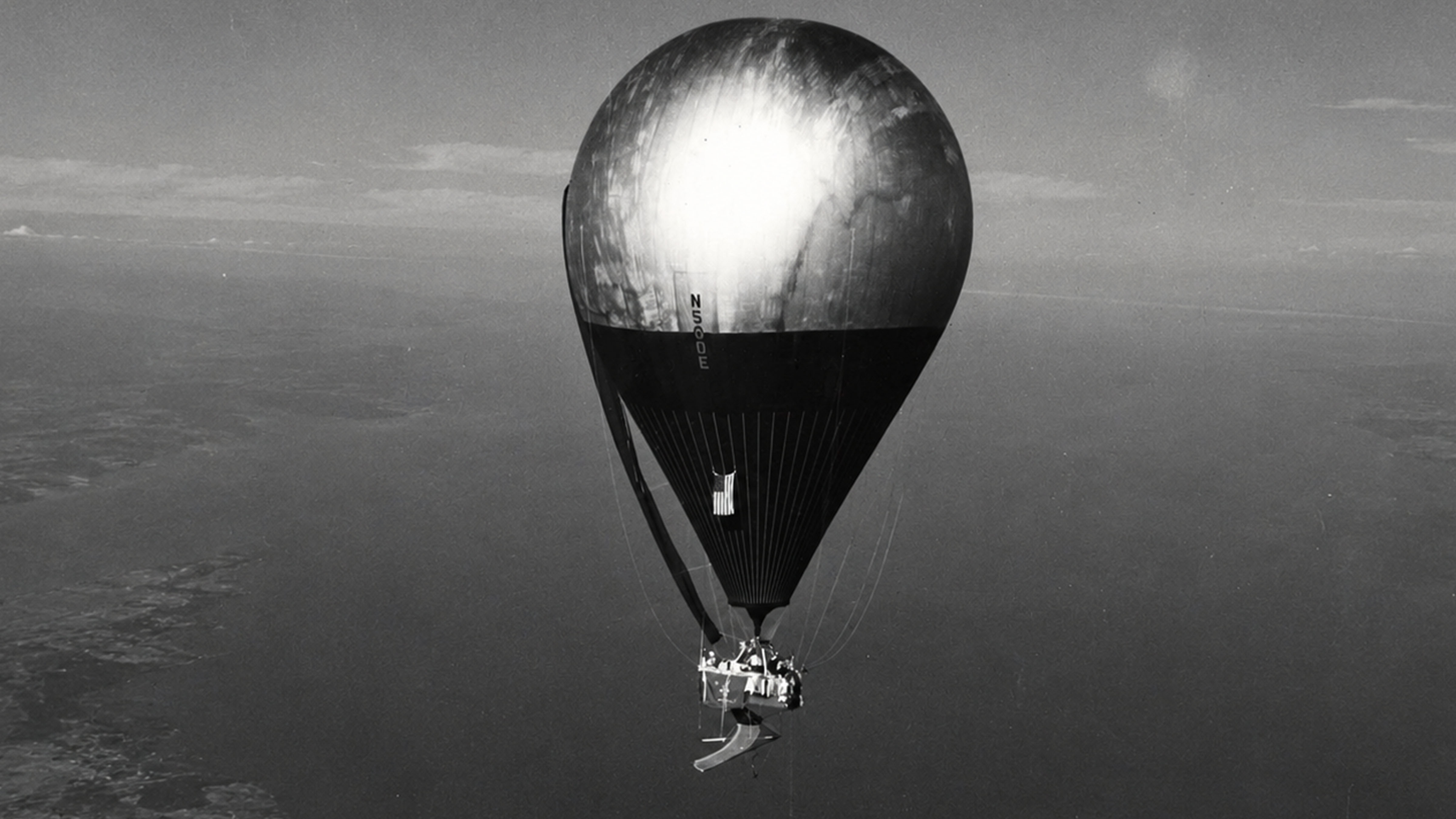
After 17 previous attempts had failed, three American balloonists crossed the Atlantic in a helium balloon, completing a 137-hour journey from Maine to France.
On August 17, 1978, Double Eagle II descended into a wheat field near Miserey, France, carrying Ben Abruzzo, Maxie Anderson and Larry Newman to the end of a journey aviators had pursued for generations. After 137 hours and six minutes in the air, the three Americans had completed the first successful transatlantic crossing by balloon, travelling roughly 5,000 kilometres from Presque Isle, Maine, to France.
The achievement came 195 years after the Montgolfier era opened human balloon flight in 1783 and decades after airplanes had conquered the Atlantic. Yet crossing the ocean in a free balloon remained an unusually difficult aviation challenge: there was no engine to drive the craft toward Europe and no conventional way to steer it. Success depended heavily on understanding and exploiting winds at different altitudes while keeping the balloon aloft for days.
The men aboard Double Eagle II were attempting something that had already cost lives. Before their successful flight, 17 transatlantic balloon attempts had failed and seven people had died.
Double Eagle II Takes to the Atlantic
Abruzzo and Anderson already knew how quickly the Atlantic could defeat a balloon expedition. In September 1977, they attempted the crossing aboard the original Double Eagle, only to be forced down by bad weather off Iceland. They survived and began planning another attempt.
For the second mission they were joined by Newman, an experienced hang-glider pilot and manufacturer. Their new helium balloon was built by pioneering balloonist Ed Yost, who had attempted an Atlantic crossing himself in 1976.
Double Eagle II stood about 112 feet high and 65 feet in diameter, with an envelope capable of holding approximately 160,000 cubic feet of helium. Suspended below it was a gondola measuring roughly 15 feet long, seven feet wide and four-and-a-half feet high. Named The Spirit of Albuquerque, the gondola incorporated a catamaran-style hull intended to keep the crew afloat if they were forced to land on the ocean. Navigation computers and radio equipment connected the balloonists with monitoring stations on the ground.
At 8:42 p.m. on August 11, 1978, the balloon lifted away from Presque Isle in northern Maine. Ahead lay thousands of kilometres of ocean and nearly six days of flight.
The crew could not simply point the balloon toward France. Gas balloons move with the surrounding air, so altitude became an essential part of navigation. By climbing or descending into different layers of wind, the balloonists could seek currents moving in more favourable directions.
Temperature added another complication. Helium expanded as sunlight warmed the balloon and contracted as temperatures fell, producing significant changes in altitude. Ice could also accumulate on the balloon during cold periods, adding weight. Managing gas, ballast, altitude and weather became a continuous exercise in keeping the aircraft airborne while allowing atmospheric currents to carry it eastward.
The gondola originally carried a hang glider that Newman had considered using for a separate descent near the end of the journey. Instead, the crew eventually discarded it to reduce weight and help keep Double Eagle II flying.
By the evening of August 16, the balloon had reached the Irish coast. The Atlantic had finally been crossed by balloon.
But the flight was not over.
A 137-Hour Flight Into Aviation History
Double Eagle II continued over Europe and ultimately approached France. On August 17, Abruzzo, Anderson and Newman brought their balloon down safely in a wheat field near Miserey, approximately 60 miles, about 97 kilometres, northwest of Paris.
Their total flight time was 137 hours and six minutes, or more than five and a half days. The Smithsonian gives the journey as approximately 3,100 miles, while another National Air and Space Museum account calculates the distance at 5,021 kilometres, or 3,120 miles. The small difference reflects differing measurements of the flight path rather than disagreement about the achievement itself.
The landing ended a challenge that had attracted serious attempts for more than a century. The Smithsonian traces an early effort to 1873, when American Civil War balloonist John Wise attempted an Atlantic crossing sponsored by the Daily Graphic. His balloon was forced down by a storm over the Catskills before reaching the ocean.
The dream persisted even after powered aircraft made transatlantic flight practical. Charles Lindbergh’s solo New York-to-Paris airplane flight in 1927 demonstrated what aviation technology could accomplish, but balloonists faced a fundamentally different challenge. Their aircraft remained dependent on atmospheric currents rather than propulsion.
Double Eagle II demonstrated that those currents could be used successfully across an entire ocean.
The flight also helped usher in another period of ambitious long-distance ballooning. In 1984, Joseph Kittinger became the first person to cross the Atlantic alone in a balloon. Other balloonists subsequently pursued faster transatlantic flights and eventually global circumnavigation.
The physical legacy of the 1978 crossing survives as well. The Double Eagle II gondola entered the Smithsonian’s National Air and Space Museum collection in 1979, preserving the craft that carried Abruzzo, Anderson and Newman across the Atlantic.
Nearly half a century later, the achievement also retains a direct connection to modern balloon exploration. In June 2026, the crewed hydrogen balloon Atlantic Explorer departed from Presque Isle for another Atlantic crossing. The World Air Sports Federation reported that pilot and balloon builder Bert Padelt had been inspired by Double Eagle II as a boy.
The technology has evolved, but the fundamental challenge remains recognizable: a small crew suspended beneath an enormous envelope of lifting gas, navigating not by commanding the atmosphere but by learning how to travel within it.
For Abruzzo, Anderson and Newman, that method carried them from a field in Maine to another field in France, and completed one of aviation’s longest-unfinished journeys.
About the Author Brad Socha is the founder of The Universal Record, focused on sourced, factual global reporting. Coverage includes international news, geopolitics, technology, and major developments.