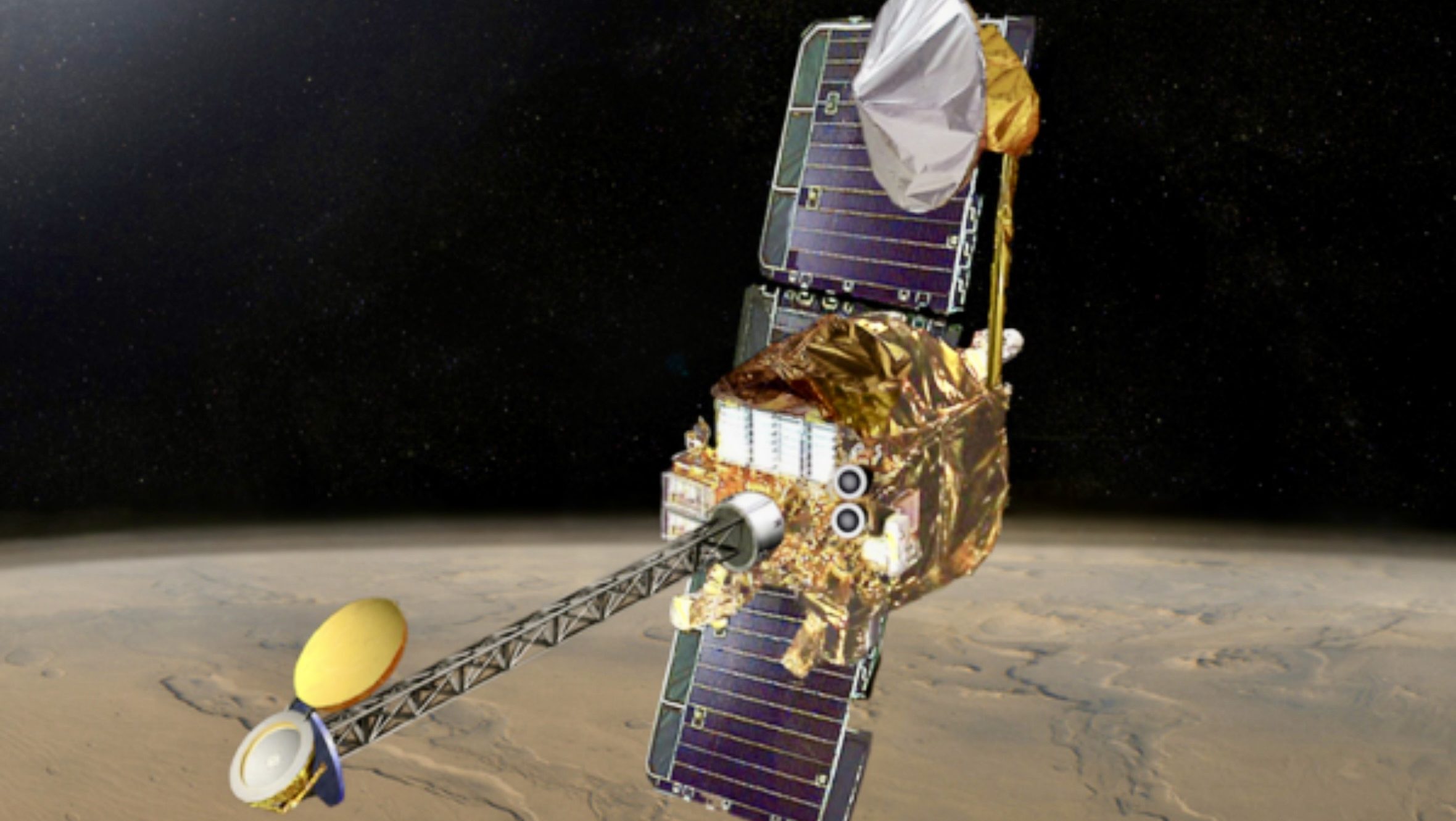
On April 7, 2001, NASA launched the 2001 Mars Odyssey spacecraft, initiating a mission to study the Martian surface, climate, and radiation environment. The spacecraft was launched aboard a Delta II rocket from Cape Canaveral Air Force Station in Florida.
Mars Odyssey was designed to map the distribution of chemical elements and minerals on the planet’s surface, with a particular focus on detecting hydrogen, which could indicate the presence of water or ice beneath the surface. The mission also aimed to measure radiation levels to better understand the potential risks for future human exploration.
After a journey of approximately six months, the spacecraft entered orbit around Mars in October 2001. Once in orbit, it began transmitting detailed data back to Earth using a suite of scientific instruments, including a gamma ray spectrometer, a thermal emission imaging system, and a radiation detector.
One of the mission’s most significant discoveries was the detection of large amounts of hydrogen in the planet’s polar regions, providing strong evidence for the existence of water ice just below the surface. This finding has been considered a key milestone in understanding Mars’ geological history and its potential to support life, past or present.
In addition to its scientific contributions, Mars Odyssey has played an important role as a communications relay for other Mars missions, supporting landers and rovers by transmitting data back to Earth.
Originally planned as a shorter mission, Mars Odyssey has remained operational for more than two decades, making it one of the longest-serving spacecraft in Mars orbit. Its continued functionality has provided valuable long-term data on seasonal changes and environmental conditions on the planet.
The mission remains a cornerstone of ongoing exploration efforts, contributing to future planning for both robotic and potential human missions to Mars.
About the Author Brad Socha is the founder of The Universal Record, focused on sourced, factual global reporting. Coverage includes international news, geopolitics, technology, and major developments.