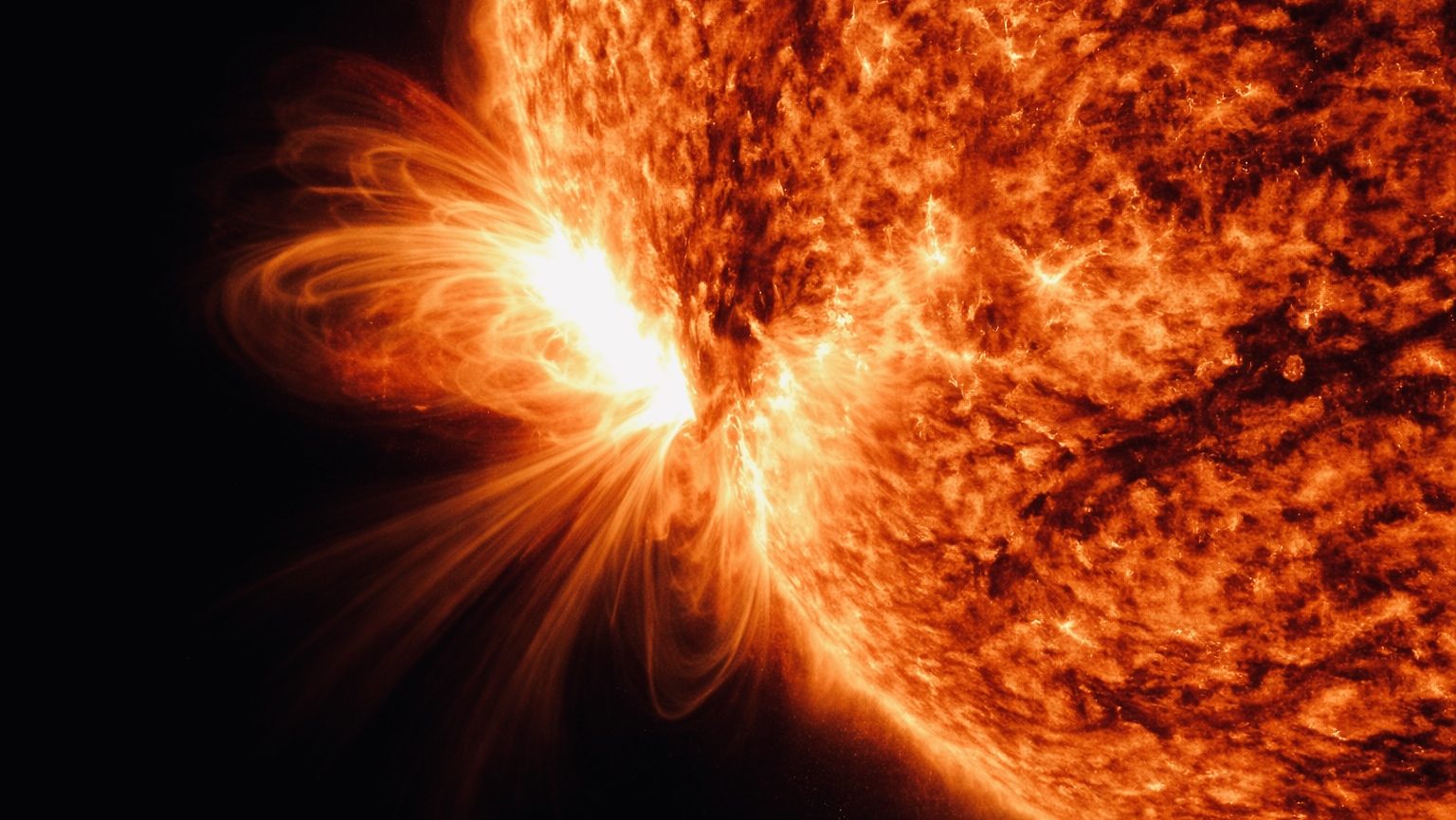
Recent solar observations indicate that the Sun is entering one of the most active phases of its current cycle, with its magnetic poles undergoing a reversal — a natural but powerful process that occurs approximately every 11 years. This phase, known as solar maximum, is associated with increased solar activity, including more frequent sunspots, solar flares, and coronal mass ejections.
The Sun’s magnetic field is far more dynamic than Earth’s and periodically flips its polarity as part of its natural cycle. This reversal is not an instant event but a gradual transition that occurs over months to years, during which the Sun’s magnetic field becomes more complex and unstable.
Current observations suggest that this reversal has recently occurred or is in its final stages, placing the Sun firmly in its peak activity period. During this time, the number of solar eruptions increases significantly, releasing bursts of radiation and charged particles into space.
Increased Solar Activity and Space Weather
As the Sun reaches solar maximum, its surface becomes more active, producing powerful solar flares and coronal mass ejections. These events can send streams of charged particles toward Earth, interacting with our planet’s magnetic field.
Recent activity has already produced strong solar flares and geomagnetic disturbances, with some events triggering radio disruptions and increased aurora activity.
These solar storms can have measurable effects on modern technology, including:
Temporary disruptions to radio communications
Interference with GPS and navigation systems
Increased risk to satellites and spacecraft
Potential stress on electrical power grids
While most solar events are relatively minor, stronger eruptions have the potential to cause more significant technological impacts.
Does the Sun’s Pole Reversal Affect Earth Directly?
Despite the dramatic nature of the Sun’s magnetic pole reversal, scientists emphasize that this process does not pose a direct threat to life on Earth. The reversal is a regular and well-understood part of the solar cycle.
Earth’s magnetic field acts as a protective shield, deflecting most harmful solar radiation and charged particles. While solar storms can interact with this field, causing geomagnetic disturbances, they do not lead to catastrophic effects under normal conditions.
The most visible impact of increased solar activity is the expansion of auroras, which can be seen at lower latitudes during strong geomagnetic storms.
Earth’s Magnetic Poles: A Different Process
The discussion of magnetic pole reversals often leads to confusion between the Sun and Earth. While the Sun’s poles flip every ~11 years, Earth’s magnetic poles reverse far less frequently and follow a completely different process.
Geological evidence shows that Earth’s magnetic poles have reversed many times over millions of years. However, these reversals occur over extremely long periods, often taking thousands to tens of thousands of years to complete.
Current scientific understanding indicates that Earth is not undergoing an imminent magnetic pole reversal, even though its magnetic field is constantly shifting and evolving.
Why This Matters Now
The current phase of heightened solar activity is drawing increased attention due to modern technological dependence. Unlike previous centuries, today’s world relies heavily on satellites, communication networks, and electrical infrastructure, all of which can be affected by space weather.
Scientists are closely monitoring solar conditions to improve forecasting models and better predict potential impacts on Earth-based systems. Missions studying the Sun’s poles and magnetic behaviour are helping refine our understanding of how these cycles evolve.
A Natural Cycle with Global Implications
The Sun’s magnetic pole reversal is a normal and recurring event, but its effects are more noticeable in a technologically advanced world. While it does not pose a direct danger to humanity, it plays a critical role in driving space weather that can influence modern infrastructure.
As solar activity remains elevated through this phase of the cycle, continued monitoring and preparedness will be essential in managing the potential impacts on communication systems, energy networks, and global technology.
About the Author Brad Socha is the founder of The Universal Record, an independent platform dedicated to sourced, factual reporting on global events. The publication focuses on delivering verified information without opinion or editorial bias. Based in Canada, the publication covers international news, geopolitics, technology, and global developments.



Leave a Reply