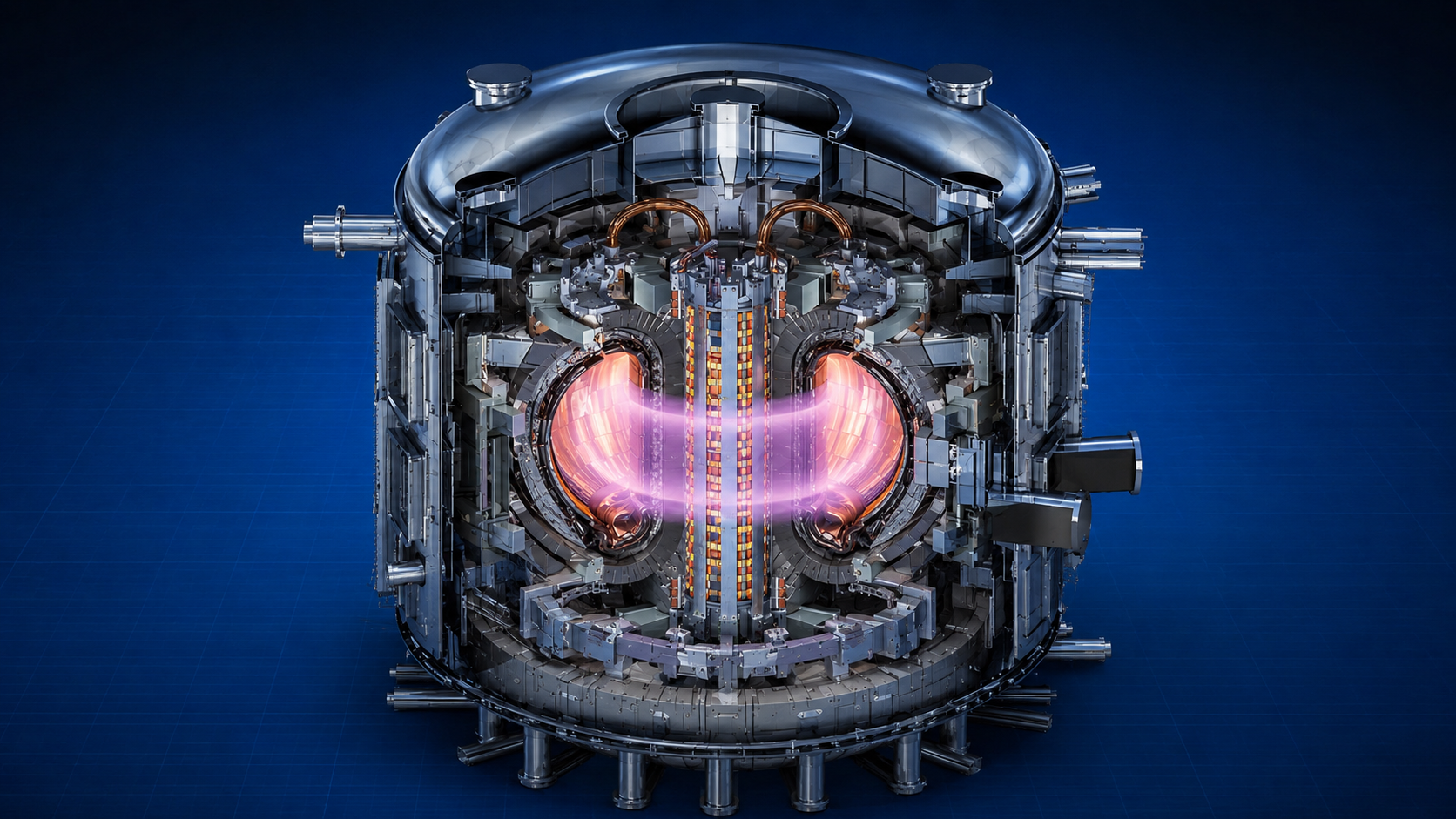
Fusion has moved from theory to repeated laboratory breakthroughs, but turning the reaction that powers the Sun into dependable electricity remains one of engineering’s hardest challenges.
Nuclear fusion is closer to becoming an energy source than at any previous point in its history, but it is not yet ready to power homes, factories, or data centres. Laboratories have repeatedly produced fusion reactions, private companies are constructing ambitious demonstration machines, and governments are investing heavily in technologies that could eventually deliver large amounts of low-carbon electricity. The remaining challenge is no longer proving that fusion can happen. It is making the process efficient, reliable, affordable, and durable enough to operate as a commercial power plant.
Fusion is often described as a source of “unlimited energy.” The phrase captures the enormous potential of its fuels, but it should not be interpreted literally. Fusion plants would still require costly infrastructure, specialized materials, fuel production systems, maintenance, and access to resources such as lithium and deuterium. What fusion could offer is an abundant source of electricity without burning fossil fuels and without the same long-lived radioactive waste profile associated with conventional nuclear fission.
How Fusion Works, and Why Net Energy Matters
Today’s nuclear power plants use fission, which releases energy by splitting heavy atoms such as uranium. A controlled chain reaction produces heat, which boils water and drives turbines.
Fusion works in the opposite direction. It joins light atomic nuclei together, releasing energy because the resulting nucleus has slightly less mass than the particles that formed it. That missing mass is converted into energy according to Albert Einstein’s relationship between mass and energy.
The Sun produces energy through fusion under immense gravitational pressure. Deep in its core, temperatures reach roughly 15 million degrees Celsius, allowing hydrogen nuclei to combine through a series of reactions that ultimately produce helium.
Earth-based reactors cannot reproduce the Sun’s gravity. Instead, most experimental systems heat fuel to temperatures exceeding 100 million degrees Celsius, creating an electrically charged gas called plasma. Researchers commonly use the hydrogen isotopes deuterium and tritium because they fuse more readily than ordinary hydrogen under achievable laboratory conditions.
One leading approach uses a tokamak, a doughnut-shaped chamber surrounded by powerful magnets. The magnetic field holds the plasma away from the reactor walls while heating systems raise it to fusion conditions. ITER, the multinational experimental reactor under construction in southern France, is the largest tokamak project in the world. Its participating members include China, the European Union, India, Japan, South Korea, Russia, and the United States.
Under ITER’s updated schedule, research operations are expected to build toward deuterium-tritium experiments beginning around 2039. ITER is designed to produce 500 megawatts of fusion heat from 50 megawatts of external plasma-heating power, a scientific gain of ten. It will not generate electricity for the grid; its purpose is to demonstrate the integrated technologies needed for future power plants.
China is also advancing magnetic-confinement research. In January 2025, the Experimental Advanced Superconducting Tokamak, known as EAST, maintained high-confinement plasma for 1,066 seconds. Long-duration plasma control is essential because commercial reactors must operate steadily rather than produce brief experimental bursts.
The other major method is inertial-confinement fusion. At Lawrence Livermore National Laboratory’s National Ignition Facility in California, 192 laser beams strike a tiny fuel capsule, compressing it rapidly enough to trigger fusion.
NIF first achieved ignition in December 2022, when the fusion reaction released more energy than the laser energy delivered to the target. An April 2025 experiment produced a record 8.6 megajoules from 2.08 megajoules of laser energy reaching the capsule, a target gain greater than four.
That milestone was scientifically significant, but it did not represent a power plant producing net electricity. The laser facility required far more electrical energy to operate than the fusion target released. A commercial laser-fusion plant would also need highly efficient lasers, inexpensive targets, rapid firing, heat-recovery equipment, and systems capable of repeating the reaction several times per second.
This distinction is central to the fusion debate. Scientific net gain means the fusion fuel releases more energy than is delivered directly to it. Engineering net gain requires the entire facility to produce more usable energy than it consumes. Commercial viability goes further, requiring that electricity be generated reliably and at a competitive cost.
The Race Toward Commercial Power
Private investment has accelerated alongside government research.
Commonwealth Fusion Systems is building the SPARC tokamak in Massachusetts using high-temperature superconducting magnets designed to create stronger magnetic fields in a smaller machine. The company says SPARC operations are expected to begin in 2027, with the goal of demonstrating net fusion energy before developing a power plant called ARC.
Helion Energy is pursuing a different pulsed magnetic system intended to convert fusion energy directly into electricity. In 2026, the company reported that its Polaris prototype had produced measurable deuterium-tritium fusion and reached plasma temperatures of 150 million degrees Celsius. Helion has also received state-level radioactive-material licences related to its planned power plant in Washington. These are important steps, although independent confirmation of commercial net electricity will be necessary before its broader claims can be fully evaluated.
Other major programs include the United Kingdom’s STEP prototype, planned for the former West Burton power station site and targeting operation in the 2040s; Japan’s JT-60SA research tokamak; South Korea’s KSTAR; Germany’s Wendelstein 7-X stellarator; Canada-based General Fusion; and American companies including TAE Technologies and Zap Energy.
The U.S. Department of Energy has set a policy objective of supporting commercial fusion power by the mid-2030s. That target reflects increasing urgency and investment, not a guaranteed delivery date. Large public programs point toward the late 2030s and 2040s for major demonstrations, while several private developers promise earlier results.
Significant obstacles remain. Reactor materials must withstand intense neutron bombardment without rapidly weakening. Tritium is scarce and would likely need to be bred inside power plants using lithium. Engineers must control unstable plasma, remove extreme heat, maintain complex magnets, and replace damaged internal components remotely.
Fusion does offer important safety advantages. The reaction cannot continue without precisely maintained conditions, so it does not create the same kind of runaway chain reaction possible in a fission reactor. Fusion plants would not produce high-level spent fuel in the same form as conventional nuclear power stations.
They would still generate radioactive material. High-energy neutrons can activate structural components, and tritium must be carefully contained. Much of this waste is expected to be shorter-lived than spent fission fuel, but managing activated materials will remain a substantial engineering and regulatory responsibility.
Fusion is therefore neither an illusion nor an imminent miracle. The science has advanced dramatically, and repeated ignition, stronger magnets, longer plasma experiments, and growing private investment have changed the field. Yet no fusion facility has produced sustained, commercially useful electricity.
The most realistic outlook is that demonstration plants may emerge during the 2030s or 2040s, followed by gradual commercial deployment if they prove reliable and economical. Fusion may eventually become an important part of the global energy system, but it will complement other energy sources rather than instantly replace them.
About the Author Brad Socha is the founder of The Universal Record, focused on sourced, factual global reporting. Coverage includes international news, geopolitics, technology, and major developments.