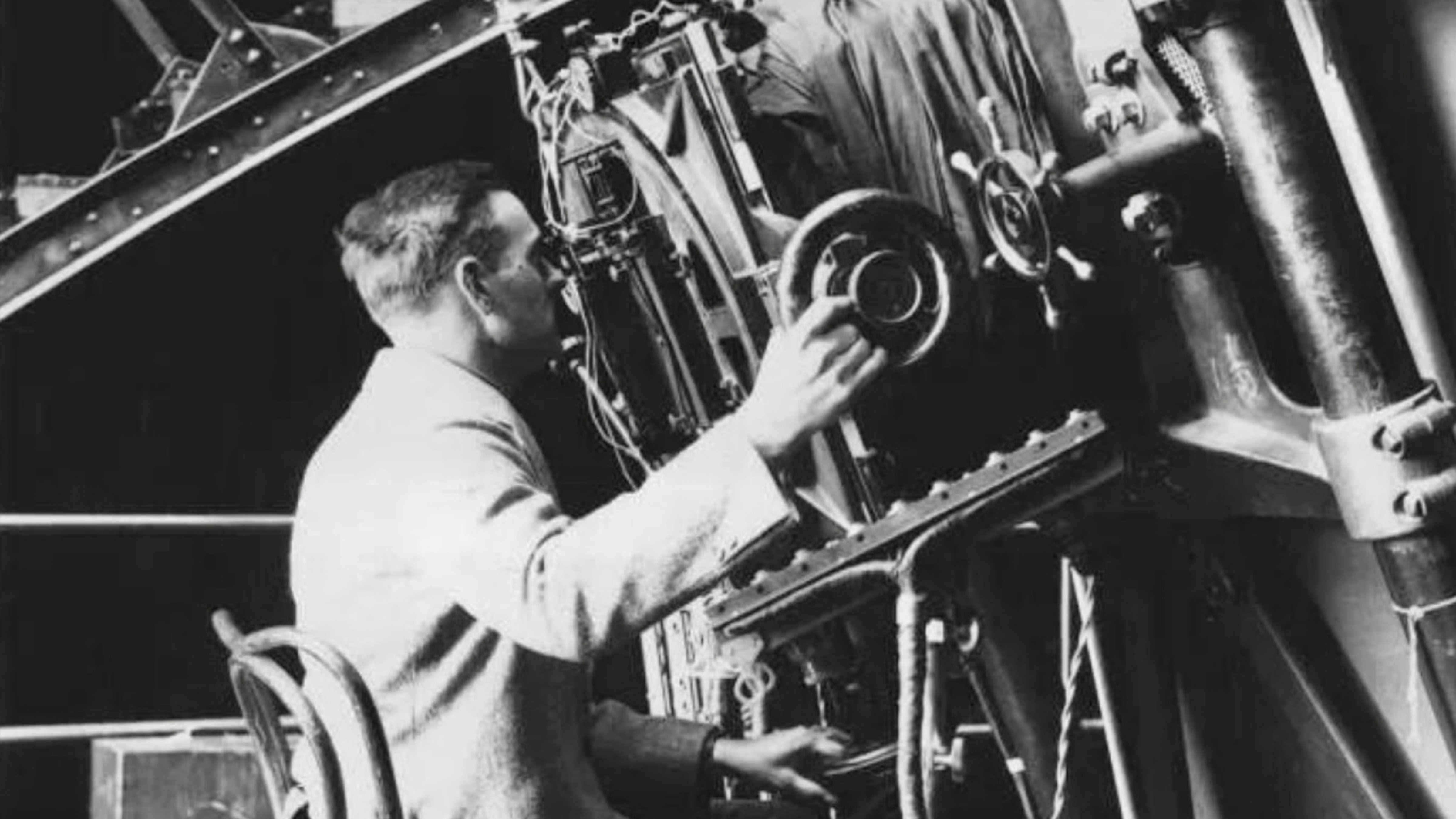
Born in Missouri, the future astronomer would help overturn long-held assumptions about the universe and transform humanity’s understanding of its place in space.
On November 20, 1889, Edwin Powell Hubble was born in Marshfield, Missouri. Decades later, his observations of distant stars and galaxies would fundamentally change astronomy, demonstrating that the Milky Way was not the entire universe and providing crucial evidence that space itself was expanding.
His discoveries helped establish modern observational cosmology, the scientific study of the universe’s structure, history, and evolution.
At the time of his birth, astronomers had no reliable measurement of the distances separating our galaxy from the many faint, cloudlike objects visible through telescopes. Some believed these objects were contained within the Milky Way, while others suspected they were independent systems of stars.
Hubble would help resolve that question using one of the most powerful telescopes of his era.
From Missouri to Mount Wilson
Hubble grew up in a family that moved to the Chicago area during his childhood. He excelled in athletics and developed an interest in mathematics and science.
He attended the University of Chicago, graduating in 1910, before travelling to Oxford University as a Rhodes Scholar. There, he studied law, partly in response to his father’s expectations.
Despite his legal education, Hubble eventually returned to astronomy. He completed his doctorate at the University of Chicago in 1917, the same year the United States entered the First World War.
After military service, he joined Mount Wilson Observatory in California in 1919.
The observatory housed the 100-inch Hooker Telescope, which was then the world’s largest operational telescope. Its ability to collect light from extremely faint objects gave astronomers unprecedented opportunities to investigate the distant universe.
One of the greatest questions concerned spiral nebulae, mysterious objects whose appearance suggested enormous rotating structures.
In 1920, astronomers Harlow Shapley and Heber Curtis had publicly debated the scale of the universe and the nature of these objects. Their disagreement reflected the limitations of existing astronomical measurements.
Hubble’s observations would soon provide decisive new evidence.
In 1923, while examining photographic plates of the Andromeda Nebula, Hubble identified a Cepheid variable star.
These stars periodically brighten and dim. Their importance had been established through the work of American astronomer Henrietta Swan Leavitt, who discovered a relationship between a Cepheid’s pulsation period and its intrinsic brightness.
By comparing a star’s intrinsic brightness with how bright it appears from Earth, astronomers can estimate its distance.
Hubble applied this method to stars in Andromeda and found that the object lay far beyond the known boundaries of the Milky Way.
Andromeda was not simply a cloud of material within our galaxy. It was a separate galaxy containing an enormous population of stars.
His findings, presented to the astronomical community in 1925, helped settle a major debate.
The universe was vastly larger than many astronomers had previously believed.
Hubble and the Expanding Universe
Hubble’s next major contribution concerned the movement of galaxies.
Astronomers had already observed that light from many distant galaxies was shifted toward longer, redder wavelengths. This phenomenon, known as redshift, could be used to investigate their apparent motion.
American astronomer Vesto Slipher had conducted pioneering measurements of these shifts beginning in the 1910s, providing important evidence that many spiral nebulae were moving away from Earth.
Meanwhile, theoretical physicists were exploring whether the universe could be expanding.
Alexander Friedmann developed mathematical models of a changing universe during the 1920s. Belgian physicist and priest Georges Lemaître independently proposed an expanding universe and published a relationship between galactic distances and recession velocities in 1927.
Hubble’s contribution was to strengthen the observational evidence.
In 1929, he published a study comparing the estimated distances of galaxies with their apparent recession velocities, drawing on earlier measurements by Slipher and other astronomers.
The results revealed a relationship: galaxies at greater distances generally appeared to be receding faster than nearby galaxies.
This became known as the velocity-distance relation, commonly called Hubble’s law and also recognized today as the Hubble–Lemaître law.
The finding provided powerful observational support for the idea that the universe was expanding.
It did not mean that Earth occupied a special central position. Rather, modern cosmology interprets the large-scale pattern as the expansion of space between distant galaxies.
Hubble continued working with astronomer Milton Humason, whose measurements helped extend the relationship to increasingly distant galaxies.
Their research established an important foundation for understanding cosmic expansion, although the earliest estimates of its rate were considerably higher than modern measurements.
Hubble also developed a system for classifying galaxies according to their visible shapes, including elliptical, spiral, and barred spiral galaxies.
That framework, often represented by the Hubble tuning-fork diagram, remains historically important in astronomy.
The expanding-universe evidence would eventually become central to the development of Big Bang cosmology, which describes the evolution of the universe from an earlier hot, dense state.
Hubble did not develop that theory alone, and his discoveries depended on decades of observational and theoretical work by other scientists.
Nevertheless, his research played a major role in transforming cosmology from a field dominated by competing assumptions into one increasingly guided by measurable evidence.
Hubble died on September 28, 1953, in San Marino, California, at the age of 63.
His scientific legacy continued long after his death.
In 1990, NASA and the European Space Agency launched the Hubble Space Telescope, named in recognition of his contributions to astronomy.
Operating above Earth’s atmosphere, the telescope has observed distant galaxies, studied stellar evolution, and helped refine measurements of the universe’s expansion rate.
Its observations have also contributed to research showing that cosmic expansion is accelerating, raising further questions about the nature of dark energy.
More than a century after Hubble’s birth, astronomers continue investigating the same fundamental questions that shaped his career: how large the universe is, how it developed, and how it may change in the future.
His work helped establish that the Milky Way is only one galaxy among countless others, permanently expanding humanity’s understanding of the cosmos.
About the Author Brad Socha is the founder of The Universal Record, focused on sourced, factual global reporting. Coverage includes international news, geopolitics, technology, and major developments.