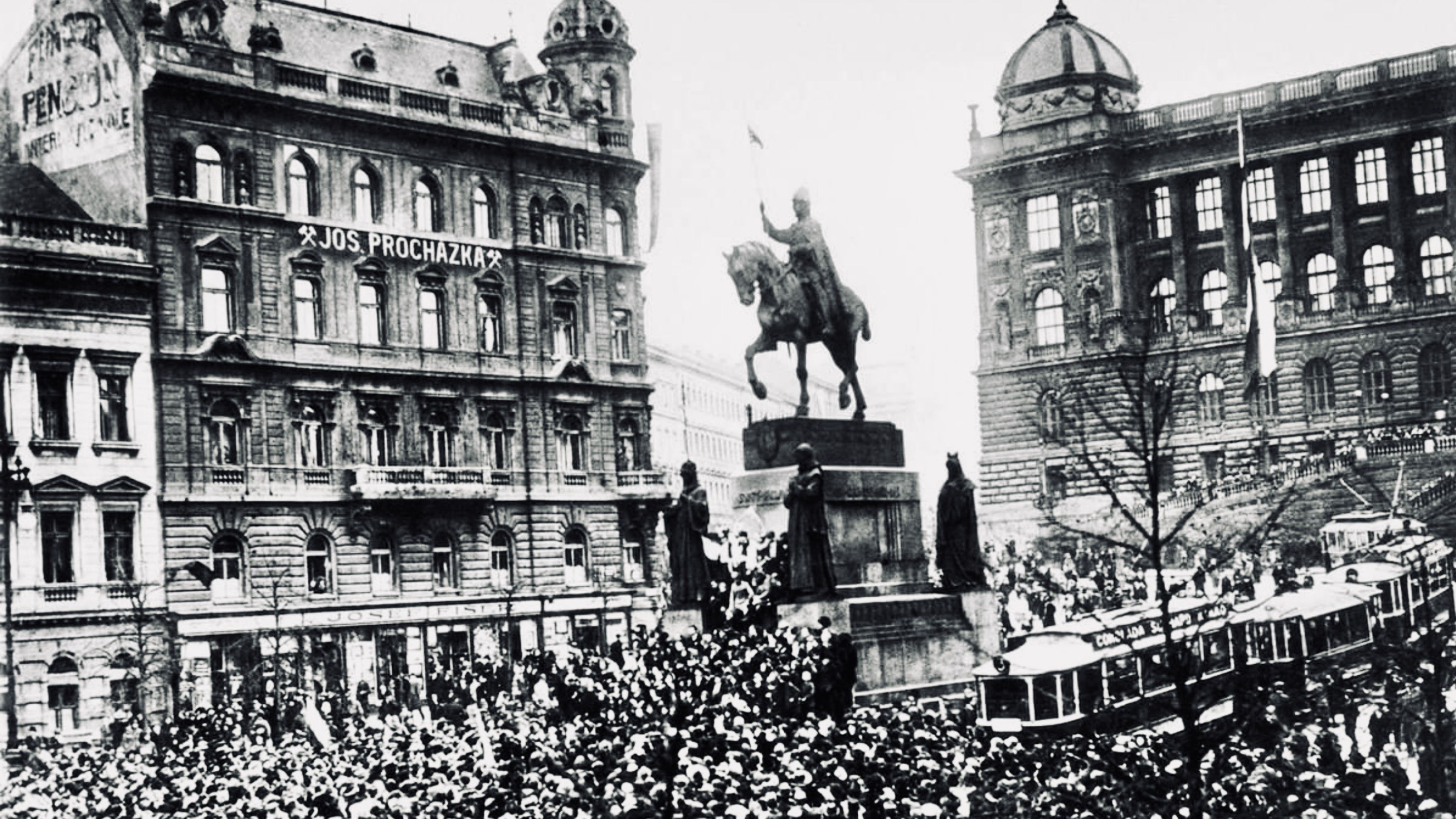
As Austria-Hungary collapsed near the end of World War I, Czech and Slovak leaders established a new republic whose creation would reshape Central Europe.
On October 28, 1918, Czechoslovakia declared independence from Austria-Hungary, bringing together Czech and Slovak lands in a new state as the First World War approached its end. The declaration in Prague marked the collapse of centuries of Habsburg rule over the Czech lands and the beginning of a new political future for millions of people in Central Europe.
The republic emerged from a combination of wartime diplomacy, growing national movements and the disintegration of the Austro-Hungarian Empire. Its creation helped redraw Europe’s political map, although questions surrounding its borders and diverse population would shape much of its subsequent history.
October 28 remains a national holiday in the Czech Republic, commemorating the establishment of independent Czechoslovakia.
The Movement for Czechoslovakia
Before 1918, the territories that would form Czechoslovakia belonged to different parts of the Habsburg monarchy.
Bohemia, Moravia and Austrian Silesia were administered within the Austrian half of Austria-Hungary, while Slovakia formed part of the Kingdom of Hungary. Their populations shared important linguistic and cultural connections, but they had developed under different political and administrative systems.
During the nineteenth century, Czech and Slovak national movements increasingly sought greater recognition and political rights.
The outbreak of World War I in 1914 transformed these ambitions. As the conflict continued, political figures began advocating independence rather than reform within the empire.
Tomáš Garrigue Masaryk, a Czech philosopher and politician, became the leading international advocate of an independent Czechoslovak state.
Working alongside Edvard Beneš and Slovak political leader Milan Rastislav Štefánik, Masaryk helped organize an independence movement abroad.
Their efforts gained support through diplomatic negotiations with the Allied powers and the activities of the Czechoslovak Legions, military formations composed largely of Czech and Slovak volunteers and prisoners of war who fought alongside Allied forces.
The legions operated in several theatres, including Russia, France and Italy. Their participation strengthened the independence movement’s claim that Czechs and Slovaks were contributing to the Allied war effort.
In May 1918, representatives of Czech and Slovak organizations in the United States signed the Pittsburgh Agreement, supporting the creation of a common state while envisaging autonomy for Slovakia.
The agreement reflected both the desire for political unity and the differences that would need to be addressed within the proposed republic.
By autumn, Austria-Hungary was approaching military defeat and political disintegration.
On October 18, Masaryk issued a declaration of independence in Washington on behalf of the Czechoslovak independence movement. It outlined principles for a democratic republic and rejected continued Habsburg rule.
Ten days later, events inside the empire provided the opportunity to establish the new state.
October 28: Independence in Prague
On October 28, 1918, news reached Prague that Austria-Hungary had accepted American President Woodrow Wilson’s conditions for negotiating an armistice.
Although the imperial government had not yet formally surrendered, the announcement was widely interpreted as evidence that the monarchy could no longer maintain its authority.
Crowds gathered in Prague, and members of the Czechoslovak National Committee moved to assume control of government institutions.
Five leading representatives of the independence movement, later remembered as the Men of October 28, played central roles in establishing the new administration.
They included Antonín Švehla, Alois Rašín, Jiří Stříbrný, František Soukup and Vavro Šrobár, the Slovak representative.
The National Committee issued the first law of the Czechoslovak state, declaring its establishment while temporarily retaining existing laws and administrative arrangements to preserve continuity.
This decision helped prevent an immediate breakdown in public administration as authority transferred from the imperial government.
The proclamation did not instantly settle the status of every territory claimed by the new republic.
On October 30, Slovak political representatives adopted the Martin Declaration, expressing support for the creation of a common Czechoslovak state and asserting the right of Slovaks to determine their political future.
The declaration strengthened the political basis for union, although not every Slovak community or political group had participated in the decision.
The new republic also encompassed substantial German-speaking, Hungarian, Ruthenian and other populations.
Many German-speaking inhabitants of the Czech borderlands opposed incorporation into Czechoslovakia and sought association with German Austria. Disputes over territory and national representation consequently emerged almost immediately.
The borders of the new state were subsequently addressed through the postwar peace settlements, particularly the Treaty of Saint-Germain in 1919 and the Treaty of Trianon in 1920.
Meanwhile, Czechoslovakia began constructing its national institutions.
On November 14, 1918, the Revolutionary National Assembly elected Masaryk as the republic’s first president.
The new government adopted a parliamentary system and developed into one of Central Europe’s more durable interwar democracies.
Yet the republic faced significant internal challenges, including differences in economic development, political representation and national identity.
The Czech lands were comparatively industrialized, while much of Slovakia remained predominantly agricultural. These contrasts complicated efforts to build a unified political and economic system.
Czechoslovakia’s independence also formed part of a broader transformation following World War I. The collapse of the Austro-Hungarian, German, Russian and Ottoman empires created new states and intensified debates over national self-determination.
The republic survived its early difficulties but faced increasing pressure during the 1930s.
The Munich Agreement of 1938 forced Czechoslovakia to surrender the Sudetenland to Nazi Germany. In March 1939, German occupation of the Czech lands and the establishment of a separate Slovak state ended the interwar republic.
Czechoslovakia was restored after World War II, but a communist takeover in 1948 placed it within the Soviet sphere of influence.
The Velvet Revolution of 1989 ended communist rule, reopening debates about the relationship between the Czech and Slovak nations.
On January 1, 1993, Czechoslovakia peacefully separated into two independent countries: the Czech Republic and Slovakia.
The state established in October 1918 no longer exists, but its legacy remains central to the histories of both countries.
Its founding demonstrated the possibilities created by the collapse of Europe’s multinational empires while also revealing the difficulties of translating national self-determination into stable borders and shared political institutions.
About the Author Brad Socha is the founder of The Universal Record, focused on sourced, factual global reporting. Coverage includes international news, geopolitics, technology, and major developments.