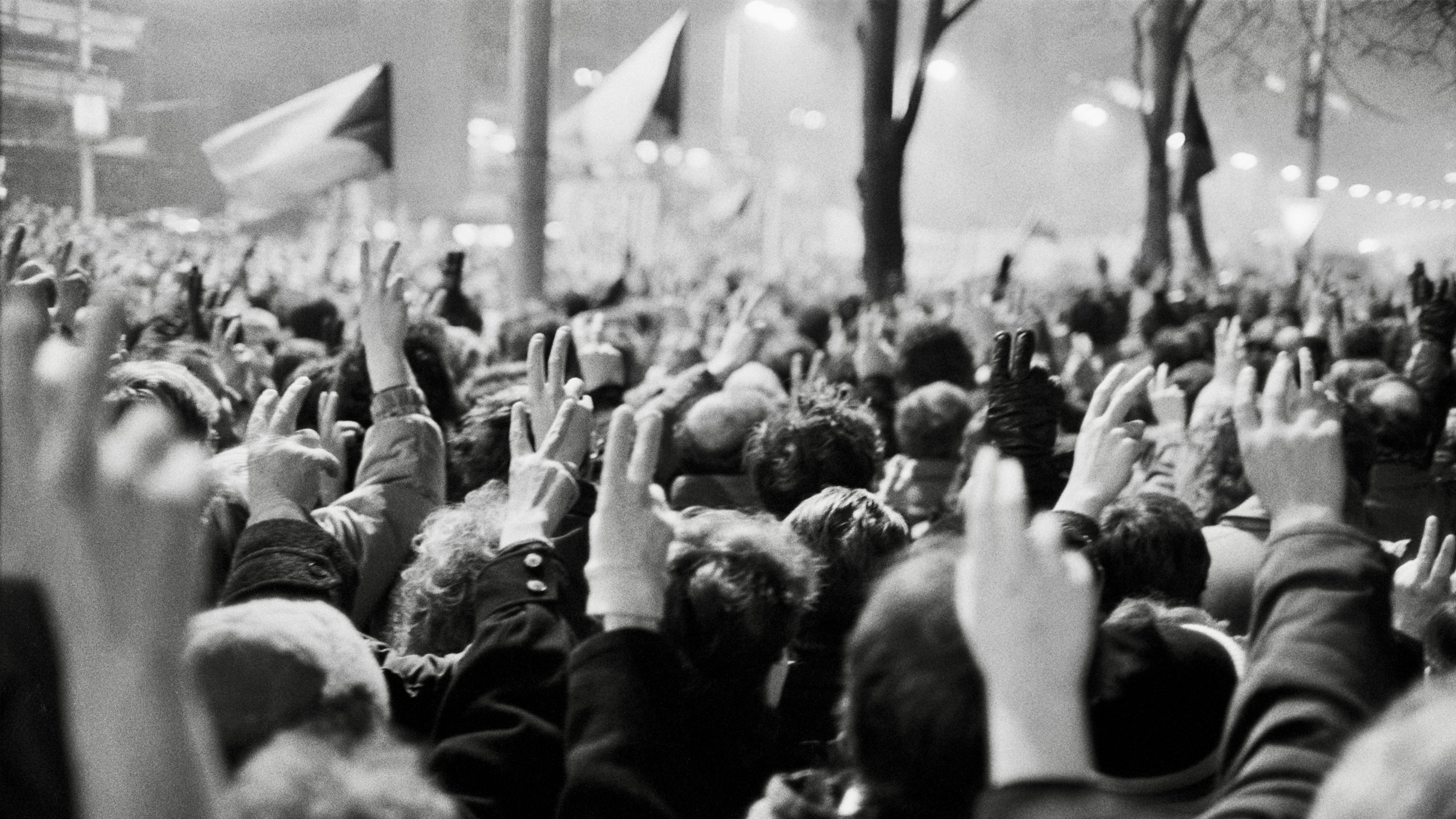
An unarmed student demonstration in Prague triggered a wave of public resistance that would transform Czechoslovakia and help reshape post-Cold War Europe.
Brad Socha | November 17, 2026 | 5:19 AM EST
On November 17, 1989, a peaceful student demonstration in Prague was violently suppressed by Czechoslovak police, setting in motion the Velvet Revolution. Within weeks, mass protests and negotiations would bring an end to more than four decades of Communist Party dominance in the country.
The events unfolded just eight days after the fall of the Berlin Wall, as communist governments across Central and Eastern Europe faced growing demands for political reform.
What began as a student commemoration became a nationwide movement involving workers, artists, intellectuals, and ordinary citizens. Its largely nonviolent character would give the revolution its enduring name.
The Student Protest That Sparked the Velvet Revolution
The demonstration on November 17 was originally organized to commemorate events from fifty years earlier, when Nazi authorities suppressed Czech student protests during the German occupation.
In November 1939, the Nazis executed nine student leaders, closed Czech universities, and sent more than a thousand students to concentration camps. Among those remembered was Jan Opletal, a medical student whose death following an earlier demonstration had become a symbol of resistance.
The anniversary carried particular significance in Czechoslovakia, where communist authorities had maintained political control since February 1948.
Although the government permitted the 1989 commemorative gathering, the demonstration developed into a broader expression of opposition to one-party rule.
Approximately 15,000 students initially assembled in Prague’s Albertov district before marching through the city.
As demonstrators moved toward central Prague, they began calling for political freedoms and democratic reforms.
Police eventually blocked the procession on Národní třída, one of the capital’s major streets.
Security forces surrounded sections of the crowd, preventing demonstrators from leaving. Riot police then used batons to disperse the gathering, injuring numerous participants.
The violence provoked widespread anger, particularly because the demonstration had been peaceful.
Reports also circulated that a student had been killed during the confrontation. The claim was later established to be false, but it contributed to the growing public outrage.
The authorities had intended to contain the demonstration. Instead, their response accelerated a political movement that would soon extend far beyond Prague’s universities.
From Public Protest to Political Change
Students and theatre workers began organizing strikes immediately after the police crackdown.
On November 19, opposition groups established Civic Forum, a broad coalition bringing together dissidents, intellectuals, students, and other critics of the communist government.
Playwright and human rights activist Václav Havel emerged as one of its leading representatives.
In Slovakia, the movement Public Against Violence developed alongside Civic Forum, reflecting the increasingly nationwide character of the protests.
Demonstrations expanded rapidly.
Prague’s Wenceslas Square became a central gathering place, where crowds demanded an investigation into police violence, political reforms, and the resignation of communist officials.
Protesters frequently jingled their keys, a symbolic gesture expressing their desire for the authorities to leave office.
By November 20, hundreds of thousands of people were participating in demonstrations in Prague. Public gatherings also spread to Bratislava and other cities.
The movement gained momentum as state-controlled media began providing greater coverage of the protests.
On November 24, Communist Party General Secretary Miloš Jakeš and other senior party leaders resigned.
The resignations marked a significant weakening of the government’s authority, but demonstrations continued.
Large crowds gathered at Prague’s Letná Plain on November 25 and 26, demanding further changes.
On November 27, millions of citizens participated in a two-hour general strike, demonstrating that opposition to the existing political system extended well beyond students and intellectuals.
The government increasingly faced the prospect of maintaining power without broad public support.
On November 28, communist officials agreed during negotiations with Civic Forum to relinquish the party’s guaranteed leading role in government.
The following day, Czechoslovakia’s Federal Assembly removed constitutional provisions establishing the Communist Party’s political monopoly.
The transition continued into December.
On December 10, President Gustáv Husák appointed a new government in which communists no longer held a majority of ministerial positions. He resigned later that day.
On December 29, the Federal Assembly elected Václav Havel president of Czechoslovakia.
A former political prisoner and prominent dissident had become the country’s head of state just six weeks after the first student demonstration.
The Velvet Revolution and Its Lasting Legacy
The name Velvet Revolution reflected the relatively peaceful transfer of political power, despite the police violence that triggered the protests.
Unlike some earlier confrontations between communist governments and reform movements in Eastern Europe, the events of November and December 1989 did not develop into a prolonged armed conflict.
The revolution formed part of a broader transformation across the region.
Communist governments had already lost power in Poland and Hungary, while East Germany was undergoing rapid political change following the opening of the Berlin Wall.
Czechoslovakia’s transition demonstrated how sustained public demonstrations, organized opposition, and political negotiations could dismantle an entrenched one-party system.
The changes also created new challenges.
The country began developing democratic institutions and moving toward a market economy, while confronting questions about its communist-era institutions and political accountability.
Free parliamentary elections followed in June 1990.
The transition also reopened discussions about relations between the country’s Czech and Slovak populations.
On January 1, 1993, Czechoslovakia peacefully separated into two independent states: the Czech Republic and Slovakia.
Both countries subsequently joined NATO and the European Union, although their paths toward membership followed different timelines.
Today, November 17 is commemorated in both countries as a national holiday associated with freedom, democracy, and the legacy of student resistance.
The date also connects the events of 1989 with the student protests against Nazi occupation in 1939.
The Velvet Revolution remains a defining episode in modern European history. Beginning with a police crackdown on unarmed students, it developed into a nationwide movement that ended communist one-party rule and opened a new political chapter for Czechoslovakia.
Feature Image: Demonstrators raise victory signs during the Velvet Revolution in Prague, November 1989. Photo: Robbie Morrison / Wikimedia Commons / CC BY 4.0. Cropped to 16:9. Licence: https://creativecommons.org/licenses/by/4.0/
About the Author Brad Socha is the founder of The Universal Record, focused on sourced, factual global reporting. Coverage includes international news, geopolitics, technology, and major developments.