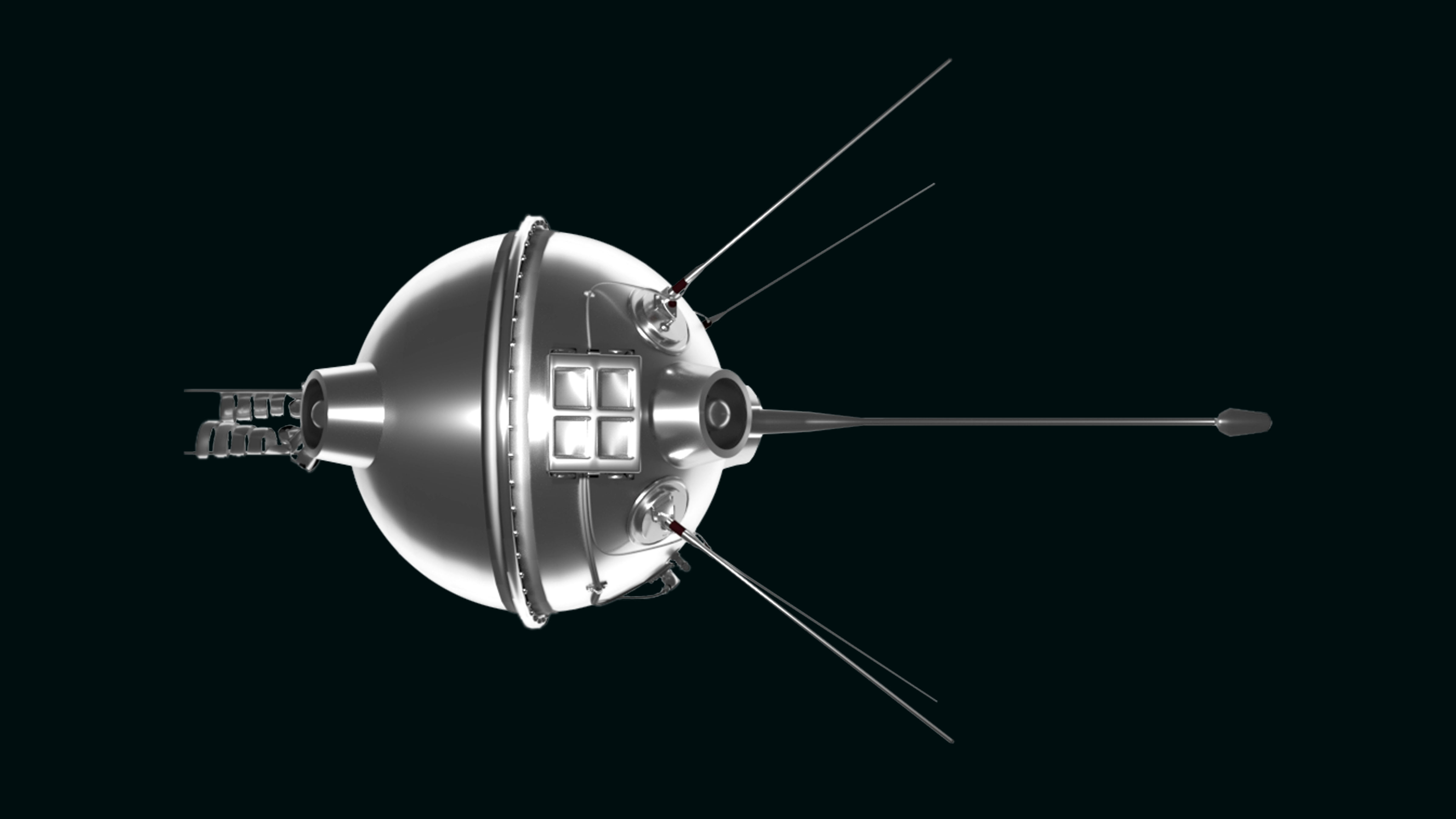
Late on September 13, 1959, by Universal Time, September 14 in Moscow, the Soviet spacecraft Luna 2 struck the Moon. The probe did not land intact and was never intended to return. Its mission ended on impact, but in doing so it crossed a boundary no human-made object had crossed before: something built on Earth had physically reached the surface of another celestial body.
The achievement came less than two years after Sputnik 1 opened the Space Age and during an increasingly intense technological rivalry between the Soviet Union and the United States. Both countries were attempting to extend spaceflight beyond Earth orbit, and the Moon became the first major destination.
Luna 2’s success also followed repeated failures. Reaching the Moon in 1959 required sending a spacecraft hundreds of thousands of kilometres through space with sufficient accuracy to intercept a moving target, at a time when orbital flight itself was still new.
The Race to Reach the Moon
The Soviet Union and United States began making serious lunar attempts in 1958. Several early spacecraft failed during launch or fell short of their intended trajectories.
The Soviets came close in January 1959 with Luna 1. Intended to strike the Moon, it missed by several thousand kilometres after its upper-stage burn placed it on the wrong trajectory. The mission nevertheless achieved another historic first: Luna 1 escaped Earth’s gravitational dominance and became the first spacecraft to enter orbit around the Sun.
The United States followed with Pioneer 4 in March. It passed the Moon at considerable distance and continued into a solar orbit, becoming the first American spacecraft to escape Earth.
The next Soviet attempt to reach the lunar surface failed during launch in June. Another opportunity came in September.
Luna 2 lifted off on September 12, 1959, aboard a modified R-7 rocket. The spacecraft was a roughly spherical probe similar to Luna 1 and carried instruments designed to investigate conditions in space, including radiation and magnetic fields.
During the journey, the rocket’s upper stage released a cloud of sodium gas that could be observed from Earth and helped scientists track the mission.
This time, the trajectory was on target.
NASA’s historical chronology records the impact at approximately 22:02 UTC on September 13. Because it was already after midnight in Moscow, Soviet announcements and some historical accounts date the achievement to September 14. This difference explains why both dates appear in authoritative records. NASA’s current deep-space chronology lists September 14 for the milestone.
The spacecraft struck the Moon in the region between Mare Imbrium and Mare Serenitatis. Its radio transmissions abruptly stopped at impact, providing confirmation that the probe had reached the surface.
Luna 2 Crosses a New Frontier
The impact was intentional. Luna 2 had no system capable of slowing it for a survivable landing.
That distinction matters. It was the first spacecraft to reach and impact another celestial body, not the first spacecraft to land softly on another world. The Soviet Union would achieve that later with Luna 9, which made the first survivable soft landing on the Moon in February 1966.
Luna 2 nevertheless carried scientific instruments throughout its flight. Measurements indicated that the Moon did not possess a strong global magnetic field comparable with Earth’s, and the mission found no evidence of substantial radiation belts surrounding the Moon.
The spacecraft also carried metallic spheres containing Soviet emblems. The spheres were designed to scatter small pennants bearing Soviet markings when the spacecraft hit the lunar surface. Days later, Soviet Premier Nikita Khrushchev visited the United States and presented President Dwight D. Eisenhower with a replica of one of the Luna 2 pennant spheres.
The symbolism was difficult to separate from the science.
Sputnik 1 had already demonstrated Soviet rocket capabilities in 1957. Luna 2 now showed that the Soviet space program could accurately send a payload from Earth to the Moon. The achievement added another prominent Soviet first during the opening years of the Space Race.
It was quickly followed by another.
Luna 3 launched on October 4, 1959. Days later, it photographed portions of the Moon’s far side, revealing terrain that humans had never seen because the Moon keeps approximately the same hemisphere facing Earth.
The succession of Soviet achievements intensified the technological competition that would eventually lead the United States toward the Apollo program. In 1961, President John F. Kennedy committed the country to landing astronauts on the Moon and returning them safely to Earth before the decade ended.
That goal was achieved on July 20, 1969, when Apollo 11’s lunar module Eagle landed in the Sea of Tranquility and Neil Armstrong and Buzz Aldrin became the first people to walk on another world.
By then, lunar exploration had advanced dramatically. Robotic spacecraft had photographed the Moon at close range, landed softly, entered lunar orbit and provided information needed for increasingly ambitious missions.
Luna 2 had done none of those things. It carried no camera, made no controlled landing and survived no time on the surface.
Its importance rests instead on the simplicity of what happened in September 1959. Until that mission, every functioning machine humanity had ever built remained on Earth, travelled through Earth’s atmosphere or moved through space without physically reaching another celestial body.
Luna 2 changed that.
For the first time, the reach of human technology extended all the way from Earth to another world.
About the Author Brad Socha is the founder of The Universal Record, focused on sourced, factual global reporting. Coverage includes international news, geopolitics, technology, and major developments.