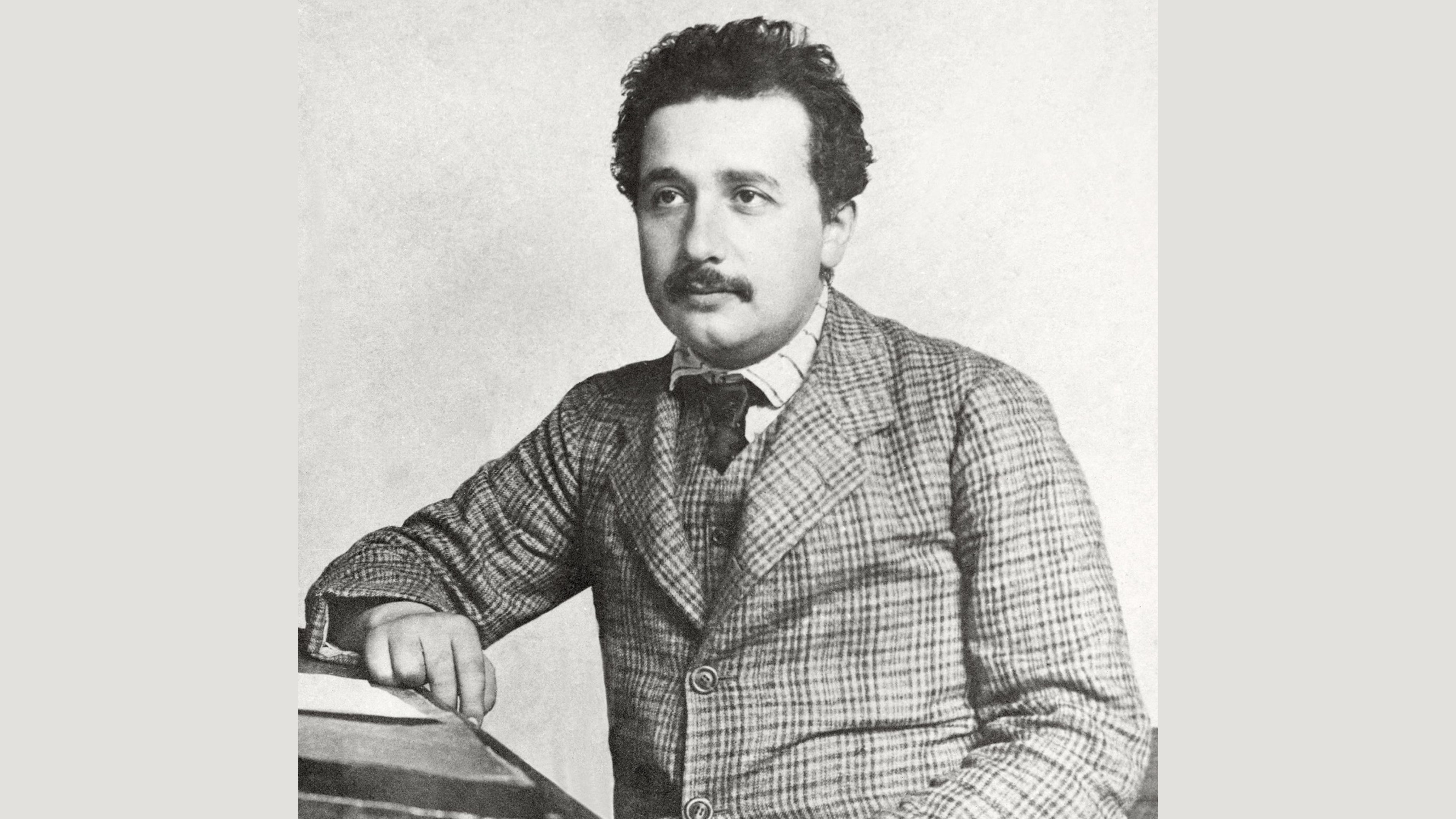
Albert Einstein’s brief paper challenged the traditional understanding of matter and energy, introducing a principle that would transform modern physics.
On November 21, 1905, Albert Einstein’s paper establishing the relationship between mass and energy was published in the German scientific journal Annalen der Physik. The three-page study introduced a principle that would later become one of the most recognizable equations in science: E = mc².
The paper, titled Ist die Trägheit eines Körpers von seinem Energieinhalt abhängig?, translated as Does the Inertia of a Body Depend Upon Its Energy Content?, proposed that a body’s mass is directly related to the energy it contains.
Einstein was just 26 years old and working at the Swiss Patent Office in Bern when he developed the idea. His findings would help reshape scientific understanding of matter, radiation, and the physical universe.
The publication formed part of Einstein’s extraordinary scientific output in 1905, a year that became known as his annus mirabilis, or miracle year.
The Discovery Behind Einstein’s Mass–Energy Relationship
At the beginning of the twentieth century, mass and energy were generally treated as distinct physical quantities.
Mass described a body’s inertia, or resistance to changes in motion, while energy appeared in different forms, including heat, light, and movement.
Physicists already understood that energy could change form and that mass was conserved in ordinary physical and chemical processes. Earlier researchers had also explored connections between electromagnetic energy and inertia.
Einstein’s work established a broader relationship through the principles of special relativity.
In June 1905, he submitted a paper titled On the Electrodynamics of Moving Bodies, introducing the foundations of special relativity.
The theory challenged traditional assumptions about space and time, establishing that measurements of time, length, and simultaneity depend on the relative motion of observers.
It also incorporated the principle that light travels at the same speed in a vacuum for all inertial observers.
Einstein recognized that these ideas had important consequences for the relationship between energy and mass.
In September, he submitted a short follow-up paper examining what happens when a body emits energy in the form of radiation.
His argument considered a body releasing equal amounts of light in opposite directions. This arrangement allowed the body to lose energy without changing its overall motion in its original reference frame.
Einstein then examined the event from another reference frame moving relative to the first.
Using the principles of relativity, he found that the loss of energy corresponded to a reduction in the body’s mass.
The relationship depended on the square of the speed of light.
Einstein concluded that mass could be understood as a measure of a body’s energy content.
His paper was received by Annalen der Physik on September 27, 1905, and published on November 21.
Although the famous expression E = mc² does not appear in the original publication, the paper established the underlying relationship from which the modern equation follows.
From E = mc² to Modern Physics
The equation E = mc² expresses the rest energy associated with a body of mass.
In the formula, E represents energy, m represents mass, and c represents the speed of light in a vacuum.
Because the speed of light is approximately 300 million metres per second, squaring that number produces an enormous value.
Consequently, even a small amount of mass corresponds to a substantial quantity of energy.
For example, the rest energy equivalent of one gram of matter is approximately 90 trillion joules.
This does not mean that an ordinary object automatically releases all its rest energy. The equation describes a physical relationship, while the amount of energy actually released depends on the process involved.
In nuclear reactions, measurable differences between the total mass of the initial materials and the final products correspond to changes in energy.
This relationship helps explain how stars generate energy through nuclear fusion.
Within the Sun, hydrogen nuclei undergo reactions that ultimately produce helium. The resulting products have slightly less total mass than the original reactants, with the difference accounted for by energy released during the process.
The same principle is fundamental to nuclear fission, in which heavy atomic nuclei split into lighter products.
During the twentieth century, advances in nuclear physics led to the development of nuclear reactors and atomic weapons.
Einstein’s equation became closely associated with these developments, although his 1905 paper did not describe nuclear fission, nuclear reactors, or methods of constructing weapons.
The practical applications emerged through decades of additional experimental and theoretical research by numerous scientists.
Mass–energy equivalence also became important in particle physics, where energy can be converted into particles and particles can release energy through interactions or annihilation.
Modern particle accelerators rely on these relationships to investigate the fundamental constituents of matter.
Einstein’s original proposal was initially a theoretical result. Its broader significance became clearer as experimental research provided increasing support for relativity and the relationship between mass and energy.
The discovery also helped establish a more complete understanding of physical conservation laws.
Rather than treating mass and energy as entirely separate conserved quantities, modern physics recognizes that energy must be accounted for in all its forms, including the energy associated with mass.
Einstein’s 1905 work was one of several major contributions he made that year.
His research on the photoelectric effect helped advance quantum theory, while his explanation of Brownian motion provided evidence supporting the atomic nature of matter.
His special relativity paper transformed the scientific understanding of space and time.
Together, these contributions established Einstein as a central figure in the development of modern physics.
The mass–energy paper was especially remarkable for its brevity. In just three published pages, Einstein identified a relationship with consequences extending far beyond the scientific questions of his own era.
More than a century later, E = mc² remains essential to understanding nuclear energy, stellar processes, particle physics, and the fundamental relationship between matter and energy.
The paper published on November 21, 1905, did not immediately reveal every implication of the discovery. It established a principle that later generations of scientists would investigate, test, and apply, permanently changing humanity’s understanding of the physical universe.
About the Author Brad Socha is the founder of The Universal Record, focused on sourced, factual global reporting. Coverage includes international news, geopolitics, technology, and major developments.