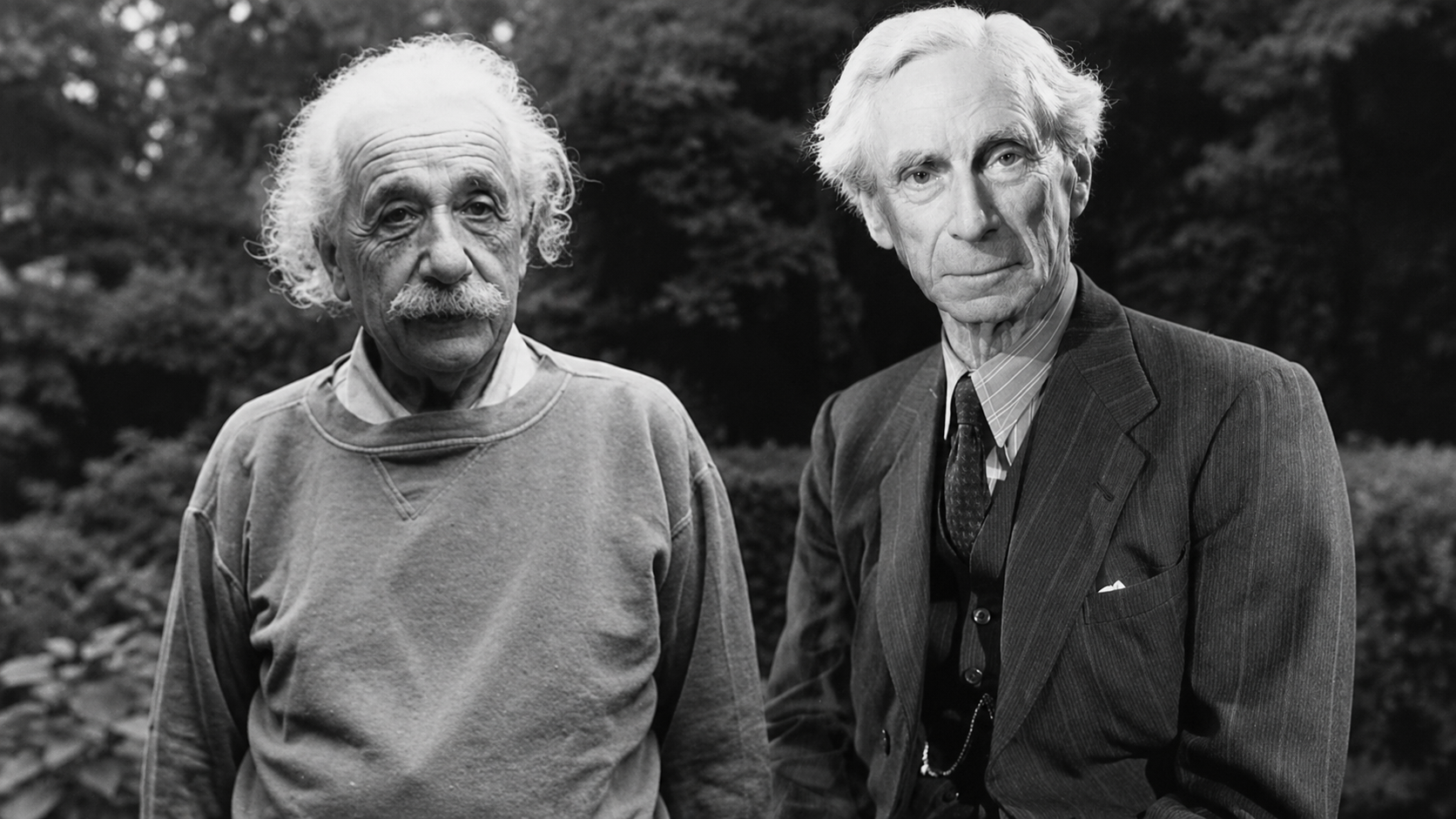
A landmark manifesto urged humanity to choose peace over nuclear conflict, becoming one of the most influential statements in the history of nuclear disarmament.
Few documents have carried a warning as profound, or remained as relevant, as the Russell–Einstein Manifesto. Released on July 9, 1955, the statement called on world leaders and ordinary citizens to confront a new reality: humanity had developed weapons powerful enough to threaten its own survival. Nearly seventy years later, as nuclear arsenals remain active across multiple nations, the manifesto continues to serve as one of history’s most enduring appeals for international cooperation and restraint.
The manifesto emerged during one of the most dangerous periods of the Cold War. Less than a decade after the atomic bombings of Hiroshima and Nagasaki, both the United States and the Soviet Union had developed hydrogen bombs far more destructive than the weapons used during the Second World War. The rapid escalation of the nuclear arms race alarmed many of the world’s leading scientists, who feared that another global conflict could have catastrophic consequences for civilization.
British philosopher Bertrand Russell drafted the statement after years of advocating for nuclear disarmament. Seeking to give the message greater scientific authority, he asked Albert Einstein to endorse it. Einstein agreed and signed the document on April 11, 1955, just one week before his death on April 18. It became the final public statement that Einstein supported during his lifetime.
The manifesto was formally presented at Caxton Hall in London on July 9, 1955. Russell introduced the document before an international audience of journalists, explaining that the issue transcended politics, ideology and national borders. Rather than addressing the conflict between East and West, the manifesto focused on the shared risk facing all humanity in the nuclear age.
The statement was signed by eleven distinguished scientists and intellectuals, including Nobel Prize winners Max Born, Percy W. Bridgman, Frédéric Joliot-Curie, Hermann J. Muller, Linus Pauling, Cecil F. Powell, Hideki Yukawa, physicist Joseph Rotblat, mathematician Leopold Infeld, philosopher Bertrand Russell, and Albert Einstein. Together, they represented several countries and scientific disciplines, reinforcing the message that the threat of nuclear war was a global concern rather than a national one.
At the heart of the manifesto was a simple but powerful appeal. The signatories urged governments to recognize that modern nuclear weapons made traditional concepts of military victory increasingly meaningless. They warned that any future world war fought with thermonuclear weapons could endanger the continued existence of human civilization.
One of the document’s most memorable lines has since become synonymous with the peace movement:
“Remember your humanity, and forget the rest.”
Rather than advocating for one political system over another, the manifesto asked governments to resolve international disputes through negotiation instead of armed conflict. It argued that scientific progress had outpaced political decision-making, creating a situation in which humanity possessed unprecedented destructive power without corresponding safeguards against its misuse.
The manifesto did not immediately change international policy, but its influence grew steadily. In 1957, it directly inspired the creation of the Pugwash Conferences on Science and World Affairs, an international forum where scientists from both sides of the Cold War met to discuss nuclear dangers and arms control.
Joseph Rotblat, one of the manifesto’s signatories, became a leading figure within the Pugwash movement. Decades later, in 1995, the organization and Rotblat jointly received the Nobel Peace Prize for their efforts to reduce the role of nuclear weapons in international politics and encourage peaceful conflict resolution.
The document also helped shape later discussions surrounding nuclear non-proliferation, arms control agreements and international diplomacy. Although treaties such as the Nuclear Non-Proliferation Treaty (NPT) would not emerge until years later, the manifesto contributed to a growing recognition that nuclear weapons required unprecedented international cooperation.
The concerns raised in 1955 remain relevant today. According to international monitoring organizations, thousands of nuclear warheads remain deployed or in reserve among several nuclear-armed states. Advances in missile technology, cyber warfare and artificial intelligence have added new dimensions to strategic stability, while geopolitical tensions continue to influence defence planning across multiple regions.
Although the global political landscape has changed dramatically since the Cold War, the central question posed by Russell and Einstein continues to resonate: can nations resolve disputes peacefully in an era when modern weapons possess extraordinary destructive potential?
For historians, the Russell–Einstein Manifesto represents more than a political statement. It illustrates a rare moment when some of the world’s most accomplished scientists publicly accepted responsibility for the broader consequences of scientific discovery. Rather than celebrating technological achievement alone, they emphasized the ethical obligations that accompany knowledge.
Its legacy can still be found in international disarmament efforts, scientific ethics discussions and diplomatic initiatives seeking to reduce the risks associated with weapons of mass destruction. The document remains one of the defining milestones in the global movement for nuclear restraint.
Nearly seven decades after its release, the Russell–Einstein Manifesto continues to remind the world that scientific progress and human survival must advance together. In an age shaped by rapidly evolving technologies and persistent geopolitical tensions, its appeal for reason, cooperation and shared humanity remains one of history’s most enduring messages.
About the Author Brad Socha is the founder of The Universal Record, focused on sourced, factual global reporting. Coverage includes international news, geopolitics, technology, and major developments.