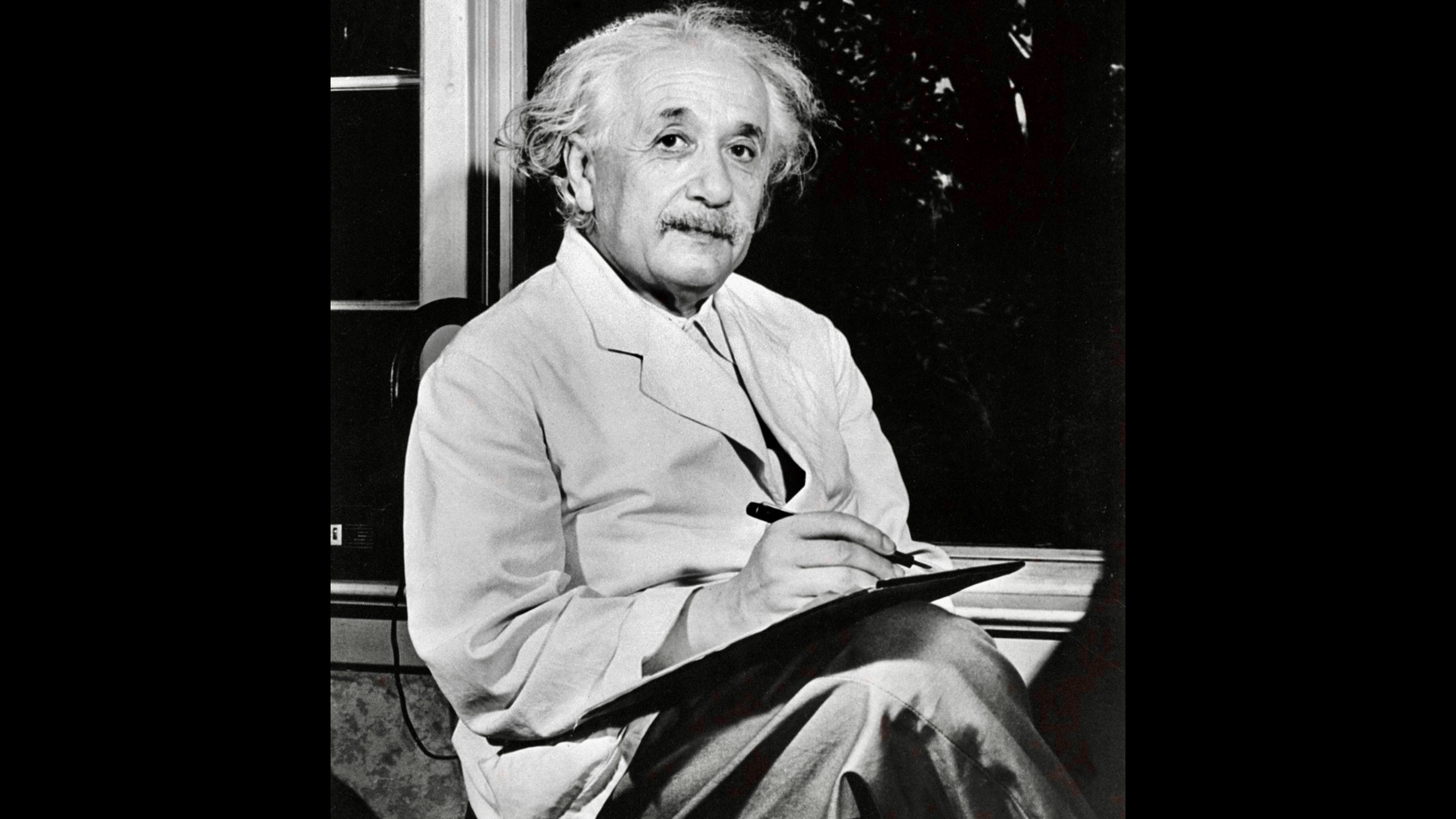
Albert Einstein was born on March 14, 1879, in Ulm, in the Kingdom of Württemberg in the German Empire. He would go on to become one of the most influential physicists in history, helping reshape humanity’s understanding of space, time, gravity, energy, and light.
Einstein is best known for developing the theories of special and general relativity. His work challenged long-standing assumptions in physics and contributed to major scientific advances in the twentieth century. He was also awarded the 1921 Nobel Prize in Physics, recognised primarily for his explanation of the photoelectric effect, which became foundational to quantum theory.
Although Einstein’s name is often associated in popular culture with the equation E = mc², his broader legacy extends far beyond a single formula. His ideas influenced astrophysics, cosmology, nuclear science, and modern technology, and his work continues to shape scientific research today.
Einstein later lived in Switzerland, Germany, and the United States. In 1933, after Adolf Hitler came to power, Einstein did not return to Germany. He eventually settled in the United States, where he continued his scientific work and public advocacy until his death in 1955.
March 14 is now widely associated not only with Einstein’s birth, but also with the enduring impact of scientific discovery on modern civilisation. His name remains one of the most recognised in the history of science.
About the Author Brad Socha is the founder of The Universal Record, focused on sourced, factual global reporting. Coverage includes international news, geopolitics, technology, and major developments.