As the world emerged from the Second World War, representatives of 44 nations gathered around an ambitious idea: could education, science, and culture help prevent another global conflict?
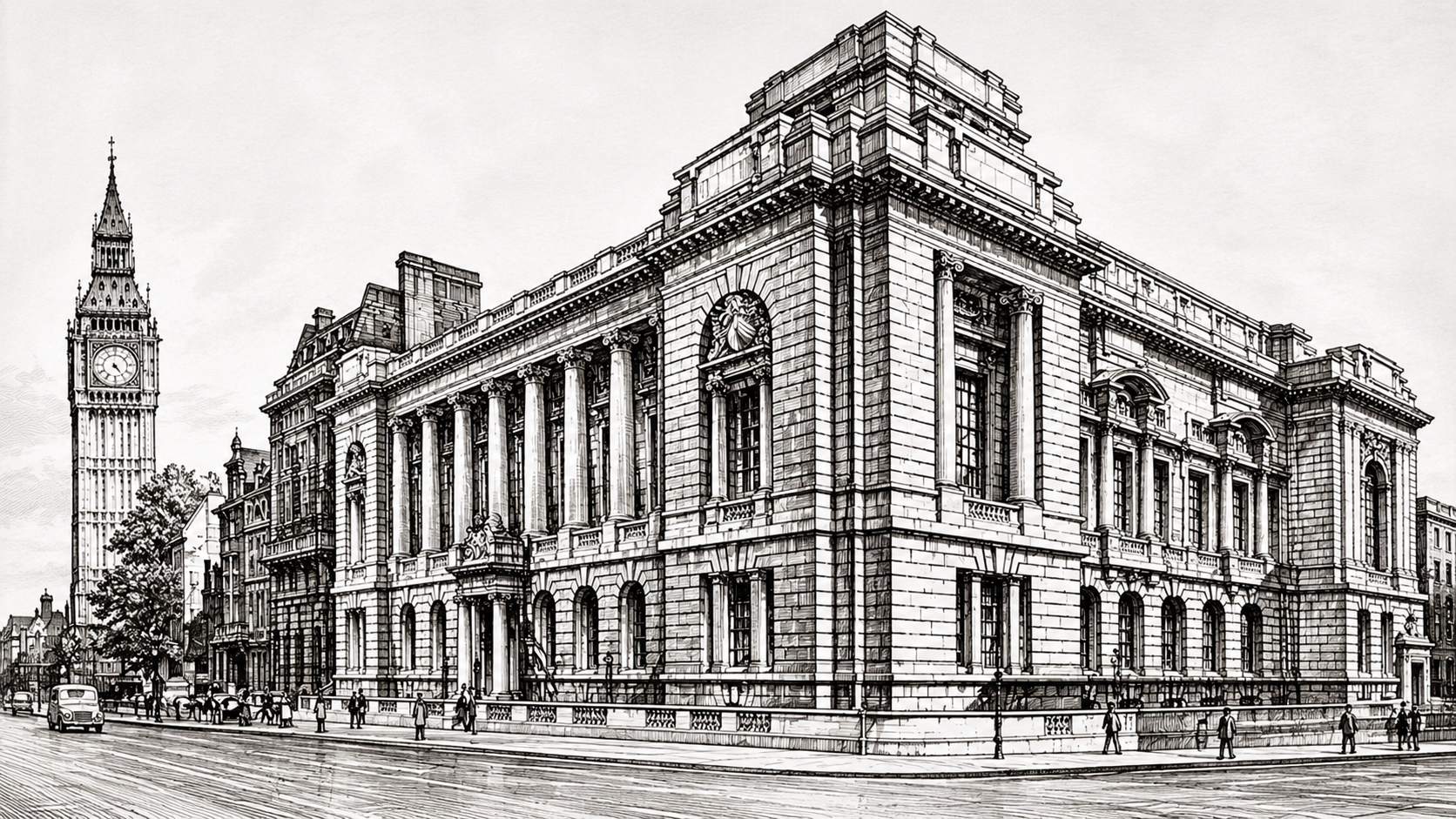
Feature Image: Historical-style illustration of the Institution of Civil Engineers building in London, where UNESCO’s constitution was adopted on November 16, 1945.
On November 16, 1945, representatives meeting in London adopted the constitution of UNESCO, the United Nations Educational, Scientific and Cultural Organization. With much of Europe still recovering from the destruction of the Second World War, governments sought to establish an international institution dedicated to strengthening peace through education, scientific cooperation, and cultural understanding.
The founding conference brought together representatives of 44 governments. Their agreement reflected a growing conviction that military alliances, political settlements, and economic arrangements alone could not guarantee lasting peace.
The organization would address another dimension of international relations: how societies understood one another, shared knowledge, and protected the intellectual and cultural foundations of civilization.
Although UNESCO’s constitution was adopted in 1945, the organization formally came into existence on November 4, 1946, after the required 20 countries had accepted it.
Why UNESCO Emerged From the Second World War
The origins of UNESCO can be traced to wartime London, where governments displaced by German occupation began discussing the reconstruction of education in Europe.
In November 1942, the Conference of Allied Ministers of Education began meeting to consider how schools, universities, and cultural institutions could be rebuilt after the war.
The challenge extended beyond repairing buildings.
Libraries had been destroyed, educational systems disrupted, and cultural institutions damaged or subjected to political control. Millions of people had experienced displacement, persecution, and interrupted schooling.
The war also demonstrated how propaganda, racial ideology, and organized discrimination could contribute to widespread violence.
Those experiences encouraged participating governments to consider education and cultural exchange as matters of international security, rather than solely domestic policy.
The discussions developed into plans for a permanent international organization.
Following Germany’s defeat in May 1945 and Japan’s surrender later that year, the newly established United Nations provided a broader framework for international cooperation.
The British and French governments jointly convened a conference in London, which opened on November 1, 1945.
The gathering took place at the Institution of Civil Engineers, a building that had survived the bombing of London.
British Minister of Education Ellen Wilkinson presided over the conference. Among the influential participants was American poet and former Librarian of Congress Archibald MacLeish, who headed the United States delegation.
Delegates examined proposals developed during the war, including a draft constitution prepared through the Allied education ministers’ meetings.
The negotiations addressed the organization’s purpose, governing structure, membership, and responsibilities.
Education was central to the proposed institution, but delegates also recognized the importance of science, cultural exchange, and the circulation of reliable information.
On November 16, the conference adopted UNESCO’s constitution, establishing the legal framework for an organization intended to operate across national boundaries.
Its preamble expressed the founding principle in a statement that became closely associated with UNESCO:
“Since wars begin in the minds of men, it is in the minds of men that the defences of peace must be constructed.”
The declaration reflected the belief that international peace required more than agreements between governments. It also depended on knowledge, mutual respect, and cooperation between societies.
How UNESCO Developed Its Global Mission
The constitution established UNESCO’s purpose as contributing to peace and security by encouraging international collaboration in education, science, and culture.
It also connected the organization’s work to human rights, fundamental freedoms, and respect for people regardless of race, sex, language, or religion.
These principles shaped an unusually broad mandate.
In education, UNESCO would encourage cooperation between governments, improve access to learning, and support the exchange of educational knowledge.
In science, the organization would promote international research and the sharing of discoveries across national borders.
Its cultural responsibilities included supporting the preservation of knowledge, encouraging artistic and intellectual exchange, and strengthening understanding between different societies.
The constitution also emphasized the free circulation of ideas through words and images, recognizing the importance of communication in international understanding.
The founding agreement did not immediately create a fully operational institution.
A preparatory commission was established to organize UNESCO’s initial activities, develop its programme, and prepare for the first General Conference.
The constitution entered into force on November 4, 1946, following acceptance by 20 signatory countries.
Among those first 20 countries were the United Kingdom, France, Canada, China, India, Egypt, Brazil, and the United States.
UNESCO’s first General Conference opened in Paris later that month, beginning the organization’s work as a functioning international body.
British biologist Julian Huxley became its first Director-General.
Over subsequent decades, UNESCO expanded its activities into fields that had not yet been fully developed when its constitution was written.
One of its most widely recognized initiatives emerged in 1972, when the World Heritage Convention established an international framework for identifying and protecting cultural and natural sites considered to possess outstanding universal value.
UNESCO also became involved in international literacy initiatives, scientific collaboration, the preservation of documentary heritage, and efforts to safeguard cultural traditions.
Its work has included promoting cooperation in ocean science, supporting educational development, and coordinating international responses to threats against cultural heritage.
These programmes have operated within a changing political environment.
Cold War divisions, disagreements over institutional priorities, funding disputes, and debates about cultural representation have periodically complicated UNESCO’s work.
Membership and participation have also changed over time, reflecting wider developments in international relations.
Nevertheless, the organization has continued to provide a forum where governments and specialists can cooperate on educational, scientific, and cultural matters.
The distinction between UNESCO’s founding in 1945 and its formal establishment in 1946 remains historically important.
November 16 marks the adoption of the constitution in London, while November 4, 1946, marks the date that the agreement entered into force.
Together, those milestones represent the transition from a wartime proposal to an operating international institution.
The founding delegates could not know how the world would change over the following decades, or which challenges international cooperation would face.
Their agreement nevertheless established a lasting principle: education, scientific knowledge, cultural understanding, and the exchange of ideas were not separate from the pursuit of peace, but essential parts of it.
About the Author Brad Socha is the founder of The Universal Record, focused on sourced, factual global reporting. Coverage includes international news, geopolitics, technology, and major developments.