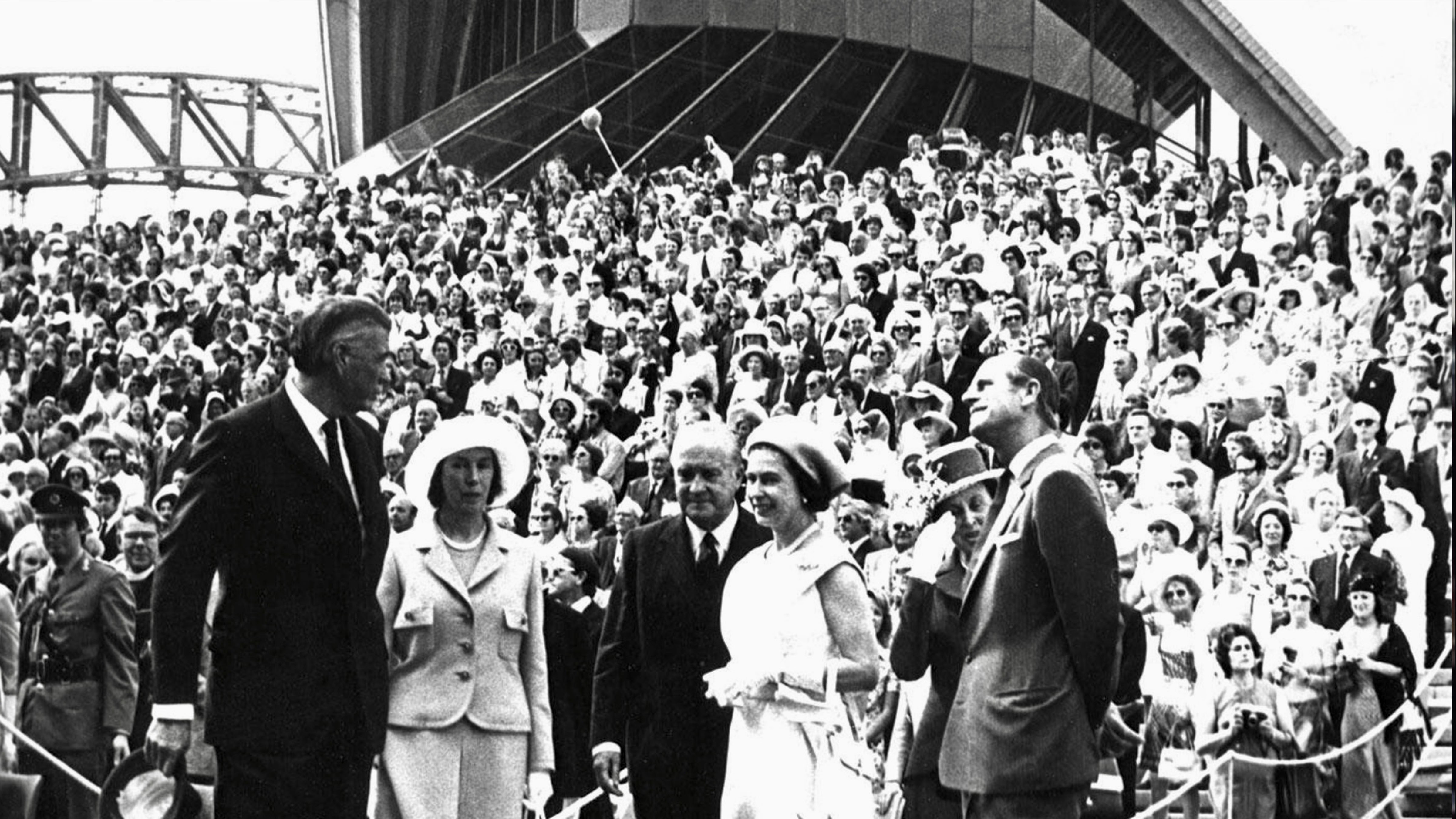
After years of construction delays, political disputes and unprecedented engineering challenges, Australia’s most recognizable building finally welcomed the world.
On October 20, 1973, Queen Elizabeth II officially opened the Sydney Opera House, completing a remarkable chapter in Australian architectural history. Rising above Sydney Harbour at Bennelong Point, the building had taken 16 years to construct, far exceeded its original budget and become the centre of a bitter dispute over its design.
Today, its distinctive white roof shells are recognized around the world. Yet the story behind them reveals how an ambitious public project pushed the limits of engineering, challenged political expectations and transformed Sydney’s cultural identity.
A Vision That Challenged Conventional Architecture
The idea for a major performing arts centre in Sydney gained momentum during the 1950s, championed by Eugene Goossens, the conductor of the Sydney Symphony Orchestra. At the time, the city lacked a purpose-built concert venue capable of meeting its growing cultural ambitions.
In 1956, the New South Wales government launched an international architectural competition for a new building at Bennelong Point, a prominent waterfront location previously occupied by a tram depot.
The competition attracted 233 entries from architects in 32 countries. The winning design came from Jørn Utzon, a Danish architect whose proposal featured sweeping roof forms unlike anything previously attempted on such a scale.
Announced in January 1957, Utzon’s design immediately attracted attention. Its sculptural roof structures appeared to rise from the harbour like sails, creating a visual relationship with the surrounding water and landscape.
But the proposal was more than an architectural statement. It presented engineering problems that had not yet been solved.
Construction began on March 2, 1959, before the design had been fully developed. The decision reflected political pressure to move the project forward, but it also contributed to difficulties that would emerge during construction.
The original estimate was approximately A$7 million, with completion initially expected in 1963.
Neither target would be achieved.
Engineers working with the British firm Ove Arup & Partners faced the challenge of translating Utzon’s dramatic roof design into a structure that could actually be built.
Early concepts proved difficult to construct. After years of investigation, the design team developed a solution in which the roof segments could be derived from the geometry of a sphere.
This breakthrough allowed the complex shapes to be manufactured using repeated precast concrete components.
The building’s roof eventually incorporated more than one million ceramic tiles, manufactured in Sweden, giving the shells their characteristic appearance.
Although often described as white, the tiles combine glossy white and matte cream surfaces, creating subtle changes in colour as sunlight moves across the structure.
The Controversy Behind the Sydney Opera House
As construction progressed, costs increased and tensions developed between Utzon and the New South Wales government.
The project became increasingly controversial because of its expense, prolonged construction schedule and unresolved technical details.
A change of government in 1965 intensified the conflict. The incoming administration placed greater scrutiny on the project’s finances and management.
In February 1966, Utzon resigned following disagreements with the government over payments, documentation and control of the project.
His departure became one of the defining controversies in modern architectural history.
Utzon left Australia and did not return to oversee the completed building. Responsibility for finishing the project passed to a team of Australian architects led by Peter Hall, with Lionel Todd and David Littlemore also playing important roles.
The new team faced substantial challenges, particularly in completing the interiors and adapting the building to the practical requirements of opera, orchestral performance and theatre.
Significant changes were made to Utzon’s original interior plans.
The larger auditorium became the Concert Hall, while the smaller principal venue was developed for opera performances. This arrangement differed from aspects of Utzon’s earlier intentions and would influence later discussions about the building’s acoustics and functionality.
Despite the controversy, construction continued.
By the time the Sydney Opera House was completed in 1973, its final cost had reached approximately A$102 million, more than 14 times the original estimate.
Much of the funding came through a public lottery established by the New South Wales government.
The official opening on October 20 drew large crowds to Sydney Harbour. Queen Elizabeth II formally inaugurated the building, marking the beginning of its life as a major performing arts centre.
The ceremony represented the completion of a national landmark, although the disputes surrounding its construction remained unresolved.
Over the following decades, the building became one of Australia’s most important cultural institutions, hosting opera, orchestral music, theatre, dance and other performances.
Efforts were eventually made to recognize Utzon’s contribution and restore elements of his architectural vision.
In 1999, the Sydney Opera House re-established contact with Utzon, who agreed to develop design principles to guide future improvements. His work subsequently informed renovations and the creation of the Utzon Room, which opened in 2004.
In 2003, Utzon received the Pritzker Architecture Prize, one of architecture’s highest international honours.
Four years later, in 2007, UNESCO inscribed the Sydney Opera House on the World Heritage List, recognizing its exceptional architectural and engineering significance.
Utzon died in 2008, but his design remains central to the building’s identity.
The Sydney Opera House stands today as both an architectural achievement and a reminder of the difficulties involved in realizing an unprecedented vision. Its construction exposed the consequences of incomplete planning, political conflict and escalating costs, while demonstrating how innovative engineering could make an apparently impossible design achievable.
More than five decades after its opening, the building remains a defining symbol of Sydney and a landmark in the history of twentieth-century architecture.
About the Author Brad Socha is the founder of The Universal Record, focused on sourced, factual global reporting. Coverage includes international news, geopolitics, technology, and major developments.