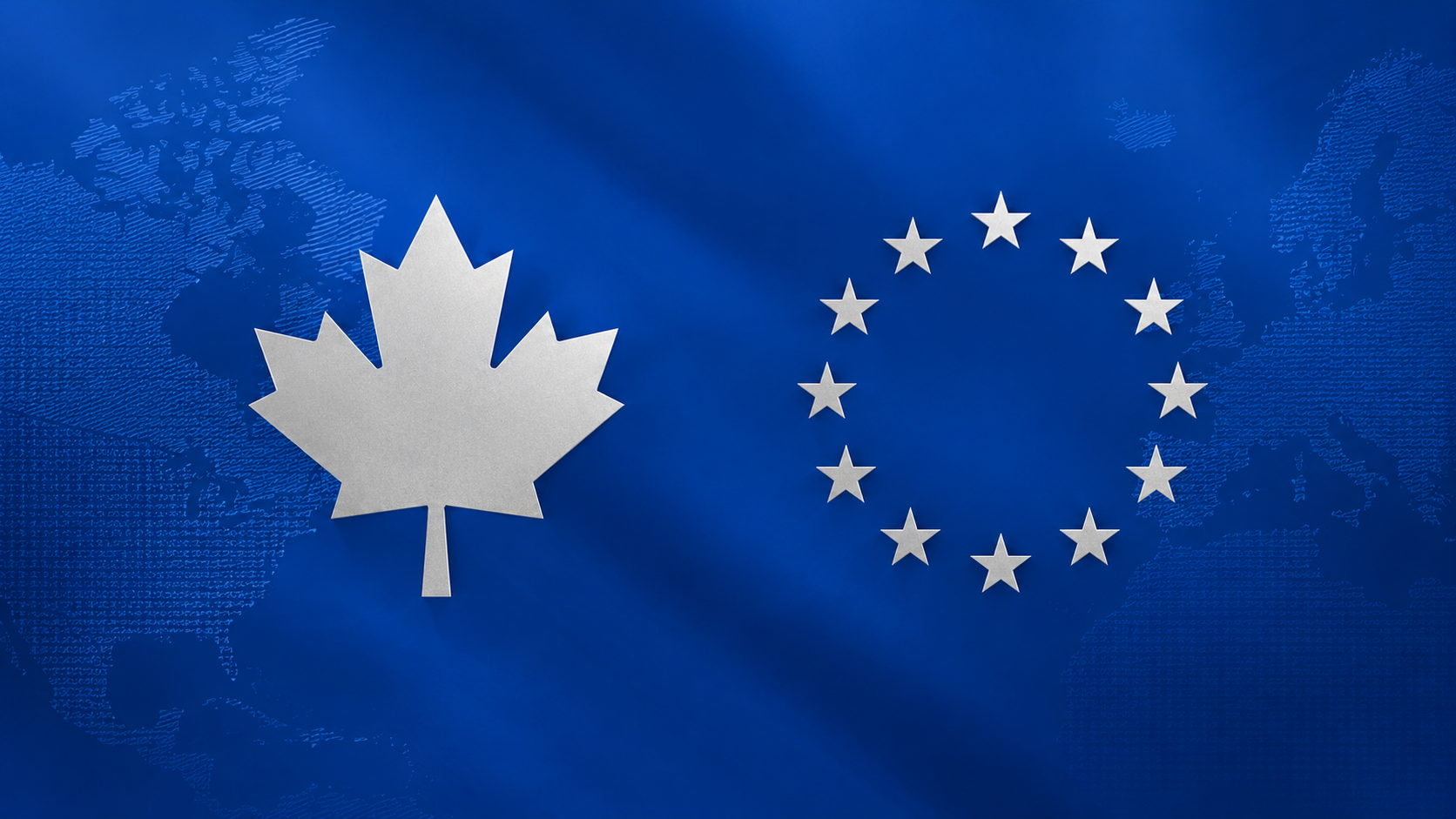
An agreement reached at the Montreal summit could reshape Canada’s relationship with Europe, opening new opportunities in trade, defence, research and mobility. But what would associate membership actually mean?
Canada and the European Union have agreed to pursue an unprecedented form of partnership that could make Canada the EU’s first associate member, following a two-day summit in Montreal on October 29–30, 2026.
Prime Minister Mark Carney met with European Commission President Ursula von der Leyen and European Council President António Costa to launch a new Alliance for the Future, intended to deepen cooperation between Canada and the 27-member European Union.
The announcement marks a significant step toward closer economic and political integration. However, Canada has not yet become an EU associate member. Both sides must still negotiate what the proposed status would involve, including its rights, responsibilities and legal structure.
The Canadian government says those discussions will take place over the coming months.
Unlike full EU membership, the proposed arrangement would allow Canada to strengthen its relationship with European institutions without becoming an EU member state.
The initiative comes as Ottawa seeks to diversify its international partnerships, expand economic opportunities and reduce vulnerabilities arising from dependence on individual trading partners.
What EU Associate Membership Would Mean for Canada
The European Union currently has no formal category of associate membership established under its founding treaties.
Under Article 49 of the Treaty on European Union, full membership is available to European states that satisfy the bloc’s admission requirements. Canada, as a North American country, is not pursuing that route.
Instead, Ottawa and Brussels are exploring a new framework that would establish a closer relationship than a conventional trade agreement while stopping short of full membership.
The precise benefits remain subject to negotiation.
Potential areas of cooperation include easier cross-border business activity, expanded research partnerships, greater access to educational exchanges and stronger coordination on defence and technology.
Associate membership would not automatically give Canadians the right to live or work anywhere in the European Union. Nor would it necessarily provide Canada with voting rights in EU institutions, representation in the European Parliament or unrestricted access to the European single market.
Those arrangements would require separate legal and political decisions.
Other non-EU countries already maintain close relationships with European institutions. Norway participates in the European Economic Area, providing extensive access to the single market, while Switzerland operates through a series of bilateral agreements.
Canada’s proposed arrangement would be different because it is being developed specifically around a broader transatlantic strategic partnership.
Any substantial integration of markets or regulations could require negotiations over standards, oversight, dispute resolution and the extent to which Canadian and European rules would align.
EU governments would also have to approve measures falling within their respective legal responsibilities.
Trade, Defence and Opportunities for Canadians
The Montreal summit produced several concrete announcements alongside the longer-term associate membership proposal.
One involves digital trade.
Canada and the EU announced a new digital trade agreement intended to make cross-border electronic commerce easier and improve conditions for companies selling goods and services online.
The partnership also includes expanded scientific and technological cooperation.
Canada has joined the European High Performance Computing Joint Undertaking, providing Canadian researchers, innovators and businesses with access to major European computing resources, including the JUPITER supercomputer.
The two sides also plan to negotiate Canada’s participation in future European research and education programmes.
These include Erasmus+, which supports international educational exchanges, and the next Horizon Europe research programme.
For Canadian students, researchers and institutions, expanded participation could eventually create additional opportunities to study, collaborate and work with European partners. The eligibility rules, costs and scope of those opportunities have not yet been finalized.
Trade is another central consideration.
According to the European Council, trade in goods and services between Canada and the EU reached approximately €130 billion in 2025, making Europe one of Canada’s most important economic partners.
The Comprehensive Economic and Trade Agreement, or CETA, already removes tariffs on most goods traded between the two economies.
The new alliance aims to build on that foundation by improving economic security, strengthening supply chains and reducing barriers in areas not fully addressed by existing agreements.
Defence cooperation is also expanding.
Canada became the first non-European country to participate in the EU’s Security Action for Europe initiative earlier in 2026, opening opportunities for Canadian companies to participate in European defence procurement.
At the Montreal summit, the Canadian government announced a contract worth more than $44 million for Montreal-based Galvion to supply military helmets to Latvia.
Ottawa also announced up to $2.5 billion in financing guarantees to support increased production of De Havilland Canada water-bombing aircraft, with potential benefits for European firefighting capacity.
The two sides additionally agreed to develop a framework for investment and stockpiling involving critical raw materials, an area increasingly important to defence, advanced manufacturing and clean-energy technologies.
These measures illustrate the alliance’s intended scope, although not all are dependent on the proposed associate membership status.
What Happens Next?
The central question is how much integration Canada and the EU can achieve without changing the fundamental structure of either political system.
Their October 30 joint statement establishes a clearer timeline: the two sides intend to define the proposed closer association by the 2027 Canada-EU summit.
That leaves several important issues unresolved, including whether Canada would gain access to additional European programmes, how closely regulations would align, what financial contributions might be required and how any new agreements would be approved.
The partnership also raises questions about Canada’s relationship with the United States.
The United States remains Canada’s largest trading partner, and closer European ties would not automatically replace the economic integration that already exists across North America.
Instead, the Canadian government is presenting the alliance as a means of diversifying trade, investment and strategic relationships while maintaining its existing international commitments.
For the EU, a closer partnership would provide additional access to Canadian energy, critical minerals, technology, industrial capacity and defence cooperation.
The agreement also signals a possible evolution in how the European Union works with countries outside Europe.
If an associate membership framework is successfully negotiated, it could establish a model for deeper partnerships without requiring full EU accession. Whether that model would eventually extend to other countries remains uncertain.
For Canadians, the most immediate changes will come through specific agreements on trade, research, technology and industrial cooperation rather than a sudden change in citizenship or travel rights.
Canada is now pursuing a relationship that neither side has previously formalized. Its ultimate significance will depend on the rights and obligations negotiated, the economic benefits delivered and the degree of integration both governments are prepared to accept.
About the Author Brad Socha is the founder of The Universal Record, focused on sourced, factual global reporting. Coverage includes international news, geopolitics, technology, and major developments.