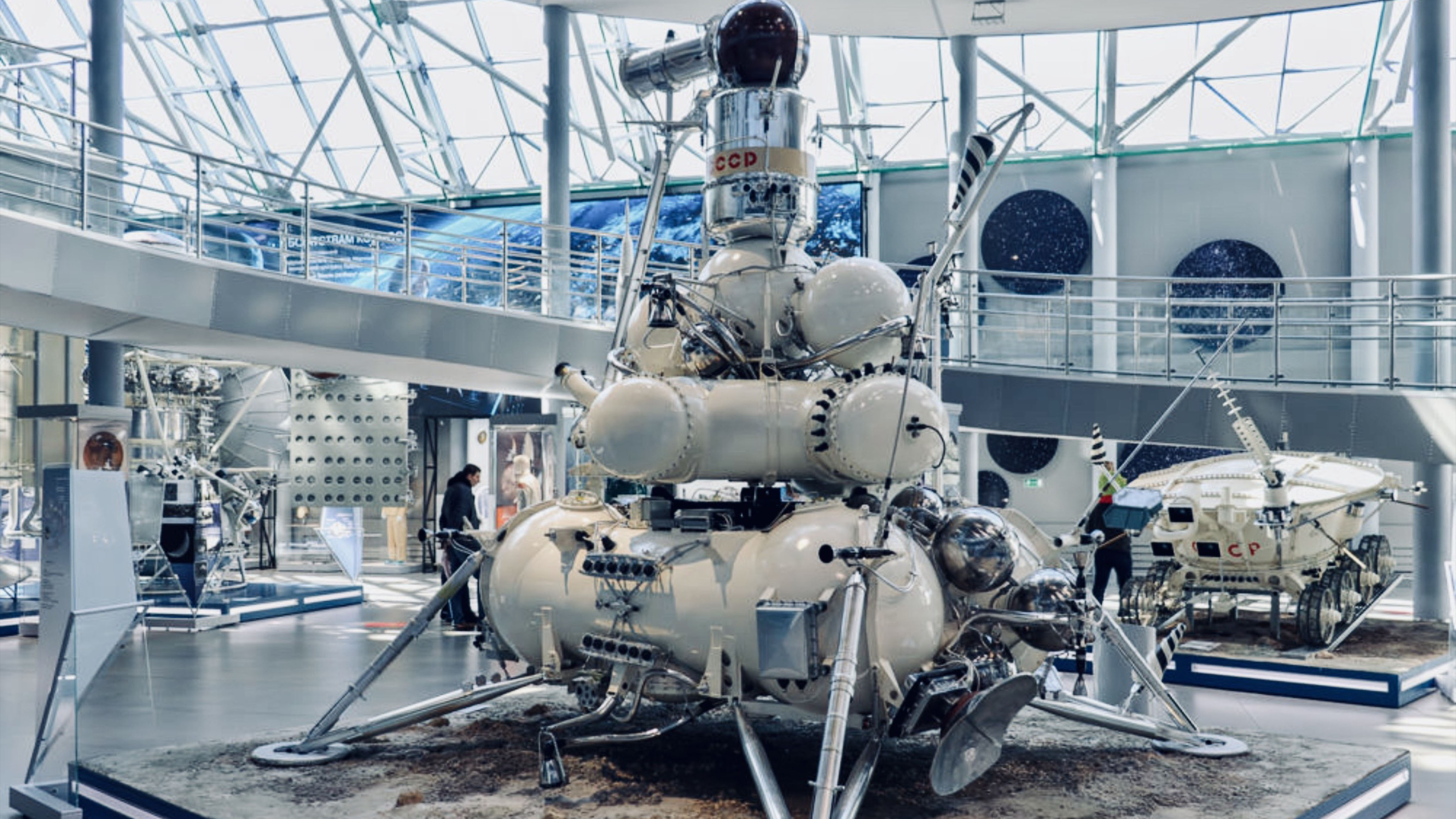
Without a single astronaut aboard, a Soviet spacecraft landed on the Moon, drilled into its surface and delivered lunar material back to Earth, proving that another world could be sampled entirely by machine.
Featured image: Luna 16 spacecraft display. Photo: Yuri Gagarin Museum-Reserve.
On September 24, 1970, a small return capsule descended by parachute onto the steppes of Kazakhstan carrying about 101 grams of material from the Moon. Four days earlier, Luna 16 had landed on the lunar surface, collected soil with an automated drill and prepared the sample for a journey back to Earth.
NASA identifies Luna 16 as the first successful robotic sample-return mission from beyond Earth. Humans had already returned lunar material during Apollo 11 and Apollo 12, but the Soviet mission accomplished the essential sequence, landing, sampling, launching from another world and returning the material to Earth, without astronauts.
It was a milestone whose basic concept remains central to planetary exploration more than half a century later.
Luna 16 Reaches the Moon
The Soviet Union had accumulated an extraordinary series of lunar firsts by 1970. Luna 2 became the first human-made object to reach the Moon in 1959. Luna 3 photographed its far side later that year. Luna 9 achieved the first survivable landing in 1966, followed shortly afterward by Luna 10 becoming the first spacecraft to orbit the Moon.
Returning material to Earth was considerably more difficult.
The Soviets had already tried. Luna 15 was intended to collect and return lunar material in July 1969, while Apollo 11 was carrying Neil Armstrong, Buzz Aldrin and Michael Collins toward the first crewed Moon landing. Luna 15 entered lunar orbit but crashed during its descent on July 21.
Further Soviet attempts also failed before Luna 16 finally succeeded.
Launched on September 12, 1970, Luna 16 travelled to the Moon and entered lunar orbit before beginning its descent. On September 20, it made a soft landing in Mare Fecunditatis, the Sea of Fertility, an expansive basaltic plain on the Moon’s near side.
The landing occurred after the Sun had set at the site, making Luna 16 the first probe to land on the Moon in darkness.
Once safely on the surface, the spacecraft began its most important task. An automated drilling system penetrated approximately 35 centimetres into the lunar material. The collected sample was transferred into a container aboard the return stage and hermetically sealed.
The operation was controlled from Earth. No astronaut was present to select rocks, handle equipment or correct problems by hand.
After spending roughly 26 hours on the lunar surface, Luna 16’s ascent stage fired on September 21. The lander’s descent stage remained behind and served as the launch platform as the upper section departed carrying its small cargo of lunar soil.
Unlike the crewed Apollo spacecraft, the return vehicle did not need to rendezvous with another spacecraft in lunar orbit. It headed directly toward Earth.
A Robotic Sample Returns to Earth
On September 24, the return capsule entered Earth’s atmosphere. A parachute slowed its descent before it landed on the steppes of Kazakhstan, where recovery teams retrieved it.
Inside were approximately 101 grams, about 3.5 ounces, of lunar material.
The quantity was tiny compared with the samples returned by Apollo astronauts. Apollo 11 alone brought back more than 20 kilograms of lunar material. But Luna 16 demonstrated something fundamentally different: sophisticated robotic systems could retrieve material from another celestial body and deliver it to laboratories on Earth.
Scientists could then examine the samples with instruments far larger and more capable than anything that could practically be carried aboard a spacecraft. The Luna 16 material came from the basaltic plains of Mare Fecunditatis, providing another physical sample of lunar geology for laboratory investigation.
The mission also offered the Soviet space program an important success after the United States had achieved the first crewed lunar landing the previous year. Rather than duplicating Apollo, Luna 16 demonstrated a different approach to lunar exploration, one based on increasingly capable automated spacecraft.
The method did not end with Luna 16.
Luna 20 returned about 30 grams of lunar material in 1972. Luna 24 followed in 1976 with approximately 170 grams. Together, the three successful Soviet robotic missions returned about 300 grams of Moon material.
The significance of robotic sample return eventually extended far beyond the Moon. NASA’s Stardust mission returned particles from comet Wild 2 in 2006. Japan’s Hayabusa missions returned material from asteroids Itokawa and Ryugu, while NASA’s OSIRIS-REx delivered a sample from asteroid Bennu to Earth in 2023. China’s Chang’e 5 returned lunar samples in 2020, followed by Chang’e 6 in 2024 with the first samples collected from the Moon’s far side.
Each mission has involved different spacecraft, destinations and engineering challenges, but they share the principle demonstrated by Luna 16: send a machine across space, collect material from another world and bring it home for scientists to study directly.
The capsule that descended over Kazakhstan on September 24, 1970, carried only a small amount of lunar soil. Its larger achievement was proving that retrieving material from another celestial body no longer required a human being to make the journey.
About the Author Brad Socha is the founder of The Universal Record, focused on sourced, factual global reporting. Coverage includes international news, geopolitics, technology, and major developments.