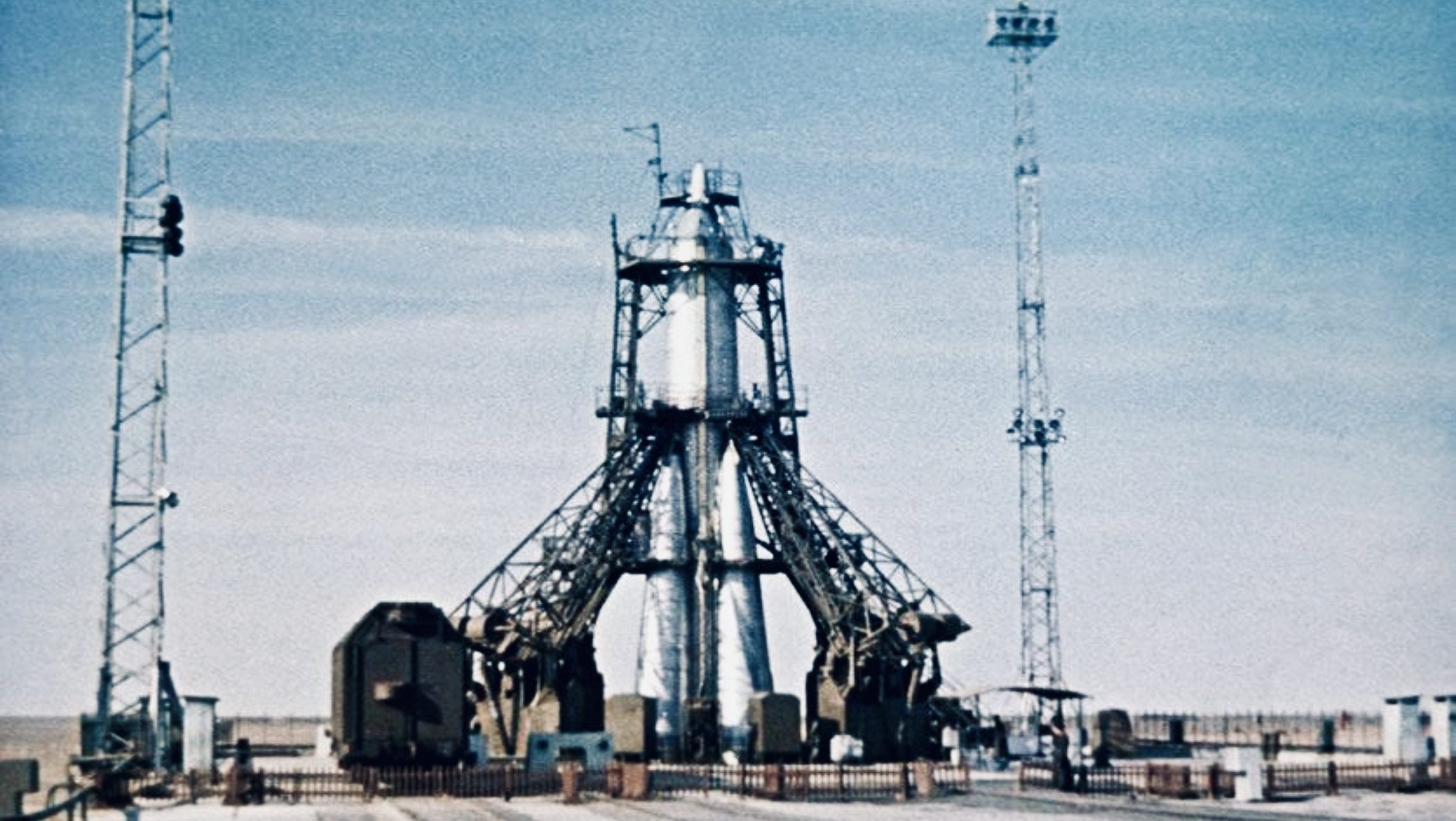
The Soviet Union’s R-7 crossed thousands of kilometres in a breakthrough that transformed nuclear strategy, and provided the rocket technology that would soon launch Sputnik.
THE UNIVERSAL RECORD
Sourced reporting. No opinions.
Brad Socha | August 26, 2026 | 4:59 AM EST
On August 26, 1957, the Soviet Union announced that it had successfully tested an intercontinental ballistic missile, revealing a technological advance with profound consequences for the Cold War. The weapon was the R-7, developed under chief designer Sergei Korolev. Its successful flight demonstrated that the Soviet Union had entered the ICBM era, and that missiles capable of spanning continents were becoming a strategic reality.
The announcement followed an R-7 test conducted on August 21 from the Soviet missile range at Tyuratam, now associated with the Baikonur Cosmodrome in Kazakhstan. The missile flew approximately 6,500 kilometres toward the Kamchatka Peninsula in the Soviet Far East. NASA’s historical account identifies it as the R-7’s first successful flight.
The breakthrough was more than a military milestone. The enormous rocket developed to carry a nuclear warhead over intercontinental distances also gave the Soviet Union the foundation for something unprecedented. Less than seven weeks later, a modified R-7 would carry Sputnik 1 into orbit and open the Space Age.
Building the First Successful ICBM
The R-7 emerged from the accelerating nuclear competition between the United States and Soviet Union during the 1950s. Both powers possessed nuclear weapons, but delivering them across intercontinental distances remained a formidable technological challenge.
Long-range bombers were the principal means of strategic nuclear delivery. An operational ICBM promised something fundamentally different: a rocket that could travel thousands of kilometres on a ballistic trajectory at enormous speed, greatly reducing warning and response times.
Korolev’s design bureau developed the R-7, known in the West as the SS-6 Sapwood, around an unusual configuration. A central core was surrounded by four strap-on boosters, creating the distinctive architecture whose descendants would become familiar sights in Soviet and later Russian space launches.
Getting it to work proved difficult.
The first R-7 flight attempt on May 15, 1957, failed before completing its planned journey. Another launch in July also ended unsuccessfully. Then came the August 21 test. The missile crossed roughly 6,500 kilometres, with its payload reaching the region of its intended target on Kamchatka. Problems remained with the warhead during atmospheric re-entry, an important qualification to the meaning of “successful,” but the missile itself had demonstrated intercontinental-range flight.
Six days later, the Soviet news agency TASS announced the development of a long-range, multistage ballistic missile. Contemporary NASA historical research dates that communiqué to August 27, while other U.S. government historical records date the TASS announcement to August 26, an enduring one-day discrepancy in English-language historical accounts.
Whatever the precise publication date, the strategic message was unmistakable. Geography could no longer provide the same degree of protection from nuclear attack.
The United States initially treated the Soviet claim cautiously. President Dwight D. Eisenhower publicly expressed doubt in early September that Moscow had yet developed an effective operational ICBM. The distinction was important: demonstrating an experimental missile was not the same as fielding a reliable, deployable weapons system.
Another R-7 test followed on September 7. The missile again completed its long-range flight, although technical problems with the re-entry vehicle persisted. The R-7 would require further development before entering operational military service.
From Nuclear Missile to Sputnik
The R-7’s most immediate historical impact would come from an entirely different payload.
Korolev had long recognized that a rocket powerful enough to propel a heavy warhead across continents could also accelerate an artificial satellite to orbital velocity. The successful August test strengthened his position as Soviet engineers prepared to attempt something no country had yet accomplished.
On October 4, 1957, an R-7-derived launch vehicle lifted off from Tyuratam carrying Sputnik 1, the world’s first artificial satellite. The polished sphere transmitted its famous radio signals as it circled Earth, providing a highly visible demonstration of Soviet rocket capability.
Sputnik shocked the United States far more dramatically than the earlier missile announcement. Its significance extended beyond science: if the Soviet Union could place a satellite into orbit, its powerful rockets had obvious implications for long-range weapons.
The response helped accelerate American missile and space programs. The United States launched Explorer 1 in January 1958, and President Eisenhower soon proposed the creation of a civilian space agency. NASA began operations later that year.
The R-7 itself proved less practical as a strategic weapon than later missiles. Its liquid-oxygen propulsion system required extensive launch preparation, and the enormous vehicle needed substantial ground infrastructure. More compact missiles using storable propellants eventually became better suited to maintaining a ready nuclear force.
As a launch vehicle, however, the R-7 architecture had an extraordinary future.
Variants and descendants of the design carried Sputnik satellites, Luna spacecraft toward the Moon and Yuri Gagarin into orbit aboard Vostok 1 in 1961. The lineage ultimately evolved into the Soyuz family, one of history’s most enduring launch systems.
The successful R-7 flight in August 1957 therefore sits at an unusual intersection of two defining technological developments of the 20th century. It demonstrated the emerging reality of intercontinental nuclear missiles while simultaneously validating the rocket technology that would carry humanity into the Space Age.
A machine conceived for nuclear deterrence became the foundation for some of the Soviet Union’s greatest achievements in space.
Sources:
NASA History — Korolev, Sputnik, and the International Geophysical Year
https://www.nasa.gov/history/sputnik/siddiqi.html
NASA History — Sputnik and the Dawn of the Space Age: Key Dates
https://www.nasa.gov/history/monograph10/key.html
NASA History — Challenge to Apollo: The Soviet Union and the Space Race
https://www.nasa.gov/history/monograph10/korspace.html
NASA History — Korolev—Sputnik
https://www.nasa.gov/history/sputnik/harford.html
About the Author
Brad Socha is the founder of The Universal Record, focused on sourced, factual global reporting. Coverage includes international news, geopolitics, technology, and major developments.