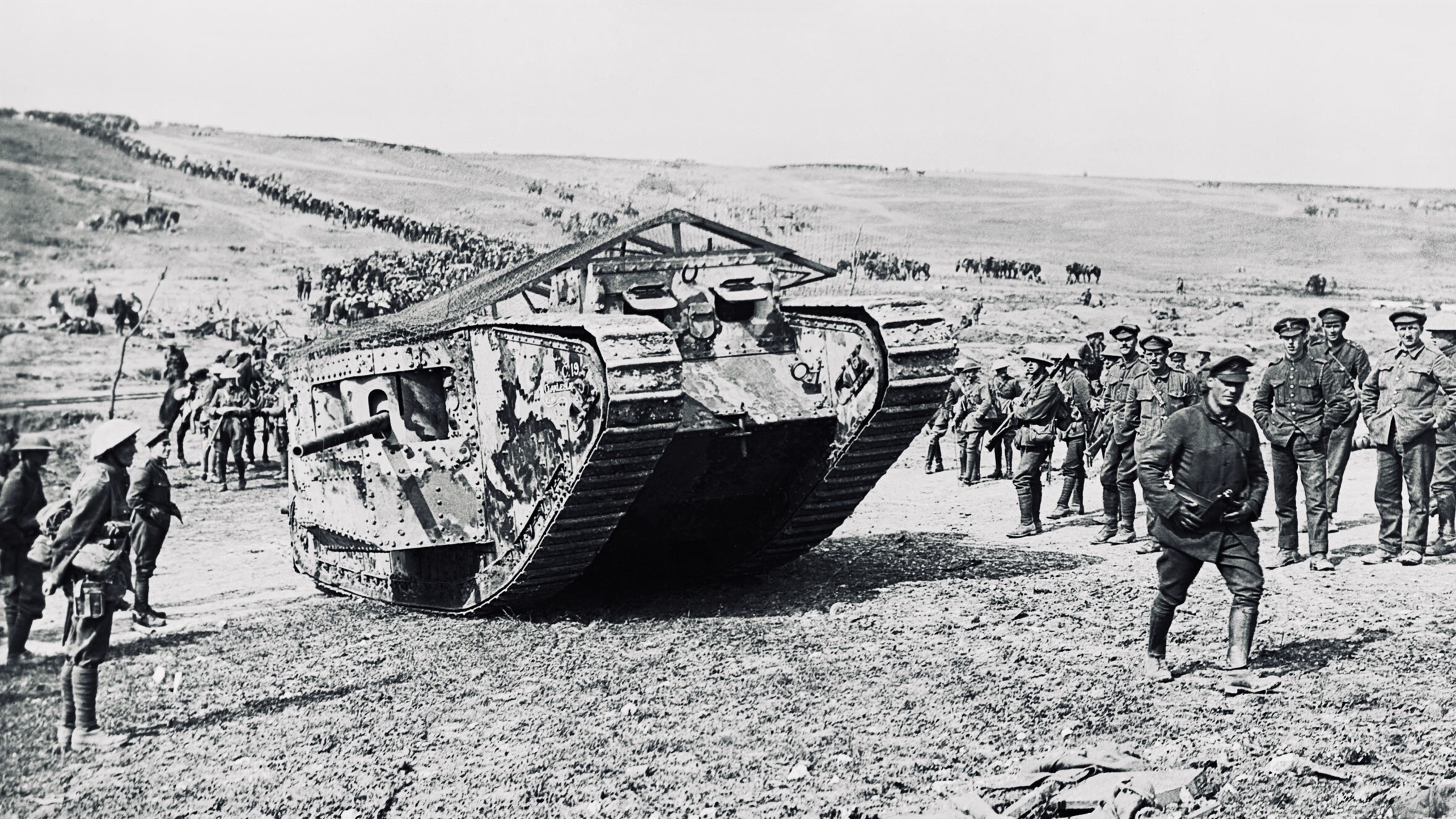
At Flers-Courcelette on the Somme, Britain introduced an armoured machine designed to cross trenches and break through barbed wire, beginning a transformation in land warfare.
At dawn on September 15, 1916, British forces introduced a weapon unlike anything previously used in combat. During the Battle of Flers-Courcelette in northern France, tanks moved onto the battlefield for the first time, crawling across shell-cratered ground as infantry advanced behind them.
The machines were primitive, slow and mechanically unreliable. Of 49 Mark I tanks allocated to the attack, only 32 reached their starting positions and 18 ultimately went into action, according to The Tank Museum. Yet their appearance on the Somme marked the beginning of a technology that would eventually transform the way armies fought on land.
Why Britain Built Tanks
By 1916, the Western Front had become a vast system of trenches protected by barbed wire, artillery and machine guns. Infantry attacks could be devastated while attempting to cross exposed ground, and even successful advances were difficult to exploit before defenders reorganized.
Britain’s answer was an armoured tracked vehicle capable of crossing trenches, crushing wire and bringing weapons forward under protection.
Development proceeded under intense secrecy. Early prototypes were tested in 1915 and 1916, and the resulting production vehicle became the Mark I. The name “tank” emerged from the secrecy surrounding the project, helping conceal the true purpose of the machines during development.
Two main versions went into service. The “male” Mark I carried two six-pounder guns as well as machine guns, while the “female” version was armed with machine guns. Their distinctive rhomboid shape allowed tracks to run around much of the hull, helping the vehicle negotiate trenches and broken terrain.
They were hardly comfortable fighting machines. Crews worked in extremely difficult conditions inside noisy, hot compartments filled with machinery, weapons and engine fumes. Steering was cumbersome, visibility limited and mechanical breakdowns common.
Despite those weaknesses, British commander General Sir Douglas Haig decided to commit the new weapon to the Somme offensive.
The tanks belonged to the Heavy Section of the Machine Gun Corps. They were secretly transported to France and prepared to support an attack involving six divisions at Flers-Courcelette. Rather than operating as a concentrated armoured force, they were dispersed in small groups intended to accompany infantry, overcome strongpoints, crush wire and suppress German machine-gun positions.
Tanks Enter Combat
At approximately 5:30 a.m. on September 15, the Mark I known as Daredevil, commanded by Captain Harold Mortimore, moved around the edge of Delville Wood and engaged German positions at the Brewery Salient. The Tank Museum identifies it as the first tank to enter combat.
Across the battlefield, however, the new technology struggled against reality.
Seventeen of the 49 allocated tanks failed to reach their starting positions. Others subsequently broke down, became stuck in shell holes or trenches, or suffered damage. The Tank Museum’s detailed history concludes that 18 ultimately went into action, although some historical accounts use different totals depending on whether they count tanks reaching the start line, moving forward at the opening of the assault, or actually engaging the enemy.
Where tanks did operate effectively, their impact could be considerable. Their armour offered protection against ordinary rifle and machine-gun fire, while their tracks could flatten barbed wire and negotiate obstacles that stopped infantry.
Several helped British forces advance around Flers. One tank was famously observed moving along the village’s main street as troops followed behind. Flers and Courcelette were captured, but the tanks did not produce the decisive breakthrough their advocates hoped for.
The battlefield itself exposed many of the Mark I’s limitations. The Somme had been churned by prolonged artillery bombardment into a landscape of craters, trenches and loose earth. Tanks could become immobilized, and their low speed made them vulnerable to artillery and mechanical failure.
One surviving example of those difficulties was tank C1, Champagne, assigned to support Canadian forces attacking Courcelette. Difficult terrain slowed it dramatically before it became stuck. The crew spent hours attempting to free the vehicle before abandoning it.
The first tank attack therefore produced mixed results rather than a revolution overnight.
But British military leaders saw enough potential to continue development. Within days, plans were advancing for greatly expanded tank production. In 1917, the Tank Corps was formally established, and later models incorporated lessons learned from the first battlefield deployments.
Tanks became increasingly important during the remaining years of the First World War. At Cambrai in November 1917, hundreds were employed in a much larger concentrated assault. By 1918, improved tactics increasingly combined armour with infantry, artillery and aircraft.
The technology continued evolving between the world wars. By the Second World War, tanks had become central to mobile operations conducted by major armies, with far greater speed, range, reliability and firepower than the Mark I crews of 1916 could have imagined.
The machines that appeared at Flers-Courcelette did not end trench warfare, nor did they decide the Battle of the Somme. Most failed to accomplish everything expected of them.
Their significance lies instead in what began that morning. On September 15, 1916, the armoured fighting vehicle moved from experiment to battlefield weapon. Land warfare would never develop in quite the same way again.
About the Author Brad Socha is the founder of The Universal Record, focused on sourced, factual global reporting. Coverage includes international news, geopolitics, technology, and major developments.