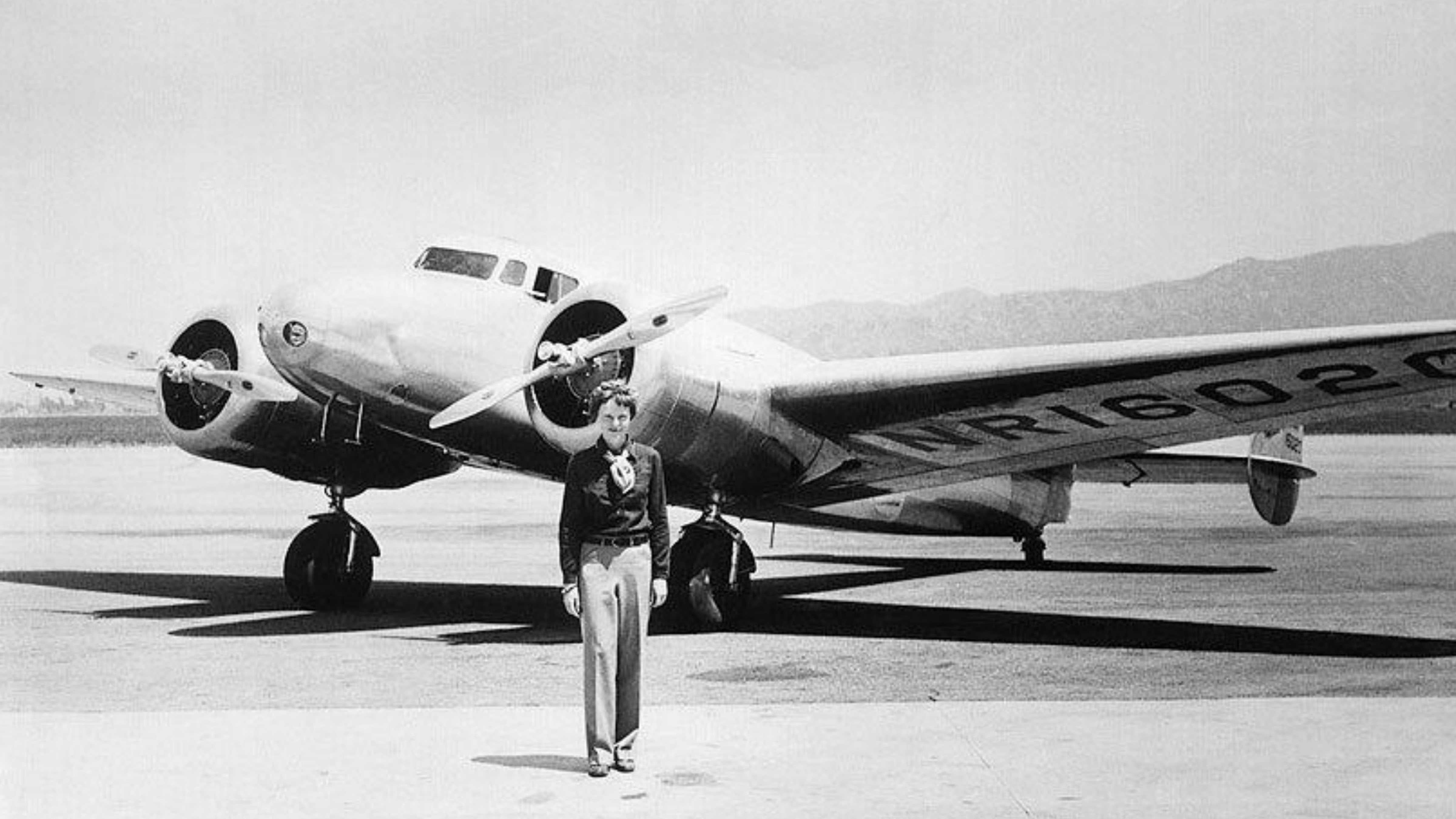
During her historic attempt to become the first woman to fly around the world near the equator, Amelia Earhart disappeared over the Pacific Ocean, launching one of aviation’s greatest mysteries and inspiring generations of explorers, historians, and researchers.
THE UNIVERSAL RECORD
Sourced reporting. No opinions.
By Brad Socha | July 2, 2026 | 4:51 AM EST
More than eight decades after Amelia Earhart’s final radio transmissions faded into silence, her disappearance remains one of history’s most compelling unsolved mysteries. Beyond the mystery itself, Earhart’s life transformed aviation by breaking barriers for women in flight and demonstrating that determination could redefine what was considered possible. Every new expedition, technological advance, and historical investigation reflects the lasting impact of a journey that never reached its destination.
By 1937, Amelia Earhart had already established herself as one of the world’s most celebrated aviators. She became the first woman to fly solo across the Atlantic Ocean in 1932, earned numerous aviation records, promoted commercial aviation, and advocated for greater opportunities for women in science, engineering, and flight. Her achievements made her an international symbol of courage during aviation’s pioneering era.
Her most ambitious challenge began on June 1, 1937, when she departed Miami, Florida, with experienced navigator Fred Noonan to attempt a flight around the globe near the equator. The planned route covered roughly 47,000 kilometres (29,000 miles), making it one of the longest flights ever attempted at the time. Flying a specially modified Lockheed Model 10-E Electra equipped with additional fuel tanks, the pair crossed South America, Africa, the Middle East, India, Southeast Asia, and Australia before continuing across the Pacific.
By late June they had successfully completed approximately 35,000 kilometres (22,000 miles) of the journey. Only one of the most difficult sections remained: the flight from Lae, Papua New Guinea, to tiny Howland Island, a remote coral island roughly halfway between Australia and Hawaii. The destination measured little more than two kilometres in length, making it an extraordinarily difficult navigation target over thousands of kilometres of open ocean.
On July 2, 1937, Earhart and Noonan departed Lae shortly after sunrise. The flight was expected to take about 18 to 20 hours. As fuel diminished, Earhart maintained radio contact with the United States Coast Guard cutter Itasca, stationed near Howland Island to provide navigation assistance.
Communication problems quickly complicated the mission. Although radio operators aboard Itasca received several transmissions from Earhart, they struggled to establish reliable two-way communication. Differences in radio frequencies, atmospheric interference, equipment limitations, and uncertainty about direction-finding procedures prevented the crew from accurately guiding the aircraft.
Among Earhart’s final confirmed messages was her report that the aircraft was flying on the “157-337 line,” a navigational position intended to help locate Howland Island. She also indicated that fuel was running low and that she could not see the island. Shortly afterward, radio contact ended permanently.
An enormous international search effort followed immediately. The United States Navy and Coast Guard launched what became the largest and most expensive air-and-sea search operation in American history up to that time. Aircraft carriers, battleships, destroyers, support vessels, and dozens of aircraft searched approximately 650,000 square kilometres (250,000 square miles) of the Pacific Ocean.
Despite weeks of searching and an estimated cost exceeding $4 million in 1937 dollars, no confirmed trace of Earhart, Noonan, or the Lockheed Electra was found.
Over the decades, numerous theories have attempted to explain what happened. The most widely accepted conclusion is that the aircraft exhausted its fuel after failing to locate Howland Island and crashed into the Pacific Ocean. This remains the position supported by many aviation historians and official investigations.
Other hypotheses suggest Earhart may have landed on Nikumaroro Island, then known as Gardner Island, where later expeditions uncovered artifacts that some researchers argue could be linked to her presence. Additional theories have proposed capture by Japanese forces or other alternative scenarios, although these have not been supported by conclusive historical evidence.
Modern technology has renewed interest in the search. Deep-sea sonar mapping, remotely operated underwater vehicles, satellite imagery, forensic archaeology, and advanced ocean modelling have all been employed by organizations seeking answers. Expeditions by research groups and private explorers continue to examine areas of the central Pacific where evidence may still remain beneath the ocean floor.
While the mystery captures public imagination, Amelia Earhart’s enduring legacy extends far beyond her disappearance. She helped reshape public perceptions of women in aviation, encouraged scientific exploration, and demonstrated that aviation could connect distant parts of the world in ways previously unimaginable. Her accomplishments opened doors for countless female pilots, astronauts, engineers, and explorers.
Museums, universities, aviation organizations, and educational programs continue to celebrate her contributions. Schools, airports, scholarships, and awards bearing her name ensure that new generations learn not only about the mystery surrounding her final flight but also about the extraordinary achievements that defined her career.
The unanswered questions surrounding Amelia Earhart’s disappearance continue to inspire researchers, documentary filmmakers, and historians. Yet her greatest accomplishment may be the example she set during her lifetime: pursuing exploration despite uncertainty and pushing beyond the limits that society once placed on opportunity.
Eighty-nine years after her disappearance, Amelia Earhart remains one of aviation’s most influential pioneers. Whether the final location of her aircraft is ever discovered, her impact on aviation history, and her place among the world’s greatest explorers, is already secure.
Sources:
National Air and Space Museum — https://airandspace.si.edu/stories/editorial/amelia-earhart
National Archives — https://www.archives.gov/publications/prologue/1993/fall/earhart.html
Britannica — https://www.britannica.com/biography/Amelia-Earhart
History.com — https://www.history.com/topics/exploration/amelia-earhart
Federal Aviation Administration — https://www.faa.gov/about/history/pioneers/amelia_earhart
About the Author
Brad Socha is the founder of The Universal Record, focused on sourced, factual global reporting. Coverage includes international news, geopolitics, technology, and major developments.