During a total solar eclipse over India, an unexplained yellow line in sunlight helped reveal an element that would not be confirmed on Earth for another 27 years.
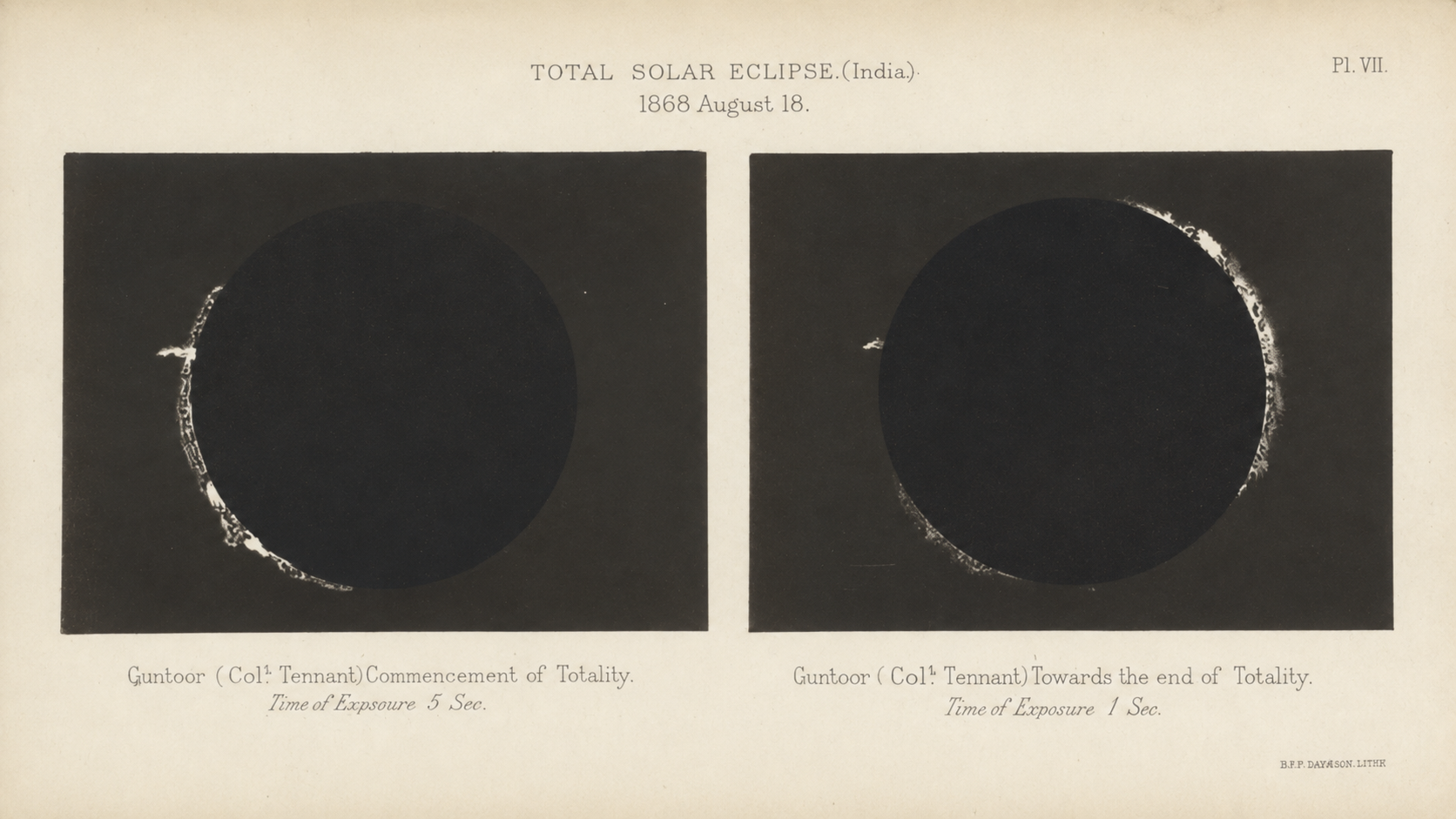
On August 18, 1868, French astronomer Pierre Jules César Janssen was observing a total solar eclipse from India when his spectroscope revealed something unexpected: a bright yellow line in the Sun’s spectrum that did not correspond precisely to any element then known. The observation became a crucial step toward the discovery of helium, an element identified through the light of the Sun decades before scientists conclusively isolated it on Earth.
The discovery was more than an astronomical curiosity. It demonstrated the growing power of spectroscopy, the analysis of light according to wavelength, to determine the chemical composition of objects that scientists could never physically reach. In doing so, the work of Janssen and British astronomer Joseph Norman Lockyer helped transform humanity’s understanding of the Sun and laid foundations for modern astrophysics.
Helium Appears in the Solar Spectrum
By the 1860s, spectroscopy was changing astronomy. When light is separated into a spectrum, atoms and elements produce characteristic lines at particular wavelengths. These patterns act much like chemical fingerprints, allowing researchers to identify substances from the light they emit or absorb. Scientists had already begun using the technique to determine that elements familiar on Earth were also present in the Sun and stars.
The total solar eclipse of August 18, 1868, offered astronomers an exceptional opportunity. NASA records that the path of the eclipse extended from the Red Sea across India toward Southeast Asia and the Pacific, with totality lasting as long as approximately six minutes and 47 seconds. Astronomers used spectroscopes to study the Sun’s prominences, showing that hydrogen was a major component.
Janssen observed from Guntur, India. While examining the spectrum associated with the Sun’s prominences, he detected a strong yellow emission line. It was close to the familiar spectral lines of sodium but did not match them. The unexplained line indicated that something else was producing the light.
The eclipse also led to another important advance. Janssen realized that the spectral signatures of solar prominences were sufficiently strong that they could be studied without waiting for another eclipse. This helped make routine spectroscopic observations of the Sun possible.
Thousands of kilometres away, Lockyer was pursuing similar work in Britain. On October 20, 1868, he successfully observed solar prominences in daylight and detected the same unusual spectral signature. Janssen and Lockyer had independently reached closely related findings, and both became associated with the discovery. Their reports reached the French Academy of Sciences on the same day, reinforcing their shared historical credit.
The unidentified element eventually received a name derived from Helios, the Greek personification of the Sun: helium.
From the Sun to a Laboratory on Earth
The implications were remarkable. Spectroscopy appeared to have revealed a chemical element in an object about 150 million kilometres from Earth before scientists had established its presence in terrestrial material.
But confirming that helium actually existed on Earth took decades.
In 1882, Italian physicist Luigi Palmieri reported the characteristic spectral line while studying material associated with Mount Vesuvius, providing evidence that helium was not confined to the Sun. Later work with uranium-bearing minerals brought scientists closer to isolating the element.
The decisive breakthrough came in 1895. Scottish chemist William Ramsay extracted a gas from the uranium-bearing mineral cleveite and found that its spectrum corresponded to the element previously identified in sunlight. Swedish chemists Per Teodor Cleve and Abraham Langlet independently worked with the gas and measured its atomic weight. Helium had finally been established as a terrestrial element.
The discovery also brought a surprise. Helium was not the metal some researchers had initially expected. It was an exceptionally unreactive gas, later classified among the noble gases.
Scientists now know that helium is the second-most abundant element in the universe after hydrogen and is produced extensively within stars. On Earth, however, it is comparatively scarce. Helium generated through radioactive decay can migrate upward and ultimately escape into space because of its low mass.
Its properties have made it far more important than its familiar association with balloons suggests. Liquid helium can reach extraordinarily low temperatures and is essential for cooling superconducting magnets, including those used in many magnetic resonance imaging systems. Helium is also used in scientific research, specialized industrial applications and breathing mixtures for some forms of deep-sea diving.
The events of 1868 ultimately represented something larger than the discovery of a single element. Janssen and Lockyer showed how information encoded in light could reveal the chemistry of a distant astronomical object without anyone collecting a physical sample.
That principle remains fundamental to astronomy today. Scientists use spectroscopy to investigate the composition, temperature and motion of stars, nebulae, galaxies and the atmospheres of planets beyond the Solar System.
The yellow line noticed during an eclipse in 1868 therefore marked a turning point: the universe itself had become a laboratory, and light provided scientists with a way to analyze it.
About the Author Brad Socha is the founder of The Universal Record, focused on sourced, factual global reporting. Coverage includes international news, geopolitics, technology, and major developments.