On July 18, 1968, Robert Noyce and Gordon Moore established Intel Corporation, launching a company whose innovations in semiconductors would help power the personal computer, the internet, smartphones, cloud computing, and today’s artificial intelligence revolution.
Few companies have had a greater influence on modern technology than Intel Corporation. Founded on July 18, 1968, in Mountain View, California, by semiconductor pioneers Robert Noyce and Gordon Moore, Intel began as a small startup focused on advancing integrated circuit technology. Over the following decades, its innovations helped transform computing from a specialized industrial tool into a technology that now touches nearly every aspect of daily life.
From personal computers and enterprise servers to cloud computing and artificial intelligence, Intel’s legacy continues to shape the digital infrastructure supporting the modern world.
The company’s origins can be traced to the rapid evolution of the semiconductor industry during the 1960s. Robert Noyce, often recognized as one of the inventors of the integrated circuit, and Gordon Moore, a respected physicist and engineer, had previously worked together at Fairchild Semiconductor. Seeking greater freedom to pursue new technologies, they left the company in 1968 to establish a new enterprise dedicated to semiconductor memory.
They were soon joined by Andrew Grove, a Hungarian-born engineer whose operational leadership would become instrumental in Intel’s rise. Although Grove was not one of the company’s original founders, he became one of its defining figures, later serving as president, chief executive officer, and chairman.
Initially known as NM Electronics, the company quickly adopted the name “Intel,” derived from the words Integrated Electronics.
The young company attracted approximately US$2.5 million in initial financing from venture capitalist Arthur Rock, a substantial investment for a technology startup at the time. From its earliest days, Intel emphasized engineering excellence, rapid innovation, and manufacturing quality, principles that would become hallmarks of Silicon Valley’s emerging technology culture.
Intel’s first commercial products focused on semiconductor memory chips. Its 3101 Schottky bipolar SRAM, introduced in 1969, demonstrated the company’s technical capabilities, followed by increasingly sophisticated memory devices that competed with magnetic-core memory then used in computers.
The company’s most influential breakthrough arrived only a few years later.
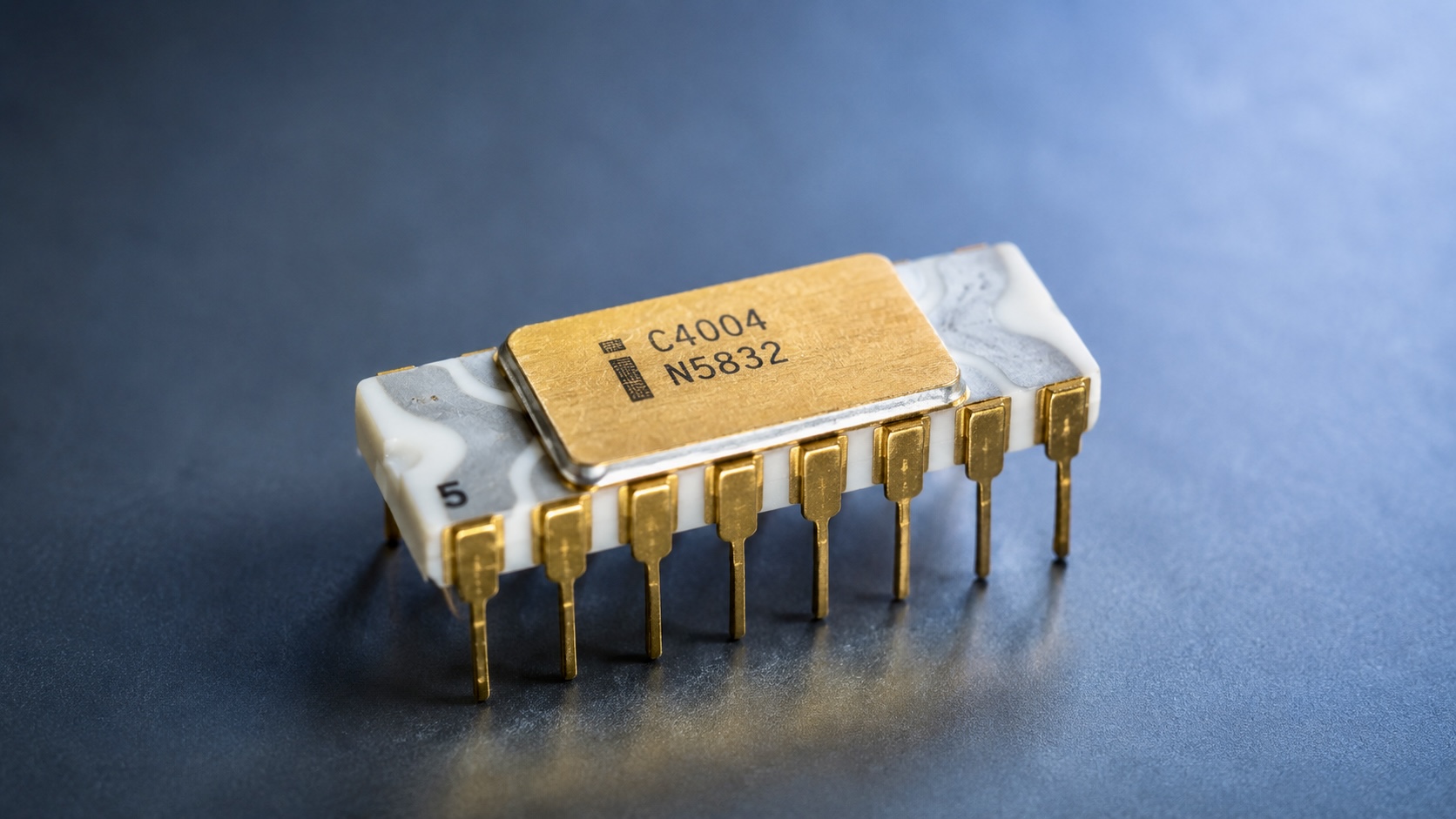
In 1971, Intel introduced the Intel 4004, widely recognized as the world’s first commercially available single-chip microprocessor. Developed for a Japanese calculator manufacturer, the tiny processor condensed the functions of an entire central processing unit onto one integrated circuit.
Although modest by today’s standards, the 4004 represented a revolutionary shift in computer engineering. Instead of designing dedicated hardware for every task, manufacturers could build programmable systems around a general-purpose processor.
That concept fundamentally changed the future of computing.
Intel rapidly expanded its processor family with the 8008, 8080, and eventually the 8086 architecture, introduced in 1978. When IBM selected the Intel 8088 processor for its first IBM Personal Computer in 1981, Intel became a central force behind the emerging PC industry.
As personal computers spread into homes, schools, and businesses throughout the 1980s and 1990s, millions of systems relied on Intel processors. Software developers increasingly optimized programs for Intel’s x86 architecture, reinforcing the company’s position at the center of the global computing ecosystem.
Intel’s influence extended well beyond desktop computers.
Its processors powered scientific research, financial systems, manufacturing automation, telecommunications networks, medical equipment, and government infrastructure. As internet usage accelerated during the late 1990s and early 2000s, Intel chips became a cornerstone of the rapidly expanding data center industry that supported websites, cloud services, and online commerce.
The company’s technological leadership also helped fuel broader advances in semiconductor manufacturing. Intel invested heavily in fabrication plants, commonly known as fabs, where increasingly sophisticated chips were produced using advanced lithography techniques. Continuous improvements in transistor density enabled processors to become smaller, faster, and more energy efficient.
Many of these advances aligned with Moore’s Law, Gordon Moore’s famous 1965 observation that the number of transistors on integrated circuits would roughly double every two years while costs declined. Although never intended as a physical law, Moore’s prediction became one of the semiconductor industry’s guiding principles for decades, driving relentless innovation across global electronics.
Intel’s success also helped establish Silicon Valley as the world’s leading center for technology innovation. The company’s culture influenced generations of engineers, entrepreneurs, and startup founders who would later build companies specializing in software, networking, mobile devices, cloud computing, and artificial intelligence.
Today, the computing landscape is far more competitive than when Intel dominated the personal computer era. Companies including AMD, NVIDIA, Apple, Qualcomm, and numerous custom chip designers have expanded the range of processors powering modern devices. Artificial intelligence has also accelerated demand for specialized accelerators and graphics processing units alongside traditional central processors.
Even so, Intel remains one of the world’s largest semiconductor manufacturers and continues investing in advanced fabrication facilities, processor design, artificial intelligence hardware, and next-generation manufacturing technologies. Governments in the United States and Europe have also viewed domestic semiconductor production as increasingly important for economic resilience and national security, leading to significant public and private investments in chip manufacturing.
The importance of semiconductors has become even more apparent in recent years as AI systems require enormous computing power. Modern data centres depend on sophisticated processors, networking hardware, memory, and storage technologies, many of which trace their origins to the semiconductor revolution that Intel helped accelerate more than half a century ago.
Looking back, the founding of Intel was more than the creation of another technology company. It marked the beginning of a transformation that reshaped computing, communications, industry, science, and society.
From the first microprocessors to today’s AI infrastructure, Intel’s story reflects one of the most consequential technological journeys of the modern era. The company founded by Robert Noyce and Gordon Moore on July 18, 1968, continues to influence the devices people use every day and the digital systems that increasingly power the global economy.
About the Author Brad Socha is the founder of The Universal Record, focused on sourced, factual global reporting. Coverage includes international news, geopolitics, technology, and major developments.