The Continental Congress adopts the U.S. dollar, creating the world’s first officially decimal-based national currency and establishing a financial system that would influence global commerce for centuries.
Few financial decisions have had a greater long-term impact than the one made on July 6, 1785, when the Continental Congress selected the United States dollar as the nation’s monetary unit. At a time when the newly independent United States was struggling to establish political stability and economic credibility, the decision created a common national currency and introduced a revolutionary decimal-based monetary system. More than two centuries later, the U.S. dollar has become the world’s leading reserve currency and one of the most influential symbols of international trade and finance.
The choice reflected more than convenience. It represented a deliberate effort to build a modern economy based on simplicity, consistency, and national unity at a time when the young republic faced enormous financial uncertainty.
Before independence, the American colonies relied on a confusing mixture of British pounds, Spanish silver dollars, colonial paper money, and foreign coins circulating simultaneously. Exchange rates varied between colonies, making commerce complicated and creating frequent disagreements over the value of goods and services.
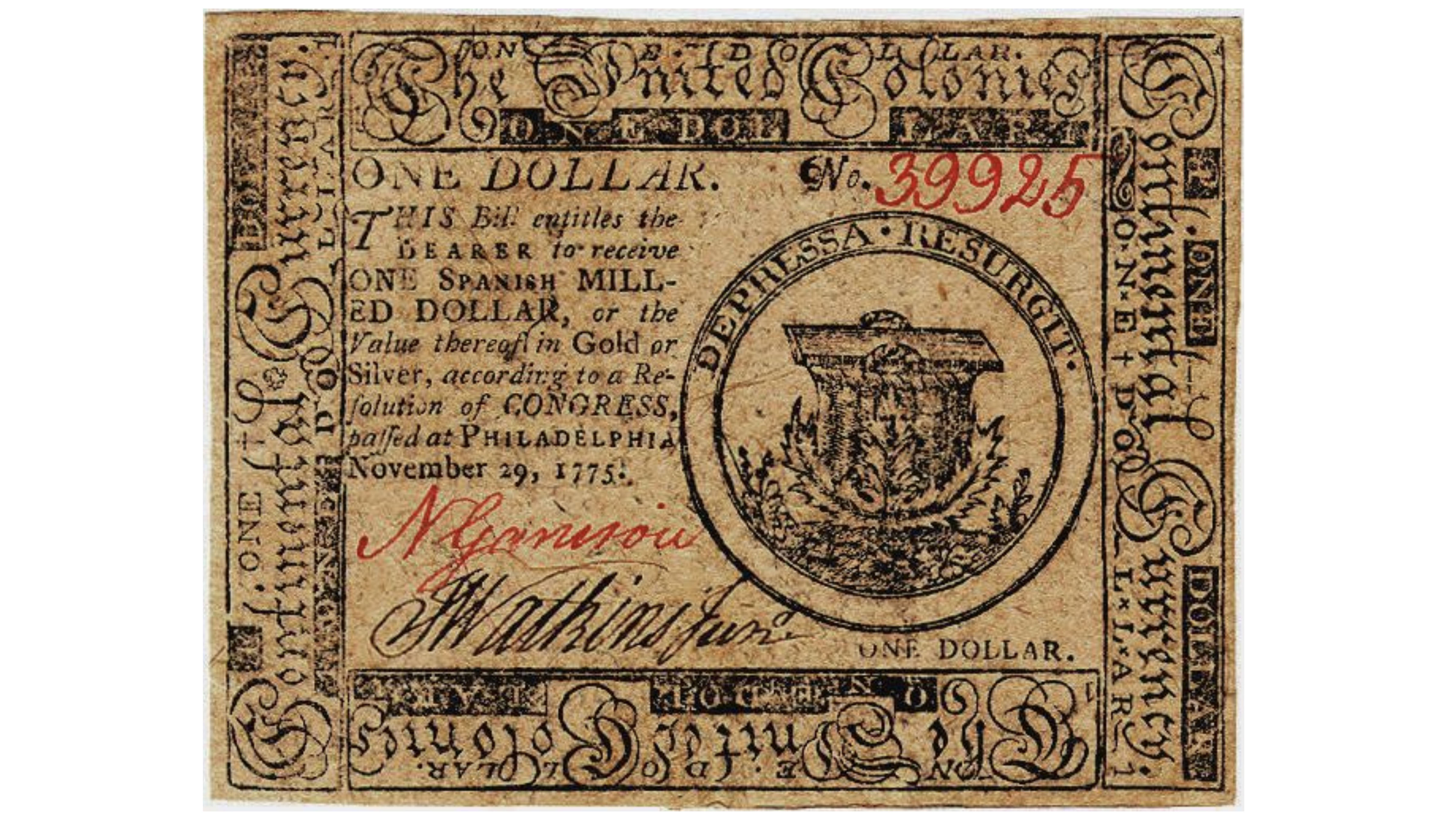
The financial strain intensified during the American Revolutionary War. The Continental Congress financed much of the conflict by issuing paper currency known as Continental dollars. As more notes entered circulation without sufficient backing, inflation accelerated rapidly. The currency eventually lost much of its purchasing power, giving rise to the expression “not worth a Continental.”
Following the war, American leaders recognized that economic stability required a standardized national monetary system.
On July 6, 1785, the Continental Congress formally chose the dollar as the monetary unit of the United States. Rather than adopting Britain’s system of pounds, shillings, and pence, Congress selected a decimal structure in which each dollar would eventually be divided into one hundred smaller units.
Although several European mathematicians had previously proposed decimal currencies, the United States became the first nation to officially adopt such a system for its national currency. The approach simplified accounting, taxation, pricing, and commercial transactions in ways that were remarkably advanced for the eighteenth century.
The decision was influenced heavily by the widespread circulation of the Spanish milled dollar, also known as the “piece of eight.” Spanish silver coins were trusted throughout North America because of their consistent silver content and broad acceptance in international trade. Americans were already familiar with using dollars in everyday commerce, making the transition far more practical than introducing an entirely new monetary unit.
The intellectual architect behind much of the new monetary framework was Thomas Jefferson. In 1784, Jefferson submitted Notes on the Establishment of a Money Unit, and of a Coinage for the United States, advocating a decimal system that would simplify calculations for merchants and citizens alike. His recommendations helped shape the structure Congress ultimately endorsed.
The July 1785 resolution established the monetary unit but did not immediately create physical American coins. That process continued over the following several years as lawmakers debated standards for coinage, precious metals, and minting operations.
A major milestone arrived with the Coinage Act of 1792. The law officially created the United States Mint in Philadelphia, established the dollar as the nation’s standard unit of value, and authorized production of gold, silver, and copper coins. It also formally divided the dollar into one hundred cents, embedding the decimal system into American law.
The first circulating U.S. coins appeared shortly afterward, gradually replacing the mixture of foreign currencies that had dominated commerce since colonial times.
The decimal system proved remarkably durable. While many nations continued using complicated monetary systems with multiple denominations and conversion rates, the United States demonstrated that decimal currency made calculations easier for governments, banks, businesses, and consumers. During the nineteenth century, numerous countries adopted similar decimal-based monetary structures, making the American approach a global model.
As the United States expanded westward and industrialized, the dollar became increasingly important to both domestic commerce and international trade. Railroads, manufacturing, banking, and expanding financial markets all benefited from a standardized currency that could support a rapidly growing economy.
The dollar’s international role accelerated after the Second World War. Under the Bretton Woods Agreement of 1944, many global currencies became linked to the U.S. dollar, which itself was convertible to gold. Although direct gold convertibility ended in 1971, the dollar retained its dominant position in international finance.
Today, the U.S. dollar remains the world’s principal reserve currency. Central banks hold substantial dollar reserves, international commodities such as crude oil are commonly priced in dollars, and global trade, investment, and financial markets continue to rely heavily on dollar-denominated transactions. According to the International Monetary Fund, the dollar accounts for the largest share of official foreign exchange reserves worldwide.
The decision made in 1785 also illustrates how thoughtful institutional design can influence history for centuries. Rather than simply choosing a name for its currency, the Continental Congress established a monetary framework built on clarity, standardization, and efficiency. Those principles continue to shape economic systems around the world.
The adoption of the dollar did not solve all of the young nation’s financial problems overnight. Inflation, government debt, banking disputes, and regional economic differences continued for decades. Nevertheless, selecting a unified decimal currency created one of the essential foundations upon which the American economy would be built.
More than 240 years later, the July 6, 1785 decision remains one of the defining milestones in economic history. It transformed a collection of former colonies into a nation with a common monetary identity and introduced a currency system whose influence would eventually extend across virtually every corner of the global economy.
About the Author Brad Socha is the founder of The Universal Record, focused on sourced, factual global reporting. Coverage includes international news, geopolitics, technology, and major developments.