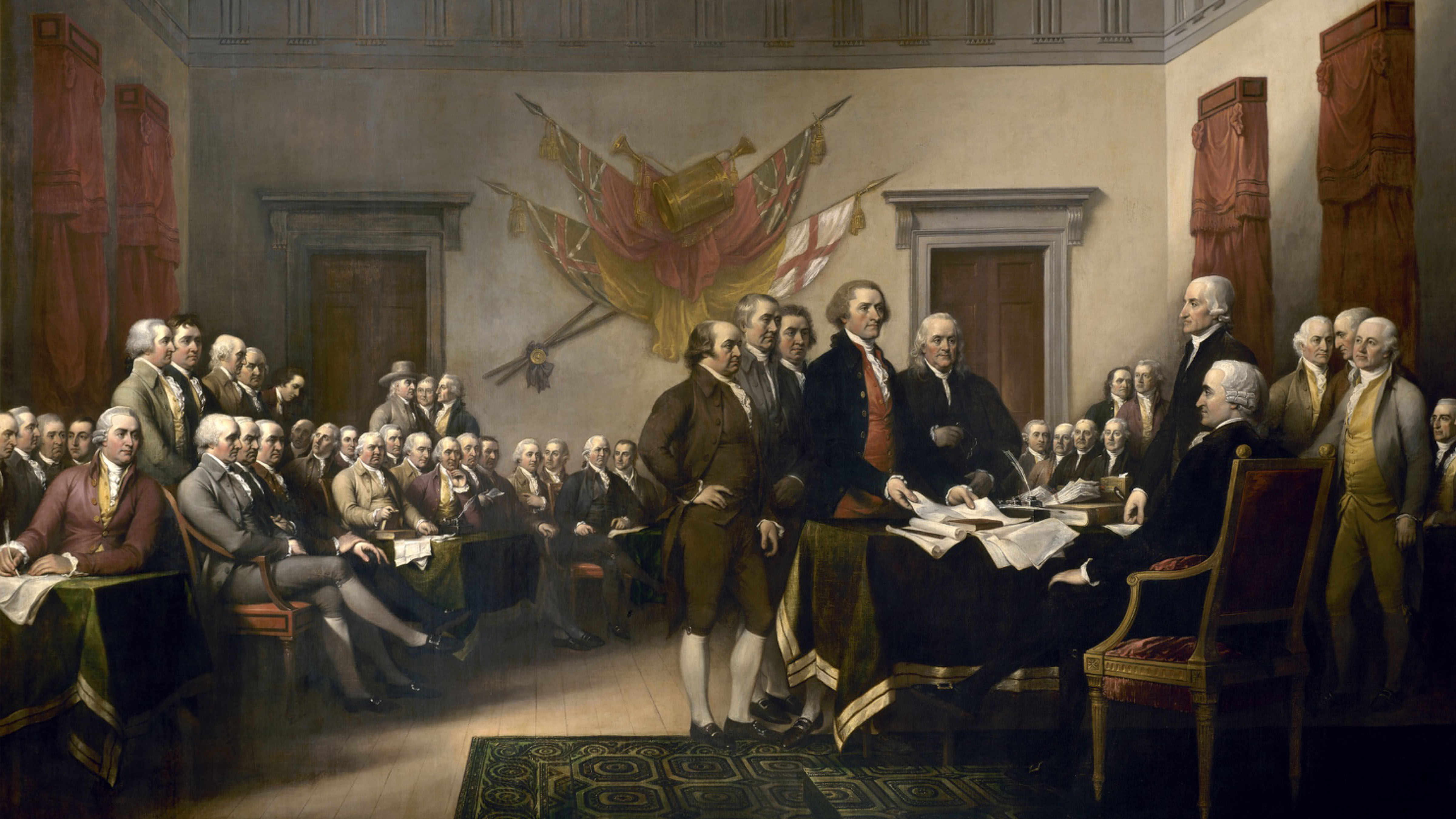
On July 4, 1776, the Continental Congress adopted the Declaration of Independence, formally asserting that the thirteen American colonies were free and independent states, a decision that reshaped world history and inspired democratic movements for generations.
Few documents have had a greater influence on modern history than the United States Declaration of Independence. Adopted by the Second Continental Congress on July 4, 1776, the declaration announced that the thirteen American colonies no longer recognized British rule and instead considered themselves independent states. More than the beginning of a new nation, it introduced principles of liberty, equality, and self-government that continue to influence governments, constitutions, and human rights movements around the world.
The Declaration did not end the American Revolutionary War, nor did it immediately secure independence. Instead, it established the political foundation for the conflict and explained to the world why the colonies believed separation from Great Britain had become necessary. Nearly 250 years later, it remains one of history’s most studied political documents.
By the mid-1770s, tensions between Great Britain and its American colonies had steadily intensified. Following the costly Seven Years’ War, Britain introduced a series of taxes and regulations intended to help pay imperial debts. Measures including the Stamp Act, Townshend Acts, and Tea Act fueled growing resistance among colonists, who argued they were being taxed without representation in Parliament.
Protests escalated into armed conflict in April 1775 with the Battles of Lexington and Concord in Massachusetts. Although fighting had begun, many colonial leaders initially hoped reconciliation with Britain remained possible. Over the following year, however, continued military action and King George III’s rejection of compromise convinced increasing numbers of delegates that complete independence was the only remaining option.
On June 7, 1776, Virginia delegate Richard Henry Lee introduced a resolution declaring that the colonies “are, and of right ought to be, free and independent States.” Debate followed, while Congress appointed a committee to prepare a formal declaration should independence be approved.
The committee included Thomas Jefferson, John Adams, Benjamin Franklin, Roger Sherman, and Robert R. Livingston. Jefferson, then only 33 years old, prepared the initial draft, drawing upon Enlightenment ideas about natural rights, individual liberty, and the social contract between governments and citizens. Franklin and Adams suggested revisions before the document was presented to Congress.
After several days of debate and edits, delegates approved the Declaration of Independence on July 4, 1776, in Philadelphia.
The opening paragraphs established ideas that would become central to democratic thought. The declaration asserted that all people possess inherent rights, including “Life, Liberty and the pursuit of Happiness,” and argued that governments derive their authority from the consent of the governed. It further stated that when governments become destructive to those purposes, citizens have the right to alter or abolish them and establish new systems of government.
The document then presented a lengthy list of grievances against King George III, accusing the British Crown of abusing power, obstructing representative government, interfering with colonial legislatures, maintaining standing armies without consent, restricting trade, and denying fair legal protections. These arguments were intended both to justify independence domestically and explain the colonies’ position to foreign governments.
Although July 4 marks the official adoption date, the famous signing of the Declaration occurred over several weeks. Most delegates signed the engrossed parchment beginning on August 2, 1776, while others added their signatures later. In total, 56 representatives eventually signed the document, fully aware that if the Revolution failed, they could face execution for treason.
The Declaration itself did not guarantee military success. The Revolutionary War continued until 1783, when the Treaty of Paris formally recognized the independence of the United States. Yet the declaration helped unite the colonies around a common purpose while encouraging support from foreign powers, particularly France, whose military and financial assistance proved decisive during the war.
Its influence soon extended far beyond North America.
Throughout the late eighteenth and nineteenth centuries, independence movements and constitutional reformers across Europe and Latin America drew inspiration from its principles. Elements of its language and philosophy appeared in documents associated with the French Revolution, the Haitian Revolution, and numerous national independence movements.
During the twentieth century, the declaration’s ideals continued to influence anti-colonial movements throughout Africa, Asia, and the Middle East. Leaders advocating civil rights, self-determination, and democratic governance frequently referenced its emphasis on equality and individual rights.
The document also exposed contradictions within the young nation. While proclaiming universal equality, slavery remained legal throughout much of the United States, women lacked political rights, and Indigenous peoples were excluded from the declaration’s promises. These inconsistencies became central issues in later American history and inspired generations of reformers seeking to expand the rights described in 1776 to more of the population.
Today, the original Declaration of Independence is preserved by the National Archives in Washington, D.C., where it remains one of the country’s most important historical documents. Advanced preservation techniques protect the aging parchment while allowing millions of visitors to view it each year.
As the United States approaches the 250th anniversary of its founding in 2026, the Declaration continues to occupy a central place in discussions about democracy, constitutional government, civil liberties, and national identity. Nearly two and a half centuries after its adoption, its ideas remain the subject of historical scholarship, legal interpretation, and public debate.
Its significance ultimately extends beyond one nation’s independence. By asserting that legitimate government depends on the consent of its citizens and that fundamental rights belong to individuals rather than rulers, the Declaration of Independence helped establish principles that continue to influence democratic societies around the world.
About the Author Brad Socha is the founder of The Universal Record, focused on sourced, factual global reporting. Coverage includes international news, geopolitics, technology, and major developments.