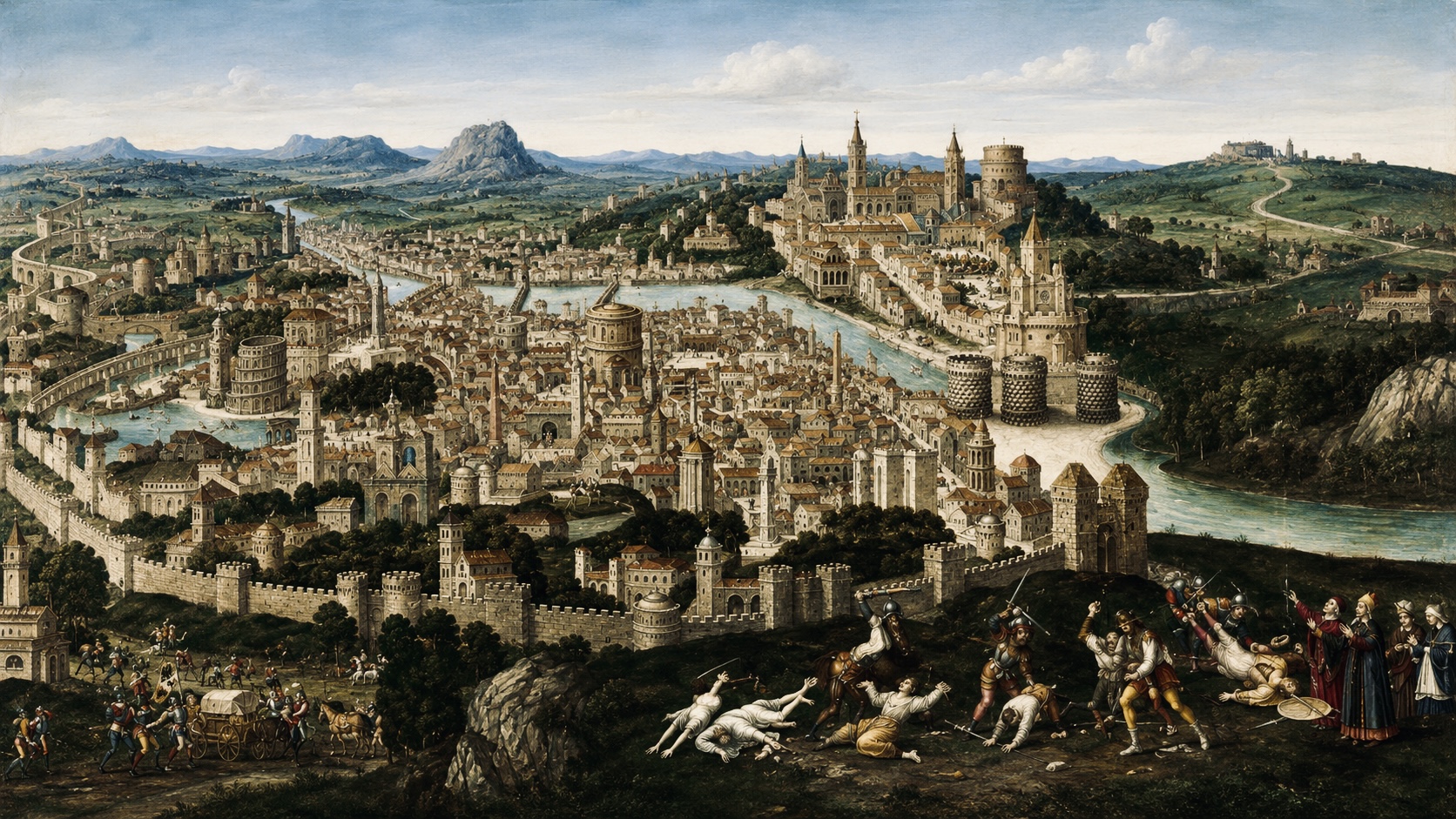
Italian troops loyal to the Holy Roman Emperor stormed Rome on May 6, 1527, unleashing one of the darkest and most transformative events in European history
The Sack of Rome still matters today because it marked the violent collapse of an era many historians associate with the height of Renaissance culture, art, and political influence. Nearly 500 years later, the event remains one of the most dramatic examples of how quickly political instability, economic pressure, and military conflict can reshape civilization. The destruction shocked Europe, weakened the Papacy, and permanently altered the balance of power across the continent.
On May 6, 1527, troops serving Holy Roman Emperor Charles V breached the walls of Rome after months of tension between the emperor and Pope Clement VII. Many of the attacking soldiers were unpaid mercenaries from Spain and Germany who had become increasingly desperate after long military campaigns in Italy. Once inside the city, discipline collapsed rapidly. Violence, looting, executions, and destruction spread throughout Rome for days, turning one of Europe’s richest cultural centres into a battlefield.
The attack occurred during the broader Italian Wars, a prolonged struggle involving France, Spain, the Holy Roman Empire, and various Italian states competing for influence across the Italian peninsula. Rome itself had become deeply entangled in the conflict after Pope Clement VII joined an alliance opposing the emperor. When imperial forces advanced toward the city, Rome was left poorly defended.
The assault began near the Janiculum Hill and the Vatican district. During the initial attack, the commander of the imperial forces, Charles de Bourbon, was killed. Despite losing their leader, the attacking troops continued forward and overwhelmed the city’s defenders. One of the most remembered moments involved the Swiss Guard, who fought to protect Pope Clement VII as he escaped through the Passetto di Borgo, a fortified corridor connecting the Vatican to Castel Sant’Angelo.
The Swiss Guard suffered devastating losses during the defence. Their sacrifice became one of the defining moments in Vatican history and is still commemorated annually by the modern Swiss Guard in Vatican City. The pope ultimately survived but remained effectively trapped inside Castel Sant’Angelo for months while the city endured chaos and occupation.
The human toll of the Sack of Rome was severe. Thousands of civilians were killed, while churches, monasteries, palaces, and libraries were looted or destroyed. Wealthy citizens were targeted for ransom, and many artists, scholars, and intellectuals fled the city entirely. Rome’s population declined dramatically in the aftermath as famine, disease, and economic collapse spread through the devastated capital.
The disaster also carried major symbolic consequences for Europe. Rome had long been viewed as both the spiritual centre of Catholicism and one of the leading cities of the Renaissance. The destruction deeply damaged the prestige of the Papacy at a time when the Protestant Reformation was already challenging the authority of the Catholic Church across Europe. Historians often describe the event as a turning point that accelerated religious and political fragmentation throughout the continent.
Artists and writers of the time recorded the horror in letters, paintings, and historical accounts. The trauma of the sack influenced Renaissance culture itself, contributing to a shift away from the optimism and balance associated with the High Renaissance period. In the years that followed, artistic movements increasingly reflected tension, instability, and emotional intensity.
The Sack of Rome also reshaped international politics. Emperor Charles V emerged as the dominant power in Italy, while the influence of independent Italian city-states continued to weaken. Spain’s position in European affairs grew significantly stronger during the decades that followed. At the same time, the Papacy became more cautious and politically constrained after witnessing how vulnerable Rome had become.
Today, the event remains one of the most studied moments in Renaissance history because it combined military conflict, religious upheaval, political rivalry, and cultural destruction into a single defining catastrophe. Museums, historical archives, and Vatican commemorations continue to preserve records and artifacts connected to the sack nearly five centuries later.
Interest in Renaissance history has continued to grow globally through documentaries, streaming productions, tourism, and renewed public fascination with major turning points in Western civilization. The Sack of Rome stands out because it was not only a military defeat but also a psychological shock that transformed Europe’s political and cultural future.
As modern societies continue debating the fragility of institutions, cultural preservation, and geopolitical conflict, historians often revisit the events of 1527 as a reminder of how rapidly established systems can collapse under pressure. The destruction of Rome became more than a battle, it became a symbol of the end of one age and the uncertain beginning of another.
About the Author Brad Socha is the founder of The Universal Record, focused on sourced, factual global reporting. Coverage includes international news, geopolitics, technology, and major developments.