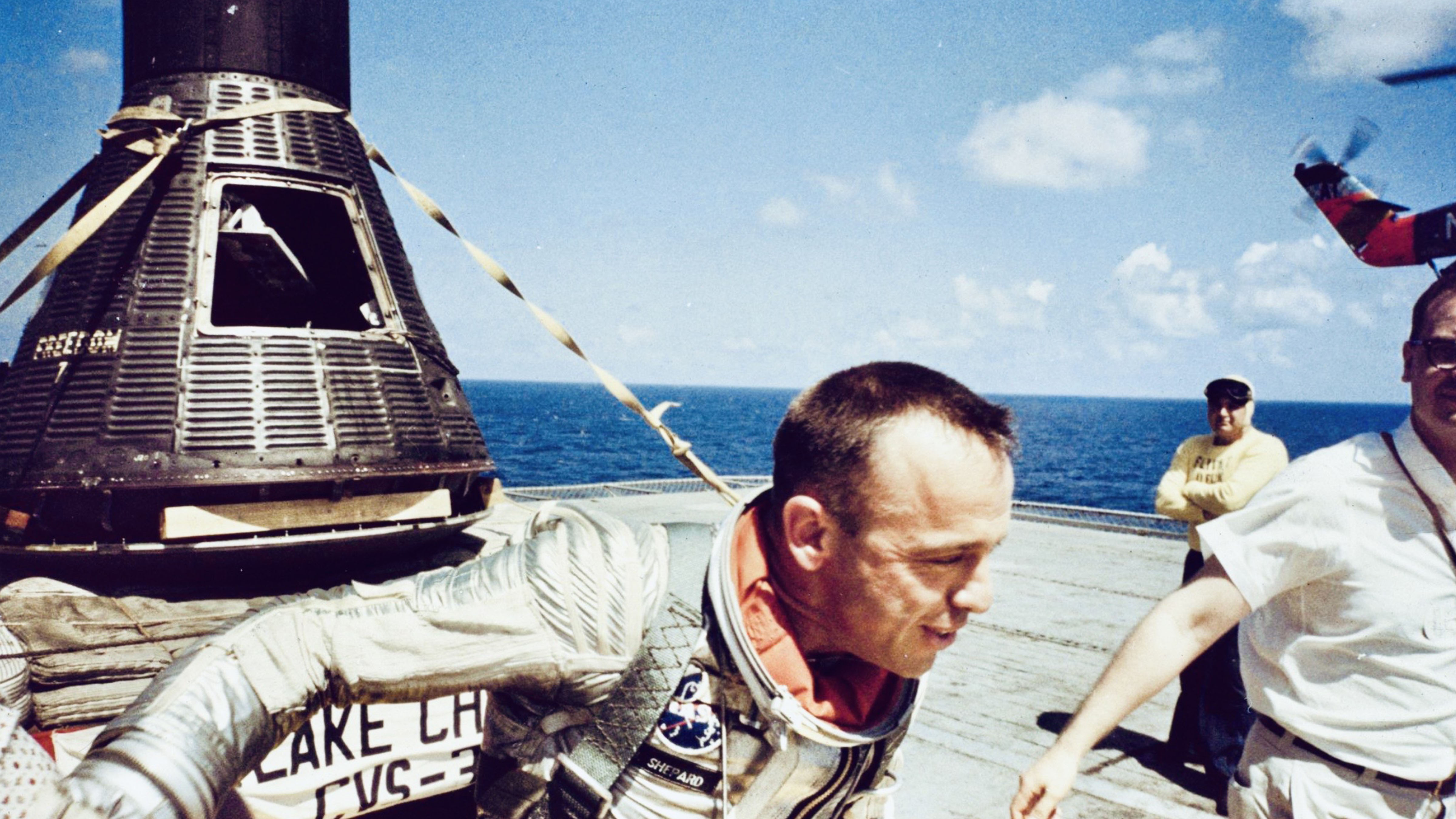
The first American in space in 1961 marked a turning point in technological competition, national ambition, and the future of exploration. In an era now defined by private spaceflight, lunar missions, and renewed competition between global powers, the origins of human space travel continue to shape how nations approach innovation, security, and discovery beyond Earth.
On May 5, 1961, astronaut Alan Shepard became the first American to travel into space aboard the Freedom 7 spacecraft. The mission, launched by NASA as part of the Mercury program, came at a critical moment during the Cold War, just weeks after the Soviet Union had achieved the first human spaceflight with Yuri Gagarin. While Shepard’s flight was shorter and suborbital, it demonstrated that the United States had the capability to send humans into space and safely return them, an achievement with both symbolic and strategic importance.
Shepard’s journey lasted approximately 15 minutes, reaching an altitude of about 187 kilometres before descending back to Earth in the Atlantic Ocean. Though brief compared to modern missions, the flight required precise engineering, advanced life-support systems, and rigorous training. It proved that astronauts could operate spacecraft controls in microgravity, withstand launch and re-entry forces, and communicate effectively with ground teams.
The mission’s impact extended far beyond its duration. At the time, space exploration had become a central arena for geopolitical competition. The Soviet Union’s early lead in space achievements had raised concerns in the United States about technological and military capability. Shepard’s successful flight helped restore confidence and signalled that the United States was fully engaged in the space race.
In the months and years that followed, this momentum accelerated rapidly. NASA expanded its human spaceflight efforts, leading to orbital missions, longer-duration flights, and eventually the Apollo program. Just eight years after Shepard’s flight, the United States achieved another historic milestone by landing astronauts on the Moon. The path from suborbital flight to lunar exploration was built on the lessons learned during early missions like Freedom 7.
Shepard himself would later return to space in 1971 as commander of Apollo 14, becoming one of the few individuals to participate in both the earliest and more advanced phases of human space exploration. His career reflects the rapid evolution of space technology within a single decade, from experimental flights to complex missions involving precision navigation and surface exploration.
The legacy of the first American in space continues to influence modern space programs. Today, agencies such as NASA, along with private companies like SpaceX and Blue Origin, are developing new spacecraft designed for long-duration missions, lunar bases, and eventual journeys to Mars. The principles tested during Shepard’s flight, human adaptability, spacecraft control, and mission coordination, remain fundamental to current and future exploration.
Beyond technology, the mission also had a lasting cultural impact. Shepard’s flight was broadcast widely, capturing public attention and inspiring a generation to pursue careers in science, engineering, and aviation. It reinforced the idea that space was not only a domain for governments but a frontier for human achievement and possibility.
In the current global landscape, interest in space exploration is once again intensifying. Countries including China, India, and members of the European Space Agency are advancing their own missions, while commercial ventures are expanding access to space. The competitive and collaborative dynamics seen today echo the environment of the early 1960s, making historical milestones like Shepard’s flight increasingly relevant.
As space becomes more central to communication, navigation, defence, and scientific research, understanding the origins of human spaceflight offers valuable context. The first American mission demonstrated not only technical capability but also the importance of vision, investment, and international competition in driving innovation.
More than six decades later, the significance of May 5, 1961, lies in its lasting influence. What began as a short suborbital flight helped define the trajectory of space exploration and continues to shape how humanity approaches the next chapter beyond Earth.
About the Author Brad Socha is the founder of The Universal Record, focused on sourced, factual global reporting. Coverage includes international news, geopolitics, technology, and major developments.